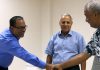
In an exclusive interview with Hawaii News Now, Palau President Surangel Whipps, Jr, talked about efforts to attract more U.S investment in the region to balance increasing investment and influence by Chinese companies.
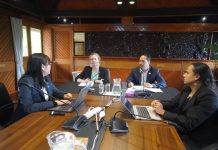
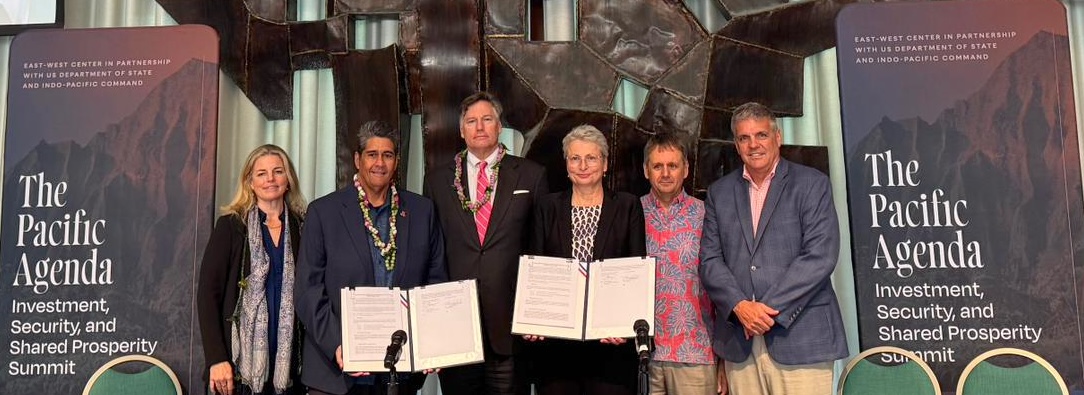
Whipps was among the Pacific Island leaders attending the inaugural Pacific Agenda Summit with U.S government officials and business executives at the East-West Centre this week.
The two-day conference focused on “Investment, Security, and Shared Prosperity,” with a number of deals signed through the U.S Trade and Development Agency, including a feasibility study to be led by local firm Architects Hawaii Limited into building a new modern hospital on Palau.
Whipps says Palau’s current hospital has a poor design and “salty concrete” and is being held up by shoring jacks.
He says a new, disaster-resilient hospital is critical to care for members of the Freely Associated States (FAS) who serve in the U.S military, but don’t return to Palau because of the lack of medical care.
“We serve at some of the highest rates of any state or any country, and we want those veterans to return home,” he said.
FAS encompasses the Federated States of Micronesia, the Republic of the Marshall Islands, and the Republic of Palau, which have a “Compact of Free Association” (COFA) with the United States. The renewed compacts include provisions to provide care for those veterans.
“We keep them home, and then it builds local capacity,” he added. “So better doctors, better nurses, better biotech people, all that builds in it. And when you have that ecosystem at home, it’s higher-paying jobs. It keeps the money circulating in the economy.”
Whipps said he’s grateful for U.S. investment, and conferences like this one are an opportunity to target where the investments go.
“This is an opportunity for us to really look at what is really needed, and maybe target that investment so that it’s better spent because at the end of the day, it’s U.S. taxpayer money, and it should be about resilience, building partnerships together, and make us all stronger together,” he said.
Whipps said that while the United States is Palau’s largest bilateral partner in education, healthcare, and infrastructure, China is currently Palau’s largest private sector investor, with investments in hotels.
“To me, they’re reaping all the profits that really the investment that the United States and the United States taxpayer put in, they’re not reaping the benefits,” Whipps said. “We want to see Marriotts, we want to see Hiltons, we want to see U.S participation.”
During the summit, U.S Deputy Secretary of State Christopher Landau affirmed the importance of improving infrastructure and bringing in U.S investors across the Pacific, not just for regional security but also for economic growth.
Whipps said one way Palau can expand its economy is through tourism due to its proximity to Asian markets.
“We look at our area as really being the Caribbean of Asia,” he said.
Whipps added that Palau is three and a half hours from Hong Kong, four and a half from Tokyo, and five from both Seoul and Singapore.
“We’re their backyard, and with so much population right there, I think the tourism potential is huge,” he said. “But it’s the right kind of tourism and the right kind of investment that we want to see.”
Whipps said he’s looking at Hawaii and Guam to model Palau’s tourism investments.
“We want to create a place where, you know, low impact, but people that come and respect our culture, enjoy the environment,” he said. “We’ve always believed that we’ve been blessed with tremendous biodiversity. Not only below the ocean, which we’re world famous for, but above the ocean with the flora and the fauna.”
He said United Airlines launched direct flights from Tokyo to Palau in October, operating 22 flights per week, after he raised the idea at a meeting at the U.S Chamber of Commerce in Washington. Whipps said those flights are performing well.
Whipps said the U.S is also helping Palau develop a master plan for its airports to address both military and private sector needs and is upgrading Palau’s port for naval readiness. He said the deeper port could open opportunities for U.S cruise lines to route through Palau, Yap, Guam, and Saipan.
Whipps said Palau is well known for its environmental protections and said they balance protections with production.
“I think that’s our signature … and that really comes from our culture, which for thousands of years we’ve practiced what we call the ‘bul,’” he said.
“Bul” is a traditional Palauan conservation practice where chiefs would come together and impose temporary restrictions on resources before reopening them, such as prohibiting fishing in specific reef areas, managing fish harvests and designating no-take zones to allow ecosystems to recover. He said that model has expanded over decades into formal policy.
He said a 1956 preserve in the Rock Islands has been a no-entry, no-take area since its establishment. In 2015, Palau passed a law closing 80 percent of its exclusive economic zone to fishing, which Whipps said was the largest EEZ protected at the time. Palau was also the first country at the United Nations to ratify the Biodiversity Beyond National Jurisdiction (BBNJ) Agreement, or “High Seas Treaty,” covering areas beyond national jurisdiction.
He noted that Palau has completed marine spatial planning identifying a 50-mile buffer around its reefs as the most critical area to protect, which accounts for approximately 30 percent of its waters.
Whipps said Palau has faced issues with Chinese vessels entering Palau’s exclusive economic zone without permission to conduct research, and that China has assigned Chinese names to undersea features within Palau’s extended continental shelf.
Palau is set to host the Pacific Island Forum and leaders conference later this year, with the theme “BELAU.” — an acronym standing for “Building Economies: Life. Action. Unity.” The theme is inspired by Palau’s indigenous name, centring Pacific peoples, cultures, and oceans in policy-making.
He said the forum will be combined with the Pacific Islands Conference of Leaders (PICL), which includes Hawaii and U.S territories such as Guam, Saipan, and American Samoa.
Whipps said priorities for his chairmanship include a transition to 100% renewable energy, ocean investment, and building resilience against sea level rise and storms.
“We know it’s part of protecting the homeland, but we also know that as the Pacific islands, there are geopolitical threats,” Whipps said. “The best way to maintain peace is through strength.”
“We can have cruise ships, or we can build AI centres or whatever other opportunities that are out there, and that’s what we talk (about) when we talk about shared prosperity, so I hope that the taxpayers see it as it’s bigger than just defence and security,” he said.
“There’s also economic opportunity, so your investments come and let’s share together in the prosperity,” he said.