
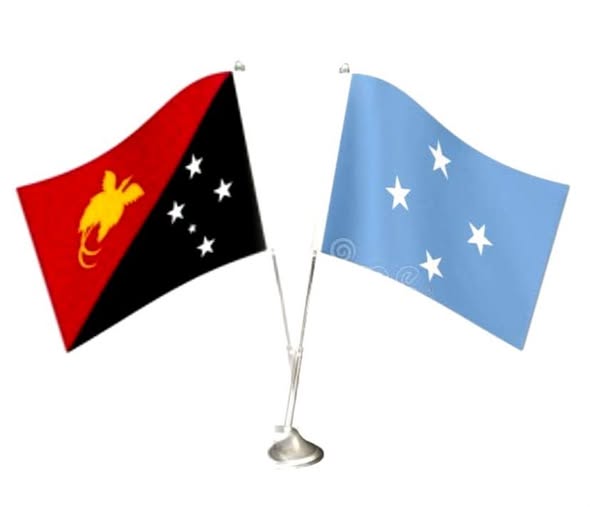
Papua New Guinea Parliament on Wednesday ratified an important treaty between Papua New Guinea and the Federated States of Micronesia.
This Treaty permanently establishes the maritime boundary between the two countries. The treaty, needing ratification since amendments to it were signed in 2015, secures national jurisdiction over marine resources and includes provisions for cooperation regarding both living and non-living resources within the defined areas.
FSM is to the north of Papua New Guinea, above the New Guinea Islands, and shares a sea boundary with PNG. A maritime boundary agreement was first signed in 1991 and amended in 2015, defining the Exclusive Economic Zone (EEZ) boundary between the two countries.
The boundary is approximately 426 nautical miles long and is defined by nearly 40 geodesic points. It separates the EEZs, generated by the southernmost FSM atolls and several PNG islands.
It is important that Parliament approved this signing, and that Papua New Guinea becomes a State Party to it. This treaty permanently establishes the maritime boundary of PNG and FSM within which both countries will exercise sovereign rights within their respective maritime borders or territories with respect to exploration and the use of their sea and seabed resources.
The treaty will also enable cooperation between both countries in exploration, use and conservation of the sea resources in the EEZs and seabed resources which both have a jurisdiction over.
Work had to go into reviewing the agreement because of errors in the geographical coordinates in the details of the treaty, but was finally completed, agreed to, and signed by former prime minister Peter O’Neill and former president of FSM Peter Christian in 2015 on the margins of the Pacific Islands Forum Meeting in Port Moresby.
A legislation supporting the treaty was also enacted by Parliament in July 2015.
The Department of Foreign Affairs, Department of Justice and Attorney-General, Department of Lands and Physical Planning, National Mapping Bureau, National Fisheries Authority, National Maritime Safety Authority and other respective partners took the lead on behalf of the National Government ensuring the finalisation of the treaty.