


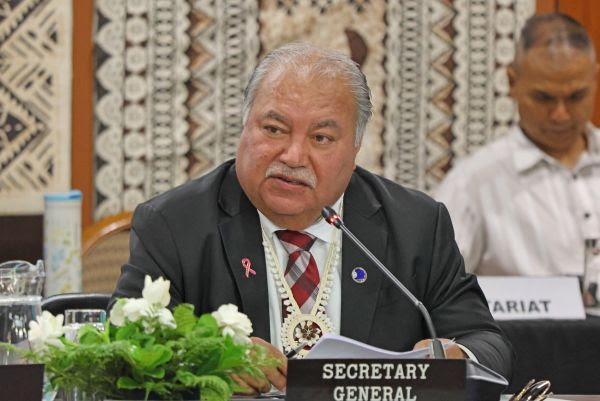
Forum Secretary General Baron Waqa says the Pacific must move beyond global ambition and focus on delivery at home to achieve the 2030 Sustainable Development Goals.
Speaking at the opening of the 9th Pacific Forum on Sustainable Development Wednesday, Waqa said the meeting provides “a platform for dialogue and collaboration to reaffirm our shared vision towards action-oriented initiatives for our region.”
“The theme for the week: ‘Transformative, equitable, innovative and coordinated actions for the 2030 agenda and its SDGs for a sustainable future for all’ is fitting,” Waqa said.
He reminded delegates that the Forum follows the 54th Pacific Islands Forum Leaders Meeting in Honiara and the strong engagement of regional leaders at the 80th Session of the United Nations General Assembly.
“At the regional and global platforms, our Leaders amplified our shared priorities on climate action, peace and security, gender equality, disability inclusion, youth empowerment, children’s wellbeing and multilateral reform,” he said.
Waqa said the Pacific continues to navigate complex global landscapes but remains committed to partners who support action on climate change, trade and economic resilience, and public health.
“The 2030 agenda reflects our common challenges and sets targets—it is clear that there is urgent work required of us to meet the ambitions we have set for ourselves,” he said.
He stressed that implementing global commitments such as the 2030 Agenda, the Beijing Platform for Action, and the World Programme of Action for Youth requires delivery at the local level.
“This Pacific Forum on Sustainable Development is one of the regional mechanisms that converts those global commitments into coordinated Pacific actions,” Waqa said.
Highlighting progress on Sustainable Development Goal 6, Waqa said the Pacific Water and Wastewater Conference hosted in Solomon Islands in August elevated water security at the highest level.
“The theme for the conference ‘Water and Wastewater for all: connecting people, policies and communities for a shared sustainable future’ brought together utility professionals, policymakers and water experts,” he said.
He added that Forum Leaders discussed the outcomes of the conference and are strengthening water and wastewater services across the region, including sustainable financing and capacity building for water security.
On Sustainable Development Goal 11, Waqa praised the efforts of 27 law students from Vanuatu who helped secure the landmark advisory opinion from the International Court of Justice (ICJ) on climate change and human rights.
“The first for smaller island countries who continue to advocate and call for action and urgency to address the injustice and the life-threatening impacts of climate change in our communities, especially our most vulnerable,” he said.
Waqa also highlighted progress on the Pacific Resilience Facility (PRF), describing it as a Pacific-owned financing mechanism for resilience building.
“Our Leaders signed the PRF Treaty at the Forum Meeting held in Honiara in September—the evening was a very proud and emotional moment for many of us in the room,” he said.
He noted that Solomon Islands had gone a step further by pledging US$1 million at the margins of the World Bank meeting two weeks ago.
Waqa also underscored progress under Goal 9, noting the Pacific Strengthening Correspondent Banking Relationships Initiative as a landmark effort to address banking challenges across the region.
“This initiative, the first of its kind globally, brings together eight and soon to be nine Pacific countries that have collectively pooled their IDA allocations from the World Bank,” he said.
Through this collaboration, a Pacific Payments Mechanism is being developed to provide a long-term, sustainable and regionally owned solution to correspondent banking issues.
He also highlighted to the Pacific Regional Private Sector Development Strategy, endorsed earlier this year, to support the growth of micro, small and medium enterprises.
Waqa reaffirmed that partnerships are central to achieving the SDGs, particularly Goal 17.
“To our UNESCAP colleagues who are partnering with us on this dialogue, thank you for continued engagement and support on a number of initiatives that have been endorsed by Leaders such as the Pacific Climate Mobility Framework and the Pacific Roadmap for Economic Development,” he said.
He also commended the Pacific Catastrophe Risk Insurance Company (PCRIC) for improving access to financial protection after disasters.
“In fact, several Members have received benefits through this facility in the last few months. This contributes to addressing our concerns on slow and insufficient access to finance and protection when disasters strike,” he said.
Waqa said that working together delivers stronger and more sustainable results for the region.
“In line with the 2050 Strategy for the Blue Pacific Continent, our Leaders call for a whole-of-region approach to implementation—one that harmonises efforts, fosters collective accountability, and aligns regional and national priorities,” he said.
He said regional coordination mechanisms have been established to strengthen collaboration and ensure coherence in delivering the 2050 Strategy.
“As we conclude this week, our collective task should be to ensure that the priorities voiced by our Leaders in Honiara and again in New York continue to resonate here in the Pacific and beyond,” Waqa said.
“We must do this through partnerships that deliver for the Pacific’s people, ocean and shared future,” he said.