
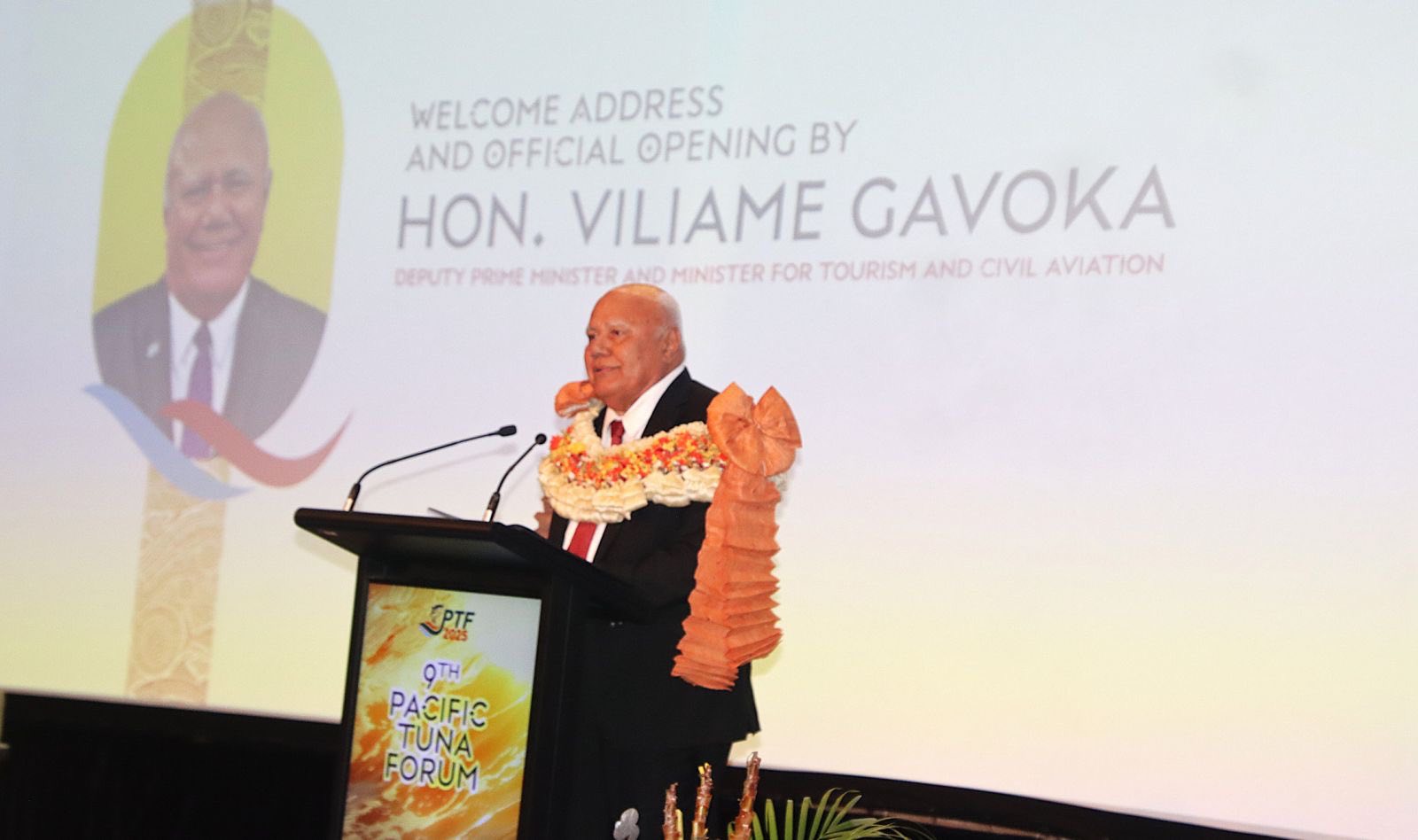
Fiji’s deputy Prime Minister and Minister for Tourism and Civil Aviation, Viliame Gavoka, opened the 9th Pacific Tuna Forum in Nadi Tuesday with a strong message of unity and responsibility, warning Pacific nations against complacency as they manage the world’s last healthy tuna stocks.
“It is my great honour to officiate the opening of the 9th Pacific Tuna Forum. I acknowledge with gratitude the Government of Papua New Guinea for co-hosting this important gathering, and InfoFish for its continued commitment to advancing the future of our region’s tuna fisheries.,” he said.
The Minister reminded delegates that the Western and Central Pacific Ocean accounts for nearly 60 percent of the world’s tuna catch, calling the region “the beating heart of the global tuna industry.”
“Beyond the numbers lies a deeper story, one of identity, resilience, and shared stewardship,” he said.
“For Pacific peoples, tuna represents not only a vital source of income but also a symbol of who we are — oceanic nations bound by a common heritage and collective responsibility.”
The 2025 forum is being held under the theme Resilience, Innovation, Equity, and Sustainable Trade for a Prosperous Future.
The Minister said the theme captures the Pacific’s collective vision for the tuna industry and outlines key priorities — retaining more value from tuna caught in Pacific waters, expanding local industries, and ensuring sustainable and transparent supply chains.
“It calls on us to embrace a holistic approach to development — one that recognises the value of our tuna resources, insists on equitable benefit sharing, and ensures responsible management for generations to come,” he said.
He noted that the region’s efforts in sustainable management have already produced tangible results.
“Tuna has created jobs, supported education and infrastructure, transferred knowledge and technology, and helped buffer our economies against climate and global shocks,” he said.
“Our ocean remains home to the world’s last healthy tuna stocks,” the Minister said.
“All key species are currently within sustainable limits, a rare global achievement and a testament to regional unity and effective cooperation.”
He credited the Western and Central Pacific Fisheries Commission (WCPFC) for anchoring tuna management in science and fairness, guided by principles such as the precautionary approach, ecosystem-based management, and recognition of the special needs of Small Island Developing States.
“This success was not accidental. It is the outcome of strong governance, evidence-based policy, and the shared will of Pacific nations to safeguard what sustains us,” he said.
The Minister drew connections between sustainable fisheries and other key economic sectors, particularly tourism and aviation.
“The health of our fisheries is tied to the wellbeing of our islands, our people, and the systems that connect us,” he said.
“Under Fiji’s National Sustainable Tourism Framework, our development vision is anchored in balance — between growth and conservation, between access and authenticity.”
He said civil aviation supports that same vision by “linking our people and industries, supporting trade and tourism, and connecting even the most remote islands with opportunity.”
“These sectors — fisheries, tourism, and aviation — together form the lifeblood of our island economies,” he said.
“They demonstrate that sustainability is not confined to any single domain. It is a shared mindset, one that values stewardship, equity, and partnership as the foundation of lasting prosperity.”
The Minister cautioned Pacific nations not to take their current success for granted.
“Healthy tuna stocks today do not guarantee healthy stocks tomorrow,” he warned.
He highlighted the ongoing challenges such as climate change, shifting migration patterns, illegal, unreported and unregulated (IUU) fishing, and global economic pressures.
“We must stay vigilant, adaptive, and united,” he said. “Strengthening monitoring, enforcement, and data sharing will be critical in upholding the integrity of our resources.”
The Minister described the Pacific Tuna Forum as a crucial opportunity to deepen regional collaboration.
“This Forum provides a vital space to deepen our understanding of tuna stock dynamics and supply chains, strengthen equitable development models, explore market diversification, and build stronger partnerships for sustainable growth within the Blue Pacific Continent,” he said.
The deputy Prime Minister reaffirmed Fiji’s commitment to the Ocean of Peace initiative launched by Prime Minister Sitiveni Rabuka in Honiara last month, describing it as “a framework of twelve principles already endorsed by Pacific leaders.”
“Ocean of Peace is not just aspiration,” he said.
“It seeks a Pacific region where strategic competition is managed, coercion is rejected, disputes are resolved peacefully, maritime environment is protected, freedom of navigation and overflight are respected, and human rights upheld.”
He said the initiative reflects the Pacific Way — a culture of consensus, dialogue, and respect.
“Through the Ocean of Peace, we reaffirm our right to live in a Pacific region free from coercion, where our waters, our fisheries, our people, our future, are governed by harmony, cooperation, and steadfast resolve,” he said.
Declaring the 9th Pacific Tuna Forum open, he said: “Let this Forum deepen our unity, strengthen our commitments, and build frameworks that uphold those twelve principles in every policy, every partnership, every action. Let us ensure that tuna remains a source of life and identity, that our islands remain resilient, and that our skies, waters, and lands remain peaceful and thriving, said DPM Gavoka.