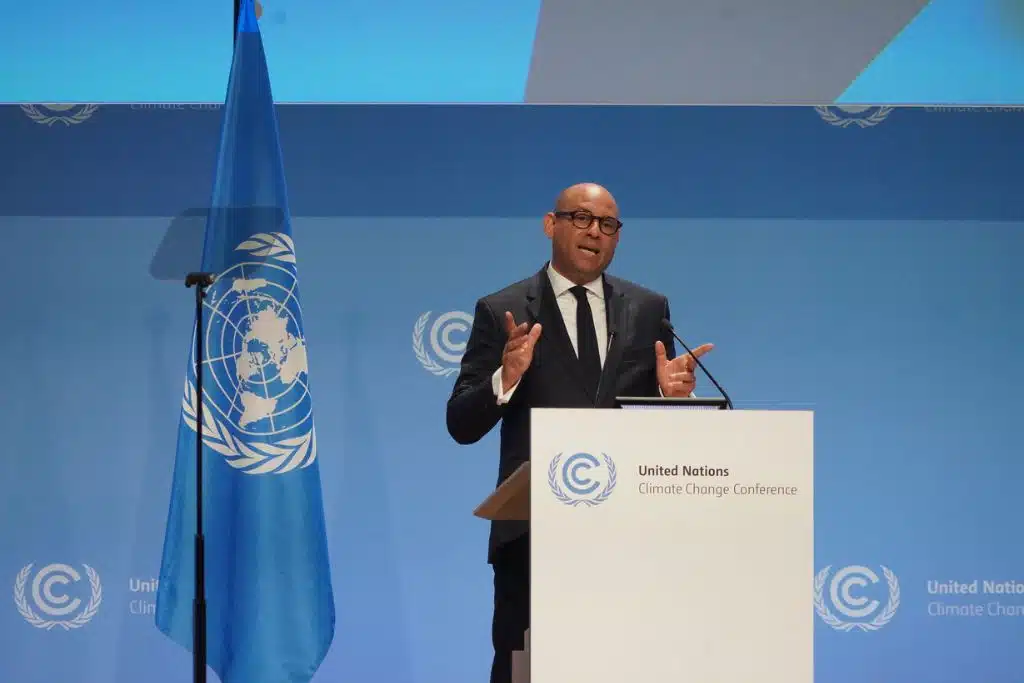
UN Climate Change Executive Secretary Simon Stiell has called for stronger political support to deliver a global climate finance roadmap aimed at mobilising US$1.3 trillion annually by 2035, warning that finance remains the key factor in turning climate commitments into action.
Speaking during a joint COP29-COP30 Presidency event on the implementation of the Baku to Belém Roadmap to 1.3T at the UN June Climate Meetings in Bonn, Stiell said climate finance is central to ensuring the world moves from planning to implementation and achieves the ambitions required under the Paris Agreement.
“This discussion goes to the heart of our work today.
“This is an era of implementation in climate action. And finance will drive it forward,” Stiell told delegates.
Stiell said climate finance is essential to delivering a global transition to low-emission and climate-resilient economies.
“It is essential for a truly global transition: For turning plans into projects. Bringing the benefits of climate action to billions of people.
*And laying the groundwork for more ambitious commitments that the science demands, for the second global stocktake,” he said.
His remarks focused on the implementation of the Baku to Belém Roadmap, which emerged from decisions taken at COP29 and is intended to guide efforts to scale up climate finance over the next decade.
Stiell reminded delegates that governments had already agreed on the scale of ambition needed.
“Together, at COP29, countries called on all actors to scale up climate finance to US$1.3 trillion by 2035.”
He said the roadmap provides a framework for reaching that target and serves as an important signal to governments, investors, development institutions and the private sector.
“This Roadmap is the plan we need to answer that call: A powerful signal of confidence – that US$1.3 trillion is both achievable and essential,” he explained.
While acknowledging that the roadmap is not a negotiated outcome, Stiell said it reflects extensive engagement across climate and finance communities.
“It is not a negotiated document. But it is the result of record submissions and hundreds of ideas from across the climate and finance communities,” he said.
The UN climate chief urged countries and institutions to unite behind the roadmap despite differing priorities.
“It may not be everything that every Party would want. But it is a plan we can and must rally behind.”
Stiell said implementation efforts are taking place against a backdrop of significant global economic and geopolitical challenges that are disproportionately affecting developing countries.
“We are all aware of the headwinds we face. And the impact they have on developing countries: Limiting their ability to make the investments they need at this crucial time.”
He stressed that achieving the roadmap’s goals will require stronger political commitment beyond the climate negotiations process.
“We need real political backing to deliver on the roadmap. Including through other international fora.”
According to Stiell, the immediate task is to focus on practical measures that can sustain momentum and unlock greater investment flows for climate action.
“And our immediate focus must be those actions that sustain and build momentum – laying the foundations for further progress down the line,” he emphasised.
He outlined a range of priorities that governments, multilateral institutions and financial actors should pursue.
“Getting the most out of every drop of climate finance, making every dollar count, including from governments and development banks.”
“Changing perceptions of capital and aligning investment frameworks with climate goals.
“And continuing to identify new and innovative sources of climate finance,” he said.
Many developing countries, particularly small island developing states and least developed countries, have repeatedly argued that limited access to affordable finance remains one of the biggest barriers to implementing climate commitments and adapting to worsening climate impacts.
Stiell said collaboration between successive COP presidencies will be critical in maintaining momentum toward the finance target and ensuring measurable progress ahead of the next major review of global climate action.
“Working with each COP Presidency. Building on your priorities and your incredible networks.”
The roadmap is expected to play a central role in shaping discussions on climate finance over the coming years as countries prepare for the second Global Stocktake, which will assess collective progress toward the goals of the Paris Agreement.
Stiell said the international community must demonstrate tangible results before that review takes place.
“So that by the second global stocktake at COP33, we show real progress.”
He urged governments, financial institutions and stakeholders to move from planning to implementation.
“We have a plan. Let’s put it to work,” he said.