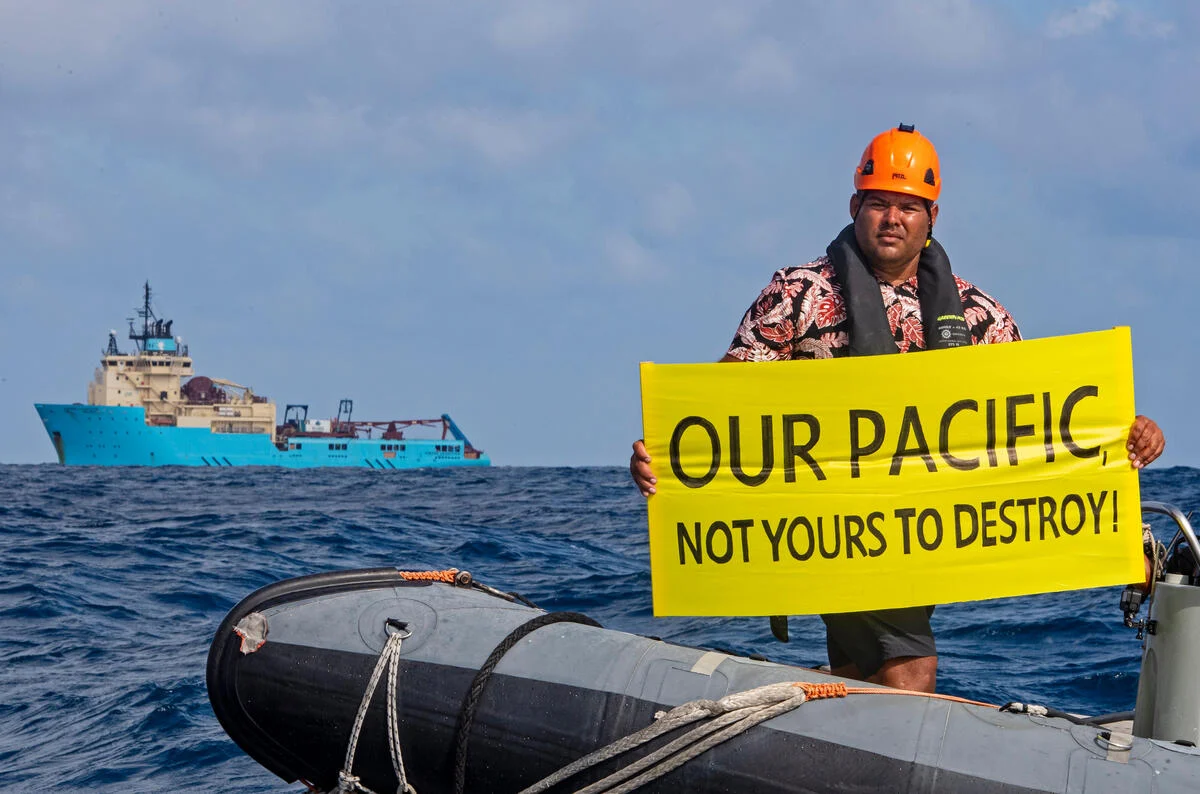
A proposal to explore for deep-sea minerals in international waters between Kiribati, the Cook Islands and French Polynesia is open for public comment until 03 August, raising questions about how the Pacific Ocean should be managed while international rules for deep-sea mining remain under negotiation.
The application, lodged by a United States company, seeks exploration licences for the Eastern High Seas Pocket, an area beyond national jurisdiction in the Pacific Ocean.
According to the Pacific Islands Climate Action Network (PICAN), the application is being considered through a United States domestic licensing process while governments continue negotiating international regulations for deep-sea mining through the International Seabed Authority (ISA), which has yet to finalise rules for commercial mining in international waters.
In response, PICAN has launched its “Speak Up for Our Shared Ocean” campaign, encouraging people across the Pacific and beyond to make submissions before the consultation closes.
In a Facebook post accompanying the campaign, PICAN Strategic Communications Lead, Dylan Kava questioned the United States’ decision to pursue a unilateral licensing process.
“The Pacific Ocean is one connected ecosystem. Ocean currents don’t stop at jurisdictional boundaries, tuna don’t stop at jurisdictional boundaries, and the potential impacts of deep-sea mining won’t either,” Kava said.He said activities with potential transboundary impacts should be guided by the precautionary principle and decided through transparent, science-based and multilateral processes.
“The U.S has now opened a public comment period before deciding whether to approve the application, and that means people around the world, including those of us in the Pacific, have an opportunity to respond,” he said.
While PICAN’s campaign centres on public participation, marine scientists say understanding the deep ocean remains one of the biggest challenges for managing its biodiversity.
Speaking at a seminar on deep-sea taxonomy and biodiversity at the University of the South Pacific (USP), research scientist Dr Tammy Horton said monitoring biodiversity was essential for understanding how human activities affect the deep ocean.
“We need to be able to assess the damage, we need to be able to monitor change in biodiversity as a result of these impacts, and we need to be able to monitor marine protected areas and monitor change in the deep sea,” Horton said.
She said researchers study deep-sea communities over time to distinguish natural changes from those caused by human activities and to understand the effects of disturbances, including sediment plumes generated by seabed equipment.
Horton described the deep sea as “one of Earth’s least understood ecosystems”, highlighting the challenge scientists face in documenting marine life before assessing environmental change.
She said research in the Clarion-Clipperton Zone, a vast region of the Pacific that has attracted significant interest for deep-sea mineral exploration, estimated there were between 6,000 and 8,000 species, with more than 5,000 remaining unnamed.
“We want to be able to manage this area. We want to be able to say how those impacts are happening. If we can’t name them, we can’t compare the datasets,” she said.
Natural History Museum researcher Dr Muriel Rabone said improving scientific knowledge of deep-sea ecosystems was fundamental to informed ocean governance.
“We need to iteratively improve knowledge of these deep-sea environments… understanding that ecology and species ranges leads us to better understand what impacts may be of human activities on the seafloor or in the water column,” Rabone said.
She said developing stronger knowledge systems was essential to supporting future policy decisions.
“For effective ocean policy, we really need to develop these knowledge systems and then put them into the process.”
PICAN says anyone can participate in the consultation regardless of where they live and that submissions do not need to be technical. The organisation has published a guide and submission template to help people prepare submissions before the consultation closes.
Public submissions will form part of the official record considered before a decision is made on the exploration licence application.
Submit a public comment before 3 August using guide: https://tinyurl.com/dsm-submission-guide