

Home Blog Page 58

Marshall Islands government shuts down at 3pm amid fuel crisis

0

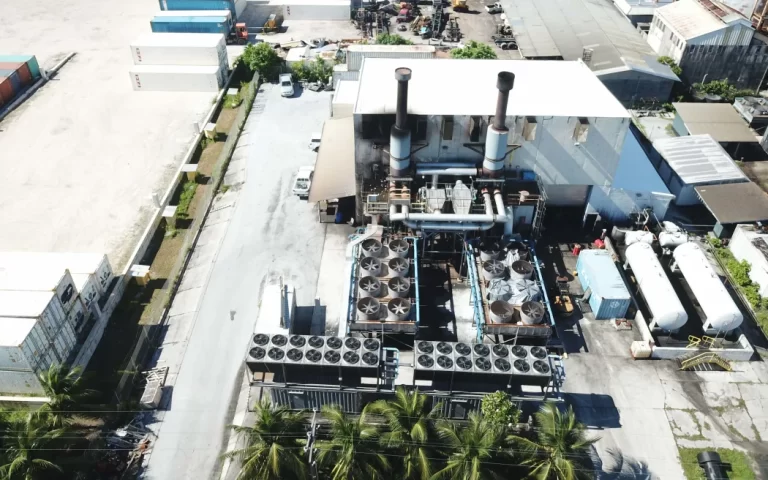
Most government offices in the Marshall Islands began enforcing a new policy this week of closing by 3pm daily as a way to conserve fuel given uncertainties of fuel supply globally.

The move is to save energy and reduce the strain on the Marshalls Energy Company’s diesel fuel resources with both fuel shortages and skyrocketing prices seen on world markets due to the US and Israel’s attacks on Iran and its retaliation by closing the Strait of Hormuz to global shipping.

The 3pm daily closure directive for all non-essential government services was issued by the government’s Cabinet on 10 April as an Emergency Electricity Savings Policy.

Aside from the government office closure to reduce energy use, the emergency directive is expected to help the private sector through the mandate of government contracts for air conditioning maintenance and repair.

Government offices are expected to remain open during the lunch hour, allowing workers to operate seven hours daily instead of the usual eight.

A key provision about the shutdown of government offices by 3pm daily is that they are required to shut off air conditioners, lights and any other equipment drawing power. The aim is to reduce energy use by 30 percent over the 90 days of the emergency decree.

The 90-day emergency order mandates the Marshalls Energy Company, the government’s power utility company, to provide detailed monthly electricity bills to every government ministry, state-owned enterprise, and subsidised agency that detail each government offices power consumption compared to the 30-day period immediately prior to the emergency declaration.

“Compliance with the 90-Day Emergency Electricity Savings Policy is mandatory,” the declaration said.

“The National Energy Authority will monitor the monthly MEC baseline reports to verify progress toward the 30 percent reduction goal.”

Various exemptions are made to the requirement of shutting down by 3pm daily. All essential services are exempted from the closure order, including public schools, the College of the Marshall Islands and Majuro and Ebeye hospitals.

Secretary of Health Francyne Wase-Jacklick said the ministry is specifically exempted so there will not be disruptions.

“So essential services remain ongoing,” she said. “Outpatient, maternal child health, immunization, public health programs, and rehab services will continue as usual, with only internal adjustments to reduce energy use where possible.”

As a consequence of the 3pm daily closure of all non-essential government/agency/state owned enterprise offices, government workers will be working only 30 hours each week. They will, however, continue to be paid for a full week of work.

The 90-day Emergency Electricity Savings Policy will accomplish two things, Finance Minister David Paul said this week

It is “an opportunity to cut down on energy usage” (while it) ⁠⁠allows people to maintain their purchasing power,” he said.

Paul said the situation with skyrocketing fuel costs has caused “an affordability crisis – so it will be counterproductive if we are trying to address a problem while creating another one.”

This is why workers will still get their full paychecks, he said.

The new 90-day Emergency Electricity Savings Policy is likely to have a positive impact on the private sector.

The new policy directs the Ministry of Public Works, Infrastructure, and Utilities to implement an “immediate transition” to contracting out air conditioning cleaning and repair services to the private sector.

“Air conditioning constitutes the largest draw on the public power grid,” said the new government emergency policy. Performance and quality of air conditioners, therefore, has a big impact on their cost of power to operate.

Public Works “currently lacks the capacity to service all government units,” the policy said.

To resolve this, the ministry is directed to coordinate with the Ministry of Finance to immediately transition maintenance responsibilities and facilitate the contracting of air conditioning cleaning and repair services to the private sector.

Further, the policy directs that “every government ministry, state-owned enterprise, and subsidised agency must allocate funds from their current budgets to hire private contractors for air conditioning repairs, maintenance, and cleaning.

While agencies are directed to transition maintenance to the private sector, they are also encouraged to explore all available avenues – including internal staffing or collaborative partnership with other agencies – to ensure units are serviced.”

A part of the emergency order requires that within the 90-day period of the order, “every agency must compile a complete inventory of their air conditioning units.”

They must also secure a maintenance contract and schedule to ensure filters are cleaned every two-to-four weeks. While physical cleaning of all units may extend beyond this 90-day window, the finalized contracts and schedules must be in place.”
IMF warns energy shock to hit Asia- Pacific

The International Monetary Fund (IMF) says rising oil and gas prices linked to the Middle East conflict are set to weaken growth, raise inflation and strain economies across Asia and the Pacific, with small island states among the most exposed.

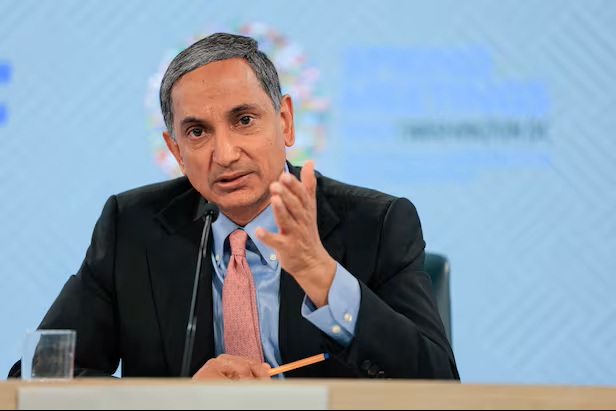
Speaking at a press conference during the Spring Meetings, IMF Asia and Pacific Director Krishna Srinivasan said the region entered 2026 strong but now faces mounting pressure from an energy shock.

“Asia entered 2026 on a solid footing with growth remaining resilient despite the region bearing the brunt of U.S tariffs and heightened uncertainty. However, given the region’s high fossil fuel intensity and reliance on the conflict areas for key commodities, the new energy shock will have a negative impact on the region. The shock is raising inflation, weakening external balances, tightening financial conditions, and narrowing policy space.”

He said growth held up through late 2025, driven by exports and consumption.

“If you look at the chart here, growth across most Asian economies turned out stronger than expected in late 2025. This is in large part thanks to exports and consumption, which held up better than anticipated, supported by accommodative policies and financial conditions.”

Srinivasan said strong demand for technology goods helped offset weaker trade with the United States.

“With regard to exports, much of the recent strength has been driven by robust demand for tech goods… Asia’s exports to the U.S declined, but that to the rest of the world increased.”

But he warned the situation has shifted with rising energy prices.

“In the context of the war in the Middle East, all oil and gas prices have risen sharply, and there’s considerable uncertainty about how persistent the shock will be.”

He said the region is highly exposed due to heavy energy use and import dependence.

“The use of oil and gas amounts to about 4 percent of GDP for the region as a whole… this is nearly double Europe’s share.”

“Altogether, net oil and gas imports amount to about 2.5 percent of GDP for the region, rising to about 8 percent for some economies such as Singapore and Thailand.”

He added that supply chain risks are also growing.

“Disruptions of fertilisers and petrochemical inputs… can create broader supply chain pressures if the conflict persists.”

Despite the shock, Asia is still expected to drive global growth, although momentum is slowing.

“Regional growth is projected to moderate from 5 percent in 2025 to 4.4 percent in 2026 and 4.2 percent in 2027.”

“Inflation is projected to rise from 1.4 percent in 2025 to 2.6 percent in 2026 and to ease 2.4 percent in 2027.”

Srinivasan warned risks are now “firmly to the downside,” especially for vulnerable economies.

“This matters in parts of South Asia, Southeast Asia, and key among the Pacific Island countries.”

He said countries heavily reliant on imported fuel face the greatest risk.

“Economies that depend heavily on imported energy use are especially vulnerable.”

Under worse-case scenarios, the impact could deepen.

“This leads to a cumulative output loss of about 0.8 percent by 2027 for the major Asian economies… In the most severe scenario… cumulative output losses of almost 2 percent by 2027.”

He said policymakers must act carefully to manage the shock.

“The near-term priority is to absorb the shock while preserving space and price signals.”

On monetary policy, he said flexibility is key.

“But monetary policy should remain agile. A prolonged energy shock could weaken currencies and generate more persistent inflation.”

On fiscal policy, he warned against broad subsidies.

“Broad fuel subsidies, tax cuts, and general price caps may smoothen inflation in the short run, but they are costly, distortionary, often regressive, and very hard to unwind.”

Srinivasan said targeted support is the better option.

“Fiscal support should be temporary, with sunset clauses targeted to vulnerable households and viable firms.”

He also stressed the need for long-term reforms to build resilience.

“This shock strengthens the case for structural reform. It does not weaken it.”

He pointed to the need for better skills, stronger safety nets, and energy transition.

“We have been calling across Asia for stronger social safety nets… and last but not least, investment in alternative energy sources, energy efficiency, and power grids.”

Srinivasan said the region must act now to manage immediate risks while preparing for the future.

“So the near-term task is to absorb the shocks while preserving price signals and policy credibility. The medium-term task is to build a more resilient, more balanced, and more inclusive growth mode,” he said.

Australia’s neighbour criticises Albanese and will ‘definitely’ ask China for fuel help

0

A Pacific leader has criticised Prime Minister Anthony Albanese as the region stares down the climate crisis, while signalling his country will “definitely” seek assistance from China amid global energy turmoil.

Vanuatu’s climate change adaptation minister Ralph Regenvanu’s comments come against a backdrop of Australia failing to secure a $500 million (US$358 million) security pact with Vanuatu in September last year, while China eyes regional influence in the Indo-Pacific.

An outspoken climate advocate, Regenvanu told SBS News that Australia “needs to think hard about where its future lies” in relying on fossil fuels, as a chokehold on oil shipments the Strait of Hormuz continues to threaten the country’s energy security.

Albanese landed in Malaysia on Wednesday, after travelling to Brunei and Singapore over the past week, to secure assurances Australia will continue to receive petrol and diesel from the countries the government is dependent on for supply.

“Australia has a great opportunity to transition to renewable energy, as it is already doing in the domestic market. And any resources spent on additional fossil fuels is resources taken away from the transition,” Regenvanu told SBS News.

“To go looking for even more fossil fuels from outside — I don’t think it’s the right approach.”

Regenvanu also threw his support behind Australia introducing a 25 per cent gas export tax, an idea which has gained traction from the crossbench and Greens during the war in the Middle East.

“We are concerned about Australia continuing to supply LNG [liquefied natural gas] to the Asian economies,” he said.

“There’s a need to rein this in, in alignment with international law. There’s a need to phase out these exports as well.”

When asked about whether it was time for a gas export tax to be introduced, Albanese said any changes would be found in the upcoming federal budget, to be handed down in three weeks.

Energy Minister Chris Bowen stressed Australia’s first priority was supply, but recognised the importance of diversifying energy — including with renewables — during times of global conflict.

“There isn’t one country in the world that said: ‘You know what this fuel crisis reminds us, is we need more fossil fuels’,” he told reporters on Monday.

“No war can impede the flow of sun to Australia. No sanctions can be applied to wind.”

The Pacific Islands are some of the most vulnerable to the effects of climate change as rising sea levels have threatened their long-term existence.

They are also among the most vulnerable to fuel shortage shocks, with the United Nations warning this week that, with Pacific nations at the end of the global supply chain, they could be pushed into deeper economic insecurity.

The Marshall Islands have declared a state of economic emergency, while one Papua New Guinean fuel supplier has started rationing. Tuvalu has ordered its government staff to work from home.

Regenvanu said Vanuatu has enough fuel reserves until the end of June, but residents will likely start seeing fuel and food price hikes by May.

Vanuatu has not asked for help with energy security from Australia yet, but Regenvanu did not rule it out.

“We are definitely going to reach out to China as well,” he said.

“I don’t think anyone has anything to be concerned about Vanuatu doing what it does as a sovereign state.

“We are not going to be a militarised state in any way. We will never host any foreign military bases. We will never abide any foreign interference in our infrastructure,” he said.

Regenvanu’s criticism come as Pasifika leaders wrap up three-day talks in Port Vila to manage a transition away from fossil fuels, ahead of a major international summit in Colombia later this month.

But Regenvanu said that the delayed and unsigned agreement between Australia and Vanuatu is “on the cusp” of being finalised.

The proposed 10-year, $500 million (US$358 million) Nakamal agreement was aimed at funding Vanuatu’s key economic and climate priorities, while locking in Australia as Vanuatu’s security partner of choice.

But last-minute sticking points emerged while Albanese travelled to Port Vila last September to sign the pact, due to concerns from Vanuatu officials it could hurt the country’s economic ties with China.

Pacific Affairs Minister Pat Conroy told the ABC on Monday the federal government was open to helping Pasifika communities where possible.

“We’re continuing to talk to our Pacific neighbours — we’re proud to be a part of the Pacific family and to understand what the challenges there are,” he said.

Tonga Finance Minister resigns following bribery conviction

0

The Minister of Finance, Lata í Faingataá Tangimana, has resigned from Cabinet following a court ruling that found him guilty of indirect bribery during the 2025 general election.

Prime Minister Lord Fakafanua confirmed the resignation at a press conference Thursday, stating it took effect immediately.

Lord Fakafanua said he received Tangimana’s resignation letter earlier this week and accepted it in light of the court judgment issued on 24 March.

The ruling was formally certified to the Speaker of Parliament on 09 April, prompting constitutional procedures regarding his parliamentary seat.

The court found that Tangimana had attempted to influence voters by distributing fish ahead of the November 2025 election. Such actions fall under electoral bribery offences under Tongan law, which can result in disqualification from Parliament.

Despite the conviction, Tangimana will remain the People’s Representative for Niua 17 for now.

The Speaker has advised that he is due to be unseated on 27 April, but the court has granted a stay of the judgment pending an appeal scheduled for early July.

Lord Fakafanua said he will temporarily assume responsibility for the finance portfolio until a replacement is made.

The Prime Minister is also overseeing Tonga’s diplomatic services while the Crown Prince serves as Prince Regent during the King’s overseas travel.

The case highlights ongoing scrutiny of electoral integrity in Tonga, with the appeal outcome likely to determine Tangimana’s political future.

Tonga declares dengue outbreak as cases spread across the Kingdom

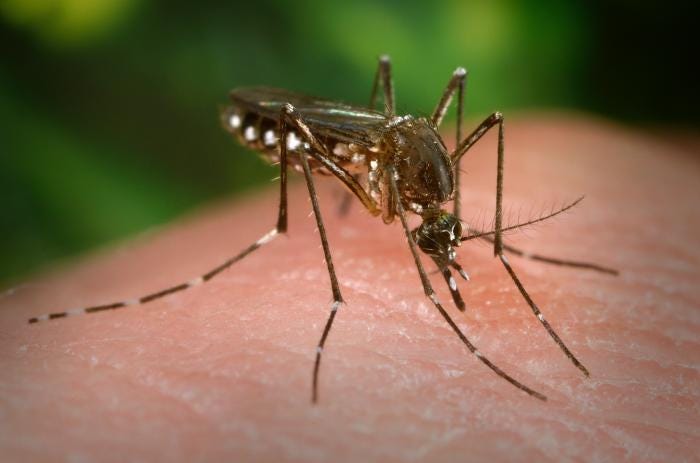
Tonga’s Ministry of Health has declared a dengue fever outbreak, warning of community transmission across three island groups as cases continue to rise.

Chief Executive Officer Dr Reynold ‘Ofanoa confirmed and suspected cases are increasing in Tongatapu, Ha’apai and ‘Eua.

“The Ministry of Health officially declares a dengue fever outbreak in Tonga as the number of confirmed and suspected cases continues to increase in Tongatapu, Ha’apai and ‘Eua. All these cases do not have any evidence of linkage which strongly indicates community transmission across these 3 island groups.”

Health officials confirmed 6 cases and 7 suspected infections, with most reported in Ha’apai.

“There are 6 confirmed and 7 suspected cases, and majority of them from Ha’apai with ages ranging from 10 to 35 years. More cases are expected due to the presence of the responsible vectors (Aedes mosquitoes) and the ongoing rain and adverse weather conditions which favor breeding sites for the mosquitoes.”

The Ministry said it is closely monitoring the situation and called on the public to take preventive action.

“The Ministry continues to monitor the spread of the disease, and the public is urged to assist in preventing further spread by maintaining household and community cleanliness, eliminating mosquito breeding sites, using mosquito repellents and bed nets, and wearing protective clothing.”

Officials reminded the public how the virus spreads.

“The Ministry reminds the public that dengue fever is contagious, it spreads from person to person through the bites of infected mosquitoes. The public is also urged not to panic but to learn about dengue fever and present early to a medical facility if they develop symptoms.”

The Ministry outlined key symptoms to watch for.

“Dengue Fever symptoms include:
*Sudden high fever
*Severe headaches
*Pain behind the eyes
*Joint and muscle pain
*Nausea
*Vomiting
*Swollen glands
*Rash that appears 3-4 days after fever begin.

It warned that severe symptoms require urgent care.

“Severe symptoms, such as abdominal pain, bleeding gums and vomiting blood or any other form of bleeding require immediate medical attention.”

The Ministry urged calm as response efforts continue.

“The public is encouraged to remain calm and follow the advice from the Ministry and the health workers on the ground.”

Leadership That Mirrors the World: The UN’s Next Great Test

0

Opinion by Annalena Baerbock, President of the General Assembly

This year, for the first time in a decade, the United Nations will select its new Secretary-General.

This critical process comes at a time when our global community faces unprecedented challenges, among them: escalating geopolitical tensions, a raging climate crisis; and rapid advances in digital technology which are transforming how we work, communicate, and function as a society.

While the world has never been more in need of the United Nations, the multilateral tools set up to meet these borderless challenges are under immense strain. At the same time, the United Nations – at it’s 80th anniversary – also needs the world, because the legitimacy and efficiency of our work is strengthened when more voices are heard, and more perspectives are included – as encapsulated in the theme I have chosen for this session: Better Together.

Against this backdrop, the 2025-2026 Secretary General selection process is more than a procedural milestone. It is a moment of reflection and an opportunity to renew our commitment to the principles that bind us.

So, what does it mean to lead the United Nations from its 80th year into the future?

The world is looking to the next Secretary-General to provide strong, dedicated leadership to deliver on the three pillars of the United Nations: peace and security, human rights, and development, while adapting the United Nations to meet the realities of today and the challenges of tomorrow.

Beginning on 21 April, the interactive dialogues with candidates offer a unique opportunity for candidates to present their vision for the future of this organisation, and for Member States and civil society to ask questions and interact directly with candidates. These dialogues will be available to watch live through the UN’s Web TV service and will spotlight the vision, skills and priorities of each candidate while fostering accountability in action.

By inviting civil society participation, the UN is signaling that the future of multilateralism depends on broad engagement, not closed door deliberations. It is an opportunity to listen, to question, and to deepen trust in the institution at a time when trust is both fragile and essential.

The interactive dialogues are therefore essential to ensuring a transparent and inclusive selection and appointment process while maintaining the important role of the General Assembly.

In parallel, the process will be available across social media platforms in a way that is accessible, dynamic, and educational.

Because this is not simply about broadcasting information; it is about cultivating understanding and connecting with people who are politically motivated, but perhaps not yet fully engaged in the multilateral sphere. By demystifying the process and presenting it through a youthful, modern lens, we aim to inspire ordinary citizens and future diplomats alike who will advocate, support, and carry forward the work of the United Nations to the next generation.

The selection of the next Secretary-General is also a moment to confront an undeniable truth: half the world’s population are women and girls, yet global leadership rarely reflects that reality.

In 80 years, I am the fifth woman to serve as the President of the General Assembly. Right now, only 22 percent of the GA floor is represented by women Permanent Representatives. And never has a woman held the role of Secretary-General. Our choice will send a powerful message about who we are, and whether we truly serve all the peoples of the world, of which, everywhere in the world, half are women and girls.

This decision is not only about putting SDG 5 on Gender Equality into action—it is also a question of credibility for an institution that champions equal rights.

Moments like this invite us to pause, to reflect, and to imagine what leadership could look like if it truly mirrored the world it serves. A world where women and men stand equally at the helm. A world where transparency is lived, not promised.

The idea of being better together only matters if we choose to make it real; in who we listen to, who we select as a beacon of progress, and who we trust to guide us forward.

The next Secretary-General will be the voice of all nations and all peoples; this choice will reflect not only our world today, but the future we will build together, Better Together.

Nauru appoints first Vice President Aingimea after Constitutional reform

0

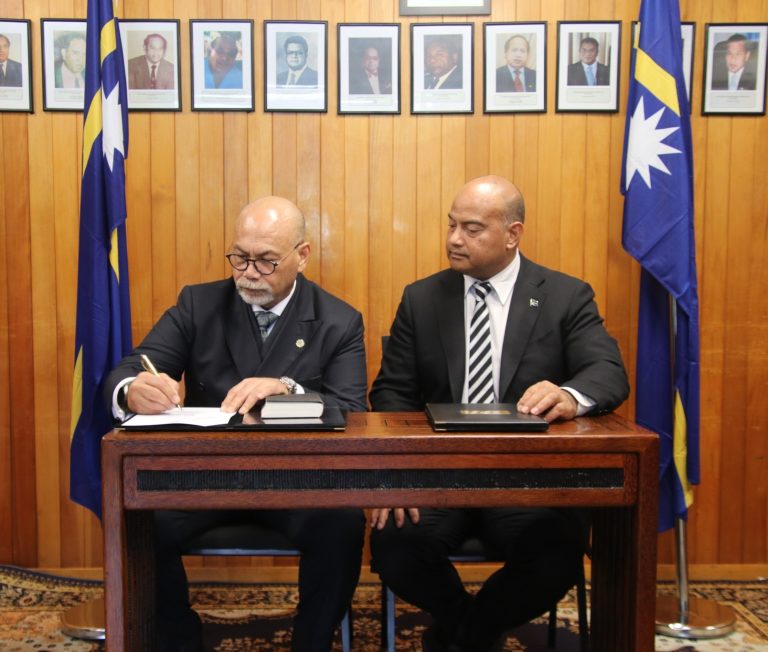
Minister Lionel Aingimea has been appointed Vice President of Nauru after Parliament passed the Constitution (Amendment) Bill 2026, creating the role.

Following the bill’s passage in Parliament Thursday, he was sworn into office.

President David Adeang said the new law marks a key step forward.

“We have taken a significant step forward in strengthening our nation’s governance and modernising our constitutional framework”.

Vice President Aingimea said the role carries serious responsibility and called for cooperation across government.

“The work that we do, we do for our country. And the work that benefits this country benefits Nauruans and all the residents here.”

The Vice President will support the President in carrying out official duties and assume responsibilities in the President’s absence.

The Constitution (Amendment) Bill, first tabled on 14 January 2026, returned to Parliament after a 90-day layover for further debate and was passed with the full support of all 18 Members of Parliament.

Tonga PM Lord Fakafānua pays tribute to late Fiji President Ratu Epeli Nailatikau

0

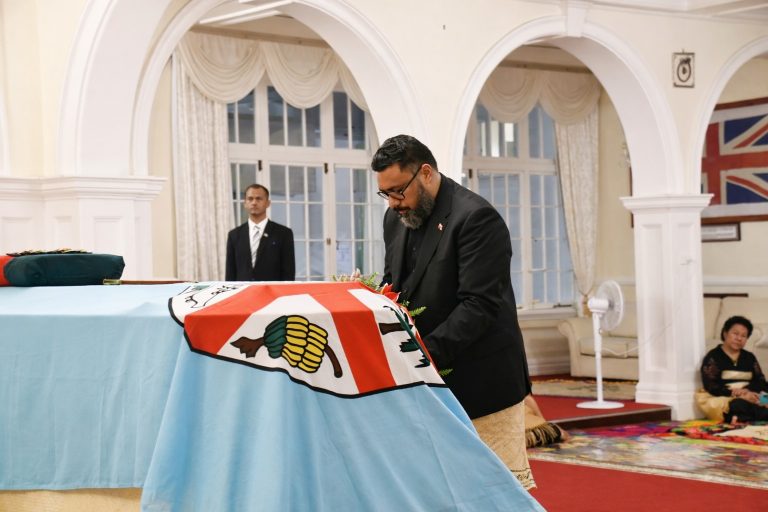
The Prime Minister of Tonga, Lord Fatafehi Fakafānua, paid his respects to the late former President of Fiji, Ratu Epeli Nailatikau, at the State House on Thursday, where the former Head of State lies-in-state.

Prime Minister Fakafānua observed a moment of solemn tribute before the casket and conveyed his condolences to the bereaved family.

The occasion reflects the close and enduring relations between Fiji and Tonga, grounded not only in shared history, but also in longstanding familial and chiefly ties, and the high regard in which Ratu Epeli Nailatikau’s distinguished service and leadership are held across the Pacific.

The Kingdom of Tonga will fly its flags at half-mast today in honour of the late former President of Fiji, Ratu Epeli Nailatikau, reflecting deep regional ties.

“The Public is hereby notified that the Cabinet has decreed that all national flags in the Kingdom of Tonga are to be flown at half-mast on Friday 17th April, 2026 in respect of the state funeral of His Excellency Brigadier-General, Ratu Epeli Nailatikau, former President of the Republic of Fiji,” said the Acting Chief Secretary and Secretary to cabinet of the kingdom of Tonga in a statement.

Widely regarded as a humble leader, Ratu Epeli was often described as the people’s president, known for walking among ordinary citizens and connecting personally with communities throughout his service.

Ratu Epeli Nailatikau’s strong links to Tonga, through his father’s heritage, further underscore the significance of the Kingdom’s tribute.

Meanwhile, a quiet sense of reverence filled the State House Thursday as Government leaders and members of the public gathered to honour the late former President, Ratu Epeli Nailatikau.

Prime Minister Sitiveni Rabuka led the viewing, followed by Deputy Prime Minister, Viliame Gavoka and fellow ministers, assistant ministers, and Members of Parliament, each arriving in solemn reflection to pay their respects.

Senior officers of the Republic of Fiji Military Forces, including former commanders, joined members of the diplomatic corps and Government representatives in signing the condolence book, offering heartfelt messages of sympathy before proceeding to the casket.

Inside, a deep silence settled over the room. One by one, leaders paused with bowed heads, reflecting on the life of a man who served Fiji with distinction as President, as Commander of the Republic of Fiji Military Forces, and as a statesman whose legacy will endure for generations.

Members of the public also turned out in large numbers, respectfully observing protocols as they came to pay tribute.

Ratu Epeli Nailatikau State Memorial Church Service will be held at Albert Park this morning.

Following the church service, a ceremonial procession will move through Suva City before he is laid to rest at the Sautabu on Bau Island, a final journey for a leader whose life was defined by service, dignity, and unwavering commitment to Fiji.

PM Manele in Fiji as Parliament deadline looms; Opposition slams “blatant defiance” of Court order

0

The Solomon Islands is currently gripped by a constitutional standoff as the 28-member Opposition coalition accuses Prime Minister Jeremiah Manele of a “blatant disregard for a lawful court directive.”

This follows the Prime Minister’s departure for Fiji despite a High Court mandate requiring him to convene Parliament within three days.

The coalition views this conduct as a grave disrespect to the rule of law and a serious undermining of the judiciary, noting that the court-ordered deadline is set to lapse this Friday.

In a statement, the coalition argued that the Prime Minister’s departure in the face of such a deadline raises “profound constitutional questions regarding compliance with binding judicial directions and the obligations of the executive under our democratic system.”

They further characteriSed the situation as an “international embarrassment,” claiming it reflects a “serious erosion of leadership responsibility” for a leader they allege is leading a minority government. Their message remains firm: “The Constitution must be obeyed. The Court must be respected. Parliament must sit.”

Prime Minister Manele is currently in Fiji chairing a Troika meeting as the Chair of the Pacific Islands Forum and is expected to return to Honiara tomorrow.

However, his legal team has already moved to challenge the ruling, filing an appeal and an application for a stay of the High Court’s order on Wednesday.

The High Court was scheduled to hear the application for a stay on Thursday.

While the executive seeks to stall, the Governor-General, Sir David Tiva Kapu, has indicated his readiness to step in.

In a letter dated 15 April, Sir David acknowledged the Chief Justice’s orders, stating that if the Prime Minister fails to act, he “may exercise my residual constitutional powers as a last resort safeguard to convene Parliament therewith.”

He clarified the timeline, noting that “The 3 days that the High Court has ordered the Prime Minister to convene parliament will lapse on Friday this week. Therefore, I may exercise my residual constitutional powers after the lapse of the 3 days if the Prime Minister fails to convene Parliament for a meeting.”

However, the Governor-General also noted that the Prime Minister’s legal maneuvers could complicate the process.

He observed that the pending appeal “may also hinder any action on my part if the Court of Appeal stays the order of the High Court.”

Despite this, Sir David maintained his commitment to the judicial process, concluding that “I will exercise my powers to convene parliament at the appropriate date and time.”

Ultimately, the immediate path forward for the nation and the Governor-General’s next steps remain uncertain, as the final outcome depends on the application for stay.

UN pushes action on resilience for LDCs and SIDS

The United Nations ESCAP Pacific Office and UN-OHRLLS say countries must move from commitments to action as climate risks and development pressures intensify across the Asia-Pacific.

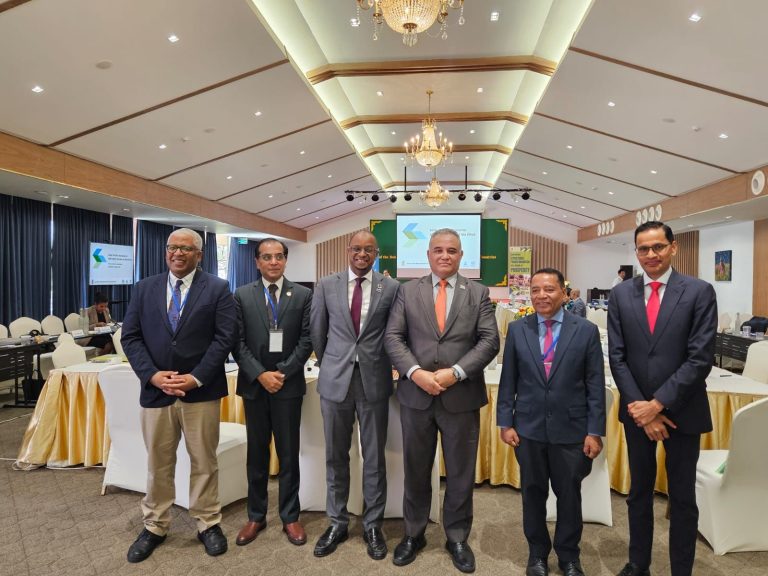
Leaders and partners met in Cambodia to assess progress under the Doha Programme of Action and sharpen focus on delivery.

“At its core, the meeting was driven by a shared ambition to ensure that no country is left behind on the journey toward sustainable development and resilience.”

Discussions centred on six priority areas, including poverty reduction, innovation, climate resilience, and global partnerships, with a strong focus on practical outcomes.

Representing the UN in Micronesia, Resident Coordinator Mamadou Kane stressed that climate action must go beyond single sectors.

“Climate resilience must be understood as a whole-of-society transformation, touching health, education, gender equality, economic diversification and cultural continuity.”

The meeting also brought renewed attention to the Pacific, where vulnerabilities remain high.

“In Micronesia, Kiribati stands as the region’s only LDC, positioned on the front lines of the climate crisis.”

Officials said countries are already taking steps to strengthen resilience with UN support.

“With the support of the UN system, countries are strengthening early warning systems, safeguarding livelihoods and unlocking climate finance to build a more resilient future.”

The issue of LDC graduation was also flagged as critical.

“The meeting also underscored the importance of getting graduation right, including ongoing reviews of country eligibility and the need for strong transition strategies to ensure progress is sustainable and resilient.”

As attention turns to the 2027 global review, the message from the meeting was clear.

“Progress is possible, Partnerships are powerful and resilience is within reach”

Officials said urgency remains, but so does confidence in regional cooperation.

“Together, from Micronesia to the wider Asia-Pacific, we can turn today’s challenges into tomorrow’s strength.”

Stay connected

529FansLike
172FollowersFollow
156SubscribersSubscribe
- Advertisement -