


The International Monetary Fund (IMF) says rising oil and gas prices linked to the Middle East conflict are set to weaken growth, raise inflation and strain economies across Asia and the Pacific, with small island states among the most exposed.
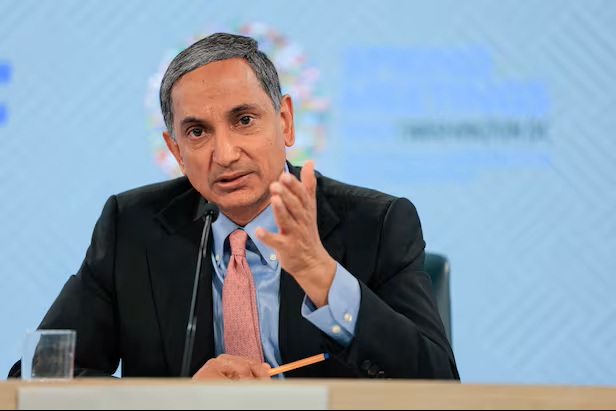
Speaking at a press conference during the Spring Meetings, IMF Asia and Pacific Director Krishna Srinivasan said the region entered 2026 strong but now faces mounting pressure from an energy shock.
“Asia entered 2026 on a solid footing with growth remaining resilient despite the region bearing the brunt of U.S tariffs and heightened uncertainty. However, given the region’s high fossil fuel intensity and reliance on the conflict areas for key commodities, the new energy shock will have a negative impact on the region. The shock is raising inflation, weakening external balances, tightening financial conditions, and narrowing policy space.”
He said growth held up through late 2025, driven by exports and consumption.
“If you look at the chart here, growth across most Asian economies turned out stronger than expected in late 2025. This is in large part thanks to exports and consumption, which held up better than anticipated, supported by accommodative policies and financial conditions.”
Srinivasan said strong demand for technology goods helped offset weaker trade with the United States.
“With regard to exports, much of the recent strength has been driven by robust demand for tech goods… Asia’s exports to the U.S declined, but that to the rest of the world increased.”
But he warned the situation has shifted with rising energy prices.
“In the context of the war in the Middle East, all oil and gas prices have risen sharply, and there’s considerable uncertainty about how persistent the shock will be.”
He said the region is highly exposed due to heavy energy use and import dependence.
“The use of oil and gas amounts to about 4 percent of GDP for the region as a whole… this is nearly double Europe’s share.”
“Altogether, net oil and gas imports amount to about 2.5 percent of GDP for the region, rising to about 8 percent for some economies such as Singapore and Thailand.”
He added that supply chain risks are also growing.
“Disruptions of fertilisers and petrochemical inputs… can create broader supply chain pressures if the conflict persists.”
Despite the shock, Asia is still expected to drive global growth, although momentum is slowing.
“Regional growth is projected to moderate from 5 percent in 2025 to 4.4 percent in 2026 and 4.2 percent in 2027.”
“Inflation is projected to rise from 1.4 percent in 2025 to 2.6 percent in 2026 and to ease 2.4 percent in 2027.”
Srinivasan warned risks are now “firmly to the downside,” especially for vulnerable economies.
“This matters in parts of South Asia, Southeast Asia, and key among the Pacific Island countries.”
He said countries heavily reliant on imported fuel face the greatest risk.
“Economies that depend heavily on imported energy use are especially vulnerable.”
Under worse-case scenarios, the impact could deepen.
“This leads to a cumulative output loss of about 0.8 percent by 2027 for the major Asian economies… In the most severe scenario… cumulative output losses of almost 2 percent by 2027.”
He said policymakers must act carefully to manage the shock.
“The near-term priority is to absorb the shock while preserving space and price signals.”
On monetary policy, he said flexibility is key.
“But monetary policy should remain agile. A prolonged energy shock could weaken currencies and generate more persistent inflation.”
On fiscal policy, he warned against broad subsidies.
“Broad fuel subsidies, tax cuts, and general price caps may smoothen inflation in the short run, but they are costly, distortionary, often regressive, and very hard to unwind.”
Srinivasan said targeted support is the better option.
“Fiscal support should be temporary, with sunset clauses targeted to vulnerable households and viable firms.”
He also stressed the need for long-term reforms to build resilience.
“This shock strengthens the case for structural reform. It does not weaken it.”
He pointed to the need for better skills, stronger safety nets, and energy transition.
“We have been calling across Asia for stronger social safety nets… and last but not least, investment in alternative energy sources, energy efficiency, and power grids.”
Srinivasan said the region must act now to manage immediate risks while preparing for the future.
“So the near-term task is to absorb the shocks while preserving price signals and policy credibility. The medium-term task is to build a more resilient, more balanced, and more inclusive growth mode,” he said.