Home Blog Page 1236

Samoa’s female PM challenger set for rerun after gender quota row

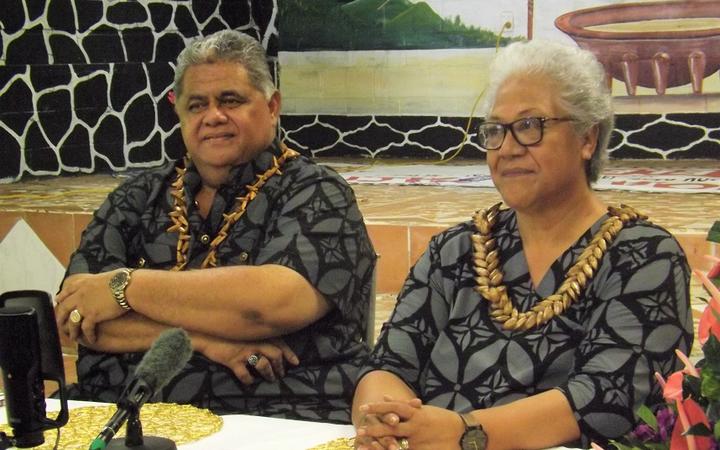
Samoans could elect their first woman prime minister later this month in the rerun of an April general election that was overshadowed by controversy over the use of gender quota rules in the small Pacific island nation.

A new party led by Fiame Naomi Mata’afa, who was bidding to become Samoa’s first female premier, had been headed for a one-seat majority until electoral authorities gave the ruling party an extra lawmaker to meet a 10 percent female representation rule.

That led to a 26-seat tie between Fiame’s opposition Fa’atuatua i le Atua Samoa ua Tasi (FAST) and the long-governing Human Rights Protection Party (HRPP) of Prime Minister Tuilaepa Sailele Malielegaoi.

FAST has filed several legal appeals over the result, but in an apparent effort to overcome the controversy, the twin-island nation’s head of state said on Tuesday the election should be held again on 21 May.

The Samoa Electoral Commission did not respond to requests for a comment.

Samoa, which has a population of about 200,000, lies in a region with one of the world’s lowest levels of female political participation.

While Samoa elected its first female MP in 1970, women have always been under-represented in parliament, prompting the introduction of the gender quota law in 2013, said Kerryn Baker, a research fellow at the Australian National University.

She said it was “really unfortunate” that the 10% quota law had become mired in controversy due to the result of the April election.

“It would be incredibly ironic if a generous interpretation of this law means that Samoa’s first woman prime minister isn’t appointed,” she told the Thomson Reuters Foundation.

To run for parliament in Samoa, which lies more than 1,000 km (600 miles) north-east of Fiji, candidates must have a traditional high chief or matai title, which tends to favour men.

Currently, about 90 percent of parliamentary candidates are male, Baker said, adding that women and girls were far better represented in other parts of Samoan society such as education.

Political analysts said a potential victory for Mata’afa’s newcomer party in the election rerun would mark a sea change in Samoan politics, and could boost women’s participation in government in years to come.

“This would be a huge form of women’s empowerment, as women in Samoa would be able to visually see a female as the commander and chief of their country,” said Lefaoali’i Dion Enari, a Samoan chief and researcher at Australia’s Bond University.

Still, Jonathan Pryke, director of the Pacific islands programme at the Lowy Institute in Sydney, said the outcome of a second poll could be vastly different from the first ballot – with the ruling party likely to change tactics.

“(But) the outcome of this election, regardless of who forms government, has changed the political landscape in Samoa for good,” Pryke said.

SOURCE: REUTERS/PACNEWS

Samoan Head of State intervenes, calls for fresh elections

Samoans woke up to the news today that they will go back to the polls in just over two-weeks’ time, on 21 May 2021.

Calling for fresh elections was the best legal way forward for the Head of State, Tuimalealiifano Vaaletoa Sualauvi II, after he met with the leaders of the two major political parties, Tuilaepa Sailele Malielegaoi of Human Rights Protection Party (HRRP) and Fiame Mata’afa of the Fa’atuatua i le Atua Samoa ua Tasi (FAST) Party.

“Separately, a delay in forming Parliament may affect our regional and international responsibilities and effectiveness of our partnership arrangements.

“The uncertainty regarding the results of the elections has affected every fabric of our society, said the Head of State.

Samoa went to the polls on 09 April and elected 26 members each of the two parties – resulting in a deadlock and a hung government with the additional seat for women now before the Court for determination.

“On Friday, 09 April 2021, our country went to the polls to select for ourselves the 17th Parliament for Samoa. To date, the 17th Parliament has yet to convene.

Some 28 petitions have been filed by candidates seeking to question the 2021 General Elections.

“Essentially, the Courts will determine the election of 29 seats of Parliament, including the additional seat for women representing more than 50% of the Membership of Parliament. The political discourse has done little to assist matters.

“Political leaders and supporters on both sides have laid serious accusations against the impartiality of the Court, lessening the appearance of that arm to discharge its constitutional and common law functions to interpret and apply our laws. Whatever the outcome of the petitions, the decisions of the Courts will be questioned and viewed through that prism, said the Head of State.

Tuimalealiifano Vaaletoa Sualauvi II said the 2021 General Elections has provided an insight into the robustness of our political system which is now in limbo.

“Of great interest is the influence from the Samoa diaspora through social media and innovative incentives. Only history will determine the extent of that influence on the 2021 General Elections, whether negatively or positively.

He said the operation of government remain uncertain given the time it will take deliberate on the court challenges.

“By June 2021, the financial year 2020/2021 will come to an end, and with it the ability of government to pay salaries of its employees, meet its expenses and pay for services- including essential services such as health and education. If the 2021/2022 budget is not tabled and passed, it will have overreaching effects on the everyday functions of Government, including its ability to respond to the Covid19 pandemic and sustain its current responses.

“Having taken into account the consideration that I have referred to above, I am of the firm belief that given the fact that there is no majority to form a Parliament, it is in the best interest of Samoa that fresh elections be called to allow our people a second opportunity to elect for itself its 17th Parliament.

“Today, by Writ, I directed the Office of the Electoral Commission to issue a Public Notice of the Writ for Election of Members of Parliament for all Constituencies and have appointed Friday 21 May 2021 as the day of Election.

“In doing so, I hereby revoke the Warrants of Appointments issued on 12 March, 16 April and 20 April 2021 in relation to the General Election held on 09 April 2021, said Tuimalealiifano Vaaletoa Sualauvi II.

Just over 128,800 eligible voters will cast their votes again to elect 52 members of Samoa’s 17th Parliament

SOURCE: PACNEWS

United Nations General General statement on World Press Freedom Day 2021

Statement from the Secretary General of the United Nations, Antonio Guterres to mark World Press Freedom Day 2021.
Happy #WPFD2021

The global challenges we have faced during the COVID-19 pandemic underline the critical role of reliable, verified and universally accessible information in saving lives and building strong, resilient societies.
During the pandemic, and in other crises including the climate emergency, journalists and media workers help us navigate a fast-changing and often overwhelming landscape of information, while addressing dangerous inaccuracies and falsehoods.

In too many countries, they run great personal risks, including new restrictions, censorship, abuse, harassment, detention and even death, simply for doing their jobs. The situation continues to worsen.
The economic impact of the pandemic has hit many media outlets hard, threatening their very survival. As budgets tighten, so too does access to reliable information. Rumours, falsehoods and extreme or divisive opinions surge in to fill the gap.

I urge all Governments to do everything in their power to support a free, independent and diverse media. Free and independent journalism is our greatest ally in combating misinformation and disinformation.
The United Nations Plan of Action on the Safety of Journalists aims to create a safe environment for media workers across the globe — because information is a public good.

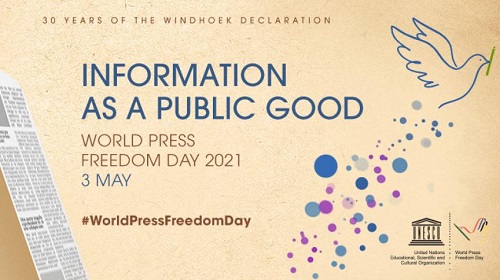
Today, we commemorate the thirtieth anniversary of the Windhoek Declaration for the Development of a Free, Independent and Pluralistic African Press. Despite dramatic changes in the media over the past three decades, the Declaration’s urgent call for press freedom and free access to information is as relevant as ever.

Let’s reflect on its message and renew our efforts to protect media freedom so that information remains a life-saving public good for all.

SOURCE: UN

Palau Media Council calls on government to support free and independent media on World Press Freedom Day

One of the hallmarks of a democratic society is free and independent media.

As we celebrate this year’s World Press Freedom Day, with the theme “Information as a Public Good,” the Palau Media Council is calling on the government to champion free and independent media.

Palau Media Council calls on the government to ensure a fair playing field by providing equal access to all; public and private media.

This year’s theme serves as a call to the government to renew its commitment to supporting the media and the importance of information as a public good.

Palau Media Council has come a long way in covering and reporting local news, it has also put Palau’s name on the
map for its independent reporting.

Freedom House has ranked Palau’s press freedom consistently in the top tier on its annual ranking. That high ranking is a result of the many independent media outlets operating in the nation.

While we welcome a strengthened government media, independent media is crucial for a fully functioning democracy.

As a group made up of small newsrooms and limited resources, we face losing our jobs or worse our companies due to challenging environment, including the pandemic, beefed-up government media, and a well-funded public communications corporation, leaving independent, media outlets behind.

Today, we urge the government to respect the role of free and independent media in the nation’s democracy, which includes ensuring the economic viability of the private media.

A state-run media strengthened through public funds can only give the public a one-sided view of information.
Therefore, we call on the government for greater access and transparency, consistent with the Open Government Act.

Press Freedom is also about providing the media with prompt and timely information.

We urge this administration, including its gatekeepers to improve collaborative relationships with independent media.

It’s time, for this administration to fulfill its promise of government transparency by supporting free and independent media.

###WPFD2021

SOURCE: PALAU MEDIA COUNCIL

“Media Workers are also COVID-19 Frontline Workers,” says PINA President

As we join the global community in marking the UNESCO 2021 World Press Freedom Day today, the Pacific Islands News Association (PINA) acknowledges the great sacrifice and commitment of our media workers in covering the COVID19 pandemic and related issues.

While our health workers have been rightfully recognised as ‘frontliners’ in the fight against COVID19, the critical frontline efforts of our media workers in bringing much-needed information and news to our people has been largely forgotten.

Much like our health sector colleagues, our media workers go about their daily work, also at high personal risk and exposure to this virus, but with the unwavering desire to inform and educate our people.

In some countries where the media is not considered a priority frontline group for vaccination, we urge these governments to vaccinate journalists to ensure they can continue to work without having to fear for their health and their lives.

Apart from personal risks to their health, our journalists are also having to deal with dangerous inaccuracies and misinformation about COVID19 from social media and from members of the public.

Some countries impose new restrictions like censorship, abuse and harassment to try and control and silence media workers from doing their job.

PINA uses today’s occasion to acknowledge and appreciate your excellent efforts, with a particular mention of our PINA regional media family members.

We stand with you and salute you all!

If not already done by our regional governments – any form of compensation to our health workers on COVID-19 – must also extend to our media workers and employers.

Like every other sector, the media industry is also experiencing some challenging times.

PINA also wants to use this special day to pay tribute to our colleagues who face intimidation or harassment, or have been injured or, tragically lost their lives while in the frontline of reporting to keep authorities transparent and accountable.

We also salute five regional media colleagues, we’ve lost recently. We remember them today for their tireless and immense contribution to the Pacific media fraternity.

1. Ricky Binihi, a well-known investigative journalist in Vanuatu, with over four decades of journalism experience, working with Vanuatu Broadcasting & Television Corporation (VBTC), Vanuatu Daily Post and the Vanuatu Weekly. He was one the pioneers of journalism in Vanuatu after independence in the 80’s. He died in January this year.

2. Glenda Popot, was heavily involved in the development of the electronic media, especially EMTV in Papua New Guinea. She worked with FM100 as its Editor before her death,

3.Alphonse Muapi, worked with the national broadcaster in Papua New Guinea, NBC before joining the Electoral Commission. He was considered an asset and bridge between the media and the Commission, during the conduct of PNG’s most immediate past two national general elections.

4. Maepeza Wickham, an experienced videographer in Solomon Islands. In a tribute from MASI President, “The loss of Peza is felt by many in the media fraternity in Solomon Islands for the many contributions he’s made to the media industry.”

5. Poliakepo Kefu – the Secretary of the Media Association of Tonga (MAT). The president of MAT, Ramanlal Vallabh said Kefu was an active member and supportive member of MAT and his demise is a huge loss to the media family in the island kingdom.

At the same time, we send our congratulations to Johnson Honimae who has returned to the mainstream media in Solomon Islands after almost 20 years to head the national broadcaster, the Solomon Islands Broadcasting Corporation (SIBC). Honimae was former President of PINA in the early 2000.

Our congratulations also goes out to the new President of the Journalist Association of Samoa (JAWS), Lagi Keresoma, who was elected last Friday. She becomes the first woman to head JAWS, replacing Rudy Bartley.

We acknowledge all your sacrifices and determination in the pursuit of “Information as a public good,” which is also the theme of this year’s World Press Freedom Day.

KORA NOU
President
Email: knou@nbc.com.pg; Tel: +675 3257175

SOURCE: PINA SECRETARIAT/PACNEWS

The Fijian Media Association statement on World Press Freedom Day 2021

The Fijian Media Association takes this moment on World Press Freedom Day to thank and pay tribute to its members for their courageous and committed reporting on the Covid- 19 pandemic which has played a key role in keeping Fijians safe from the virus.

We thank you for the sacrifices you have made, the long hours endured, for taking the flak and criticisms in your stride, for asking the questions that needed to be asked, and for the creativity to disseminate information through various platforms to the Fijian public.

We urge our journalists to keep learning and developing from the experiences gained, to keep improving their work in disseminating information to all Fijians, to work with the authorities but keep them accountable and honest, to scrutinize the decisions of our leaders and ensure they meet the highest standards, and to ensure that all voices are heard including those that are marginalised.

We thank all the key stakeholders we work with – the Government, the Opposition, the leaders of industry and civil society and the Fijian public for their support and we urge them to keep staying true to the ideals and principles of media freedom.

To our journalists – you have earned this day – World Press Freedom Day, and we are pleased to provide to all journalists these collage of messages below from the editors of the Fijian Media Association.

Stanley Simpson
General Secretary, Fijian Media Association,
Editor Mai TV

From Indra Singh – FBC News Director

“Thanking all the journalists, photographers, camera people, editors and support staff who have been working hard in ensuring Fiji is well informed in these trying times. We play an important role and regardless of the backlash faced at times for different reasons, today we come together to say we do things for our people and will continue to do so, while we put our own interests secondary, which is the passion for this job.”
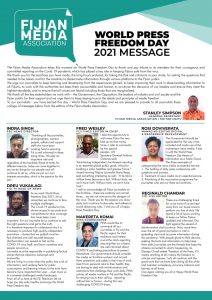
From Fred Wesley – Fiji Times Editor in Chief

I take this opportunity to wish every Fijian the very best as we face trying times. I refer to comments by two special people…UN Secretary-General António Guterres said: “Maintaining independent, fact-based reporting is an essential global public good, critical to building a safer, healthier and greener future.”

Award-winning Filipina journalist Maria Ressa said something interesting as well: “A lie told a million times becomes a fact. Without facts, we can’t have truth. Without truth, we can’t have trust.”

I wish to acknowledge all Fijian journalists on the frontline… these are certainly not normal times… we are not immune to the dangers of the virus. Thank you for the passion you show daily. Let’s continue to stay safe, and adhere to social distancing rules. I wish you all a happy Press Freedom Day.

From Rosi Doviverata, Managing Editor Digital and Readership Development

The Government should be applauded for the way it has included and made use of the mainstream news media. It ties in with the World Press Freedom Day theme of Information as a Public Good.

The three examples of catergorising the news media as essential service:

1. The holding of daily press conferences with questions and answers.

2. Treatment of news media as an essential service.

3. Prioritizing of the vaccination programme for journalists who are out there as frontliners.

From Dreu Vukailagi – Fiji TV Head of News

As we mark World Press Freedom Day 2021, let us remember we continued to face multiple challenges.

The Covid-19 pandemic has shown access to accurate and comprehensive news coverage has never been more important

For our journalist let us continue to ask the right questions and get to the truth.

It is therefore important to understand why it is necessary to produce high-quality independent journalism – stories that we publish must be fact-checked and well-sourced because disinformation can spread as fast as the COVID-19 virus itself, and harm ourselves and people around us.

Journalist must be responsible in publishing factual stories that are objective, balanced and trustworthy.

We are living in a time when the public has a lot of information, and verifying facts for public consumption and bearing witness to the truth have become more important than ever – even more so in a severely challenged media landscape.

From all of us here at the Fiji Television Ltd we hope you stay safe, healthy and enjoy the world press freedom day.

From Reginald Chandra – Fiji Live Editor

These are challenging times for us as most of us are kept away from our loved ones to perform our line of duty. We spend a lot of hours working to keep our fellow Fijians updated and informed. Our fight against the spread of disinformation shall continue. Now, more than ever, the art of good journalism is vital in spreading clear and accurate information during this pandemic. With people glued to their devices, seeking the facts and information to help keep them safe, journalists are the threads that keep the citizens connected to what’s happening. As George Orwell stated “Freedom of the Press, if it means anything at all, means the freedom to criticize and oppose.”- let’s all continue with the good work that we have been doing all this while and maintain consistency, accuracy, balance and fairness at all times.

Once again wishing you all a Happy World Press Freedom Day.

From Makereta Komai – PINA Coordinator

PINA would like to commend all our journalists in Fiji and the Pacific region for their resilience and tireless round the clock reporting ensuring that our citizens are well informed about COVID19 and taking precautions to protect themselves. Our governments should consider the media as ‘frontline workers’ and accord them protection and safety in their line of work. Apart from personal risks to their health, they are having to deal with misinformation and restrictions that challenge their work daily. PINA salutes all media workers in Fiji and the Pacific for staying true to their calling – reporting without fear or favour – during this very challenging COVID19 times.

SOURCE: FMA/PACNEWS
Dame Meg Taylor’s Pacific Islands Forum Legacy

0

Written by Greg Fry

At the centre of the recent crisis in Pacific regionalism has been a high stakes tussle over the appointment of the next Pacific Islands Forum Secretary General. As is the case with the United Nations Secretary-General, the role of the Forum Secretary General has expanded significantly beyond the narrow managerial role prescribed in the founding agreement – that of chief public servant in charge of the secretariat, and secretary to the Leaders’ meeting – to a more proactive, representational, and diplomatic, role in advocating for Pacific island country interests in a rapidly changing global context.

Dame Meg Taylor has taken this broader interpretation of the role to a new and impressive level. Her very significant contribution over the past six years is however in danger of being overshadowed by the controversy over the appointment of her successor. The decision of the Micronesian states to give notice of their intention to leave the Forum should not be seen, however, as affecting Dame Meg’s important legacy. The selection of the Secretary General and the criteria on which it is based is a matter for the Pacific leaders, not the Secretary General.

Dame Meg came to the position in late 2014 with an impressive record of international and national public service as the Papua New Guinea Ambassador to Washington and as a Vice President at the World Bank Group, among other achievements. After two three-year terms, she finishes in the role this month.

She took up the role at a particularly challenging time for the organisation, and for the region. The Forum’s political legitimacy was in question. The guiding strategy of the Pacific Islands Forum, the Pacific Plan, had failed to capture the imagination of Pacific leaders and the broader Pacific society. It had not resulted in any tangible benefits. There was also the perception on the part of Pacific leaders that Pacific regionalism was no longer controlled by them. The regional agenda was seen increasingly as a technocratic program set by public servants in the regional agencies, and in Canberra and Wellington. Furthermore, civil society groups felt excluded from the regionalism project. The hopes of political leaders and civil society for a different future were contained in the Morauta review report on the Pacific Plan released just before Dame Meg took up the post.

A second enormous challenge to the Forum’s existence was posed by Fiji’s 2014 threat not to return to the Forum unless Australia and New Zealand were asked to leave. In the meantime, Fiji sponsored and revitalised three regional organisations in direct competition with the Forum: the Pacific Small Islands Developing States grouping, the Pacific Islands Development Forum, and the Melanesian Spearhead Group. This development of an alternative regional architecture was a threat to the Forum’s continued existence and placed the future of all Pacific regionalism in a state of flux.

In supporting the Pacific leaders to navigate their way through these existential challenges, Dame Meg has been guided by two key principles, which she distilled from the Morauta Report. The first principle was that Pacific leaders should have full ownership of their regional agenda and structures. The second principle was that of inclusion, the idea that regionalism needed to have wider ownership amongst the peoples of the Pacific and their civil society organisations.

Her passionate public defence of the right of Pacific islanders to control the regional agenda affecting their lives is a major mark of her tenure. This principle informed many of the initiatives she championed as Secretary General: the reform of the Forum’s financial arrangements to ensure majority financial contribution by Forum island countries; the reconfiguration of Forum processes to ensure that it would deliver a prioritised regional agenda for consideration by the leaders via a new Framework for Pacific Regionalism; the advocacy for, and achievement of, a Pacific Resilience Facility managed by Pacific island states; and the implementation of the Pacific Humanitarian Pathway on COVID-19.

This commitment culminated in her passionate advocacy and development of the Blue Pacific Narrative, introduced by Samoa as Forum Chair in 2017. At the heart of this narrative has been a desire to ensure that the countries of the Pacific effectively retain their sovereignty and their ability to determine their future. It is a narrative that has captured imaginations around the region and globally. This is a major legacy because of the way in which Dame Meg has represented this so effectively to Pacific and wider audiences as well as reconfiguring the Secretariat to support the leaders in developing the 2050 Strategy for the Blue Pacific Continent.

This positioned the Pacific islands region well to assert their own security narrative, built on the self-determination principle and a broader notion of human security, when Western countries later began to promote an Indo-Pacific strategy, including an attempt to subsume the Pacific islands region within it.

Also in line with her commitment to the principle of regional self-determination, Dame Meg provided leadership in repositioning the Forum Secretariat as an organisation in support of the collective diplomacy of the Pacific states. This move away from a preoccupation with regional economic and security integration, to a role to help the leaders in their joint diplomatic efforts to face the geopolitical and economic changes posed by a rapidly changing global context, is a very important legacy of her tenure.

In relation to the second Morauta principle, that of inclusion, Dame Meg has been a passionate advocate of civil society participation in Forum processes including in agenda-setting, consultations during the Forum summit, and consultations in relation to key policy initiatives such as in the lead up to the making of the Pacific Resilience Facility and the Boe Security Declaration. As outlined in the FPR, she also oversaw a public policy process in which the people of the Pacific, the general public, civil society, private sector, academia and others, were invited to put forward submissions on regional issues they felt were of concern. In her public diplomacy Dame Meg frequently emphasised the importance of keeping the ‘Pacific peoples’ front of mind in regional policy deliberations.

These principles were also evident in the way Dame Meg repositioned the Forum Secretariat to support a number of formidable political/policy challenges during her tenure including: the growing discord between Australia and New Zealand, on the one hand, and the Pacific island states on the other, over Pacific climate policy; the geopolitical anxieties of Western states in relation to China’s involvement and the associated debate over the redefinition of regional security; and the health challenge of COVID-19 and its impact on Pacific economies.

For example, in relation to regional security, Dame Meg oversaw very extensive regional consultations and put forward a formula for a regional security treaty for a new era based on principles of human security with climate change as the number one priority. This achievement, which she shares with the leaders, is expressed in the Boe Declaration.

This recalibration of the regional architecture in line with these principles of self-determination and inclusion, and their application in relation to navigating key policy challenges, have gone a good way in resolving the existential challenges to the Forum which were confronting the organisation at the beginning of her tenure. It has not only resulted in a restored legitimacy of the Forum in the eyes of leaders and civil society; it also saw the end of the existential threat from the Fiji-backed regionalism. By the end of her tenure, Fiji had returned to the Forum family, perhaps because the Forum was now seen as representing the values that Fiji had been promoting as the basis for an alternative regionalism, that of self-determination and inclusion.

Finally, and not least, it has mattered for the expanding role of the Secretary General position that Dame Meg is the first woman in this role. This is undoubtedly an important legacy for Pacific women and for the principle of gender equity in regional leadership positions.

Dr Greg Fry is Honorary Associate Professor at the Department of Pacific Affairs, Australian National University. He is the author of Framing the Islands: Power and Diplomatic Agency in Pacific Regionalism, ANU Press, 2019; and co-editor (with Sandra Tarte) of The New Pacific Diplomacy, ANU Press, 2015.

SOURCE: DEVPOLICY.ORG/PACNEWS

NZ, Cook Islands travel bubble significant step in COVID-19 recovery

0

New Zealand Prime Minister Jacinda Ardern and Cook Islands Prime Minister Mark Brown have today announced that, pending final confirmation by New Zealand’s Director-General of Health and the Cook Islands Secretary of Health, two-way quarantine-free travel will commence between the two countries on 17 May (NZT).

“Two-way quarantine-free travel is a significant step in both countries’ COVID-19 recovery, and a direct result of both New Zealand and the Cook Islands’ successful response to the pandemic,” Jacinda Ardern said.

“It will mean families can reconnect, commercial arrangements can resume and Kiwis can take a much-welcomed winter break and support the Cook Islands’ tourism sector and recovery.

“That we can take this step in our recovery so soon after opening the trans-Tasman bubble highlights the benefits of our COVID-19 management, and the opportunities it is now providing New Zealand and our neighbours.

“This is a world-leading arrangement and it’s important to remember many other countries still have bans in place on travel for holiday purposes.”

Jacinda Ardern said a huge amount of work had gone into ensuring the two-way bubble was safe and that the Cook Islands was set up and ready for it.

“The health and safety of the people of the Cook Islands has at all times been paramount.

“Vaccination, while not an answer on its own, will provide an added layer of protection once rolled out, and we continue to advance these plans alongside the Cook Islands,” said Jacinda Ardern.

“The confirmation of 17 May for the commencement of two-way quarantine-free travel between the Cook Islands and New Zealand is the result of our uncompromising commitment to ensuring all necessary health and border measures are instituted to the highest standards of protection against COVID-19 prior to commencement,” Mark Brown said.

“Since my visit to New Zealand at the end of March, and various engagements with Prime Minister Ardern and members of her Cabinet, we have jointly elevated effort towards bolstering readiness and response capabilities against COVID-19 in preparation for the safe resumption of two-way quarantine-free travel between our countries.

“The learnings from the trans-Tasman arrangement have informed further bolstering of response capabilities by both Governments in preparation for commencement of the Cook Islands – New Zealand quarantine-free travel arrangement.

“In close partnership with New Zealand, we are continuing to work through final details for the deployment of vaccines to the Cook Islands and expect to provide further details on the vaccine roll-out within the next week few weeks.

“I acknowledge with deepest gratitude our people’s continued trust in our leadership and whole of society endeavour to keep our people safe from the virus, and the incredible work of a steadfast team of committed officials working in close partnership with our community and industry and their New Zealand counterparts.
“Today we start our journey of recovery. Today we get back to business. Today with our joint confirmation of the 17 May, we give our people, and particularly our industry the certainty necessary to institute remaining preparatory steps to once more welcome visitors to our shores.”

Commencement of the bubble is subject to a final set of criteria being met, including airline and airport preparedness, all necessary protocols and frameworks being in place, and final sign off from the New Zealand Director-General of Health and the Cook Islands Secretary of Te Marae Ora – Ministry of Health.

SOURCE: COOK ISLANDS GOVT/PACNEWS

Domestic terrorists declare war with state: PNG Police Commissioner Manning

The attack on police and burning of 13 police houses in Milne Bay last week is an act of terrorism and will be dealt with swiftly and strongly, says Papua New Guinea Police Commissioner David Manning.

“These are not your common criminals but are terrorists and will be dealt with as such,” he said adding that the terrorists had declared war on the Independent State of PNG,” Manning said.

“We will bring the full force of the government down hard on these terrorists.

“All resources at our disposal as well as manpower will be committed to hunting them down.

“They can run, but they cannot hide. Their days are numbered,” he said, adding the PNG Defence Force has been called out to help police hunt them.

Manning said he had directed acting deputy commissioner of Police and chief of operations Donald Yamasombi to use all available police resources and manpower to flush out and capture the terrorists.

“Two police mobile squads, including the Air Tactical Unit and Water Police will be deployed.

“They will be joined by additional manpower from the PNG Defence Force.

“They have gone too far and must be stopped. People who are supporting these terrorists must understand that the terrorists are undermining and threatening the national security of PNG and must be stopped,” the commissioner said.

Alotau MP Charles Abel has asked for the declaration of a state of emergency in the province.

“There are ongoing issues that are violence-related,” Abel said.

“After the unfortunate incident on Friday night, we are looking at the state of emergency option.

“It is being processed by the Government now and I am supporting that option.”

A man was reported dead and others injured, including two police officers, after the exchange of fire with police from Thursday night to early Friday morning.

The gang members were allegedly led by wanted criminals Tommy Maeva Baker and Michael Yawi.

Police managed to secure the town of Alotau after driving out the gang members estimated to be more than 50.

Shops were broken into allegedly by the thugs, hotels were targeted and the Water Police barracks burned down.

Meanwhile, declaring a state of emergency (SOE) in the National Capital District (NCD) as a short-term solution and option to stem ethnic violence is being discussed with the Government, Police Comm David Manning says.

“We are also suggesting to revisit the introduction of the Vagrancy Act, but this time as a provision under a proposed Internal Protection and Security Act,” he added.

Manning’s remarks follow the latest fight between two ethnic groups that has claimed two lives in a week.

The commissioner has called on the leaders of the Goilala (Central) and Hela people to end the bloody and deadly ethnic clashes in the nation’s capital.

“The recent ethnic clashes have caused so much fear and anxiety within communities in the NCD in the last three days,” he added.

“While police are out on the streets of Port Moresby to prevent further blood-shed and maintain public order and peace, real and lasting peace and normalcy can be restored with the assistance of the leadership of both groups at the family, clan, tribal, ward, district, provincial and national levels.

“These ethnic clashes have been going on for some time now between various ethnic groups within the NCD and in other parts of the country.

“We need to seriously look into these clashes and identify the underlying causes.

“While drugs and alcohol may be contributing to the clashes, there could be other reasons as well.

“Law and order is not an exclusive police responsibility but is everyone’s business as well.

“So leaders at all levels of society must step up and take responsibility,” he said.

Manning, who is also the Covid-19 national pandemic response controller, said the virus had to date claimed 115 lives and infected more than 10,000 people, including frontline workers.

He said health facilities nationwide were overwhelmed with addressing the Covid-19 and ongoing health concerns and the last thing it needed were additional patients injured from ethnic clashes.

“These ongoing ethnic clashes are symptoms of serious underlying problems within our country and we all need to begin to seriously address them instead of expecting them to go away,” he said.

SOURCE: THE NATIONAL/PACNEWS

Pacific Anti-Corruption Journalists call for regional commitment to Media Freedom

0

Marking World Press Freedom Day 2021, the Pacific Anti-Corruption Journalists Network (PACJN) has called for a regional Pacific commitment to boost media freedom and help increase reporting on activities at risk of corruption.

PACJN coordinator, Samisoni Pareti, welcomed the focus on media freedom on 3 May and called for a greater focus on how to implement that freedom.

“Pacific journalists need stronger Right to Information legislation and whistleblower protection so their daily work can better target the diversion of state and private sector funds into corrupt hands,” said Pareti.

“Our journalists have worked hard to get governments to host more regular media conferences during the onset of COVID so not only misinformation, but real procurement problems can be addressed quickly.

“But journalists need to be able to rely on their own independent reporting, without fear or favour, not just media conferences,” said Pareti.

In 2021 PACJN is delivering a media strengthening project for anti-corruption journalists in Pacific Island Countries. PACJN training sessions so far have addressed Anti-Money Laundering, Whistleblowing, Public Reporting and Health Procurement.

PACJN’s media strengthening work is being delivered by the Pacific Islands News Association (PINA), which is supported by the United Nations Pacific Regional Anti-Corruption (UN-PRAC) Project, a joint initiative by UNODC and UNDP supported by the Australian Government and the New Zealand Aid Programme..

SOURCE: PACJN/PACNEWS

Stay connected

529FansLike
172FollowersFollow
156SubscribersSubscribe
- Advertisement -