Home Blog Page 1111

Five new Fijian Drua players announced

0

The Fijian Drua have bolstered their forward stocks for Super Rugby Pacific 2022, with five new additions to the roster announced today.

Headlining today’s announcement is 47-cap Flying Fijians prop Manasa Saulo. He is joined by current Flying Fijians tighthead Samuela Tawake, Fijian 7s star Kitione Salawa Junior, Suva lock Sorovakatini Tuifagalele, and Melbourne Rising and NSW Waratahs squad member Joseva Tamani.

Fijian Drua Interim CEO Brian Thorburn congratulations the five new players for making the squad: “Depth in the forwards is crucial in Super Rugby and we are delighted to announce five players who will be eager to impress the coaching staff during the pre-season which starts in November.

The five players today demonstrated yet again Fiji Rugby’s solid player development pathways; they’ve worked their way through the ranks and are ready to show their wares for our Club.”

Thorburn gave further details of the new squad members who will be part of the Fijian Drua’s historic Super Rugby campaign in 2022.

“We are delighted to reveal our most senior squad member in Manasa Saulo. As Drua No. 23, he brings a vast wealth of knowledge and experience to what will be a very young squad. He has been to two Rugby World Cups and fans will remember him as part of a scrum that surprised the Wallabies in 2015.

Manasa is a real product of the Fijian rugby system, having been a part of the national age-group teams, Sukuna Bowl and provincial rugby. He is also an international journeyman, playing

the top-level competitions of France with Toulon and the UK with London Irish. His experience will be invaluable.”

“Drua No. 24, Samuela Tawake, is one of our rising stars who has already earned a Flying Fijians cap. He also came through our U20s programme, has played for Canterbury and Manawatu in New Zealand’s NPC, and is well known for both his scrummaging and mobility around the park. We know he will fight hard for a place in our matchday squads.”

“Drua No. 25, Kitione Salawa Junior, is a star from our domestic competition and 7s programme. At just 20, he was a strong contender for a place in that final squad to the Tokyo Olympics. He is young, fit, and is absolutely eager to go. In a squad of talented backrowers, I expect that he will make the coaching staff take notice.”

Drua No. 26, Sorovakatini Tuifagalele is Suva’s Skipper cup-winning lock. He brings his strong domestic rugby and Fijian Latui experience, along with his try scoring prowess to our squad. He has been consistent in his local performances and now has the opportunity to make a name for himself in Super Rugby. It is always a proud moment for all of us at the Fijian Drua and Fiji Rugby when a homegrown talent like him is rewarded with a professional contract.”

Finally, Drua No. 27 is talented flanker Joseva Tamani, who is also a lock option. After making waves for Ovalau domestically, he has been with the Melbourne Rising in Australia’s NRC competition. He has also been part of the wider NSW Waratahs squad as an injury cover in 2021 Super Rugby, so has already been exposed to this environment. Joseva is another one of those forwards who can run like backs that Fiji is blessed with, and we’re excited about what he brings to the Fijian Drua.”

The Club expects to make another wave of player announcements in the coming days.

SOURCE: FRU/PACNEWS

UN chief calls for bold action to end ‘suicidal war with nature’

With more than a million species at risk of extinction, countries must work now to achieve a sustainable future for people and the planet, Secretary-General António Guterres told leaders attending the UN Biodiversity Conference, which opened on Monday from Kunming, China.

“We are losing our suicidal war against nature,” he said in a video message to the meeting, which is mainly being held virtually.

The UN chief warned that “humanity’s reckless interference with nature” will have permanent consequences.

“The rate of species loss is tens to hundreds of times higher than the average of the past 10 million years – and accelerating. Over a million species of plants, mammals, birds, reptiles, amphibians, fish and invertebrates are at risk – many within decades,” he said.

“Ecosystem collapse could cost almost US$3 trillion annually by 2030. Its greatest impact will be on some of the poorest and most highly indebted countries,” he added.

The conference, known as COP15, will develop a global roadmap for the conservation, protection, restoration and sustainable management of biodiversity and ecosystems for the next decade.

“COP15 is our chance to call a ceasefire,” said the Secretary-General. “Together with COP26 on climate, it should lay the foundations for a permanent peace agreement”.

A new Global Biodiversity Framework can put nature, and people, back on track, he said, emphasising that it should work in synergy with the Paris Agreement on climate change, and other international accords on forests, desertification and oceans.

The UN chief outlined five areas for action at the conference, starting with supporting everyone’s legal right to a healthy environment. This includes the rights of indigenous peoples, who he described as “stewards of biodiversity”.

The framework must also support national policies and programmes that tackle the drivers of biodiversity loss, especially unsustainable consumption and production.

It must work to transform national and global accounting systems, so they reflect the true cost of economic activities, including their impact on nature and climate.

“Delivering the post-2020 framework will require a package of support to developing countries, including significant financial resources and technology transfer,” he said.

“And fifth, it must end perverse subsidies, including to agriculture, that make it profitable to attack nature and pollute our environment. These funds should be redirected into repairing the damage that has been done”.

Guterres said action in these five areas will go far beyond biodiversity, as they will contribute to global efforts to achieve sustainable development.

He pointed to the future, urging delegates to be bold and ambitious, for the benefit of generations to come.

“Young people stand to lose most from the devastation of natural environments and the loss of species,” he said.

“They are crying out for change. And they are mobilizing for a sustainable future for all. They, and we, are counting on you”.

The UN Biodiversity Conference consists of three concurrent meetings. In addition to COP15, meetings of the Parties to the Cartagena Protocol on Biosafety, and the Nagoya Protocol on access and sharing of genetic resources, are also taking place.

The conference is being held in two phases. The current segment runs through Friday, and will be followed by in-person meetings in Kunming from 25 April to 08 May 2022.

SOURCE: UN NEWS CENTRE/PACNEWS

COP26 : World poised for big leap forward on climate crisis, says U.S special envoy John Kerry

The world is poised to make a big leap forward at the UN COP26 climate summit, with world leaders “sharpening their pencils” to make fresh commitments that could put the goals of the 2015 Paris agreement within reach, John Kerry has said.

Kerry, special envoy for climate to Joe Biden, gave an upbeat assessment of the prospects for COP26, which begins in Glasgow at the end of this month, saying he anticipated “surprising announcements” from key countries.

“The measure of success at Glasgow is we will have the largest, most significant increase in ambition [on cutting emissions] by more countries than everyone ever imagined possible. A much larger group of people are stepping up,” he said in an interview with the Guardian.“I know certain countries are working hard right now on what they can achieve.”

Kerry cautioned that there was “still a lot of distance to travel in the next four weeks” and that the progress he anticipated was not yet “signed, sealed and delivered”. That view echoes private soundings the Guardian has taken from the UK hosts, the UN and other key figures.

But he said COP26 could set the scene for further progress to follow swiftly. “There is not a wall that comes down after Glasgow,” said Kerry. “It is the starting line for the rest of the decade.”

But Kerry, one of the pivotal figures at the talks, also acknowledged the outcome would fall short of a fully fledged deal meeting the aims of the Paris accord, which binds nations to hold global heating to “well below” 2C, with an aspirational limit of 1.5C.

“Will it be that every country has signed on and locked in? The answer is no, that will not happen,” he said. “But it is possible to reach that if [COP26 creates] enough momentum.”

He said: “Glasgow has to show strong commitment to keeping 1.5C in reach, but that does not mean every country will get there. We acknowledge that there will be a gap [between the emissions cuts countries offer and those needed for a 1.5C limit]. The question is, will we have created a critical mass? We are close to that. If we have some more countries stepping up in the next weeks, we have something to build on.”

Under the 2015 Paris agreement, 197 parties – every government bar a few failed states – agreed to hold global temperature rises to “well below” 2C above pre-industrial levels, while “pursuing efforts” to stay within 1.5C. But the commitments governments made on cutting emissions at Paris, called nationally determined contributions (NDCs), were too weak, and would lead to more than 3C of heating, so countries also agreed to return every five years to ratchet up their ambitions.

Those commitments should be made at the two-week Glasgow summit, which begins on 31 October, having been postponed for a year because of Covid-19, to be attended by more than 120 world leaders. In the six years since Paris, scientists have presented a clearer warning of the dangers of allowing temperatures to rise beyond the tougher 1.5C limit, so the declared aim of the UK hosts is to “keep 1.5C alive” by gathering enough NDCs, climate finance and pledges to phase out coal and preserve forests, to make that possible.

Staying within the 1.5C threshold would require carbon emissions to fall by 45 percent this decade, but apart from a brief plunge owing to Covid-19 lockdowns, emissions are still rising and are forecast to show their second-strongest leap on record this year. Despite new NDCs from the U.S, the UK, the EU and others, in total the commitments so far would lead to a 16% rise in emissions.

China, the world’s biggest emitter, will be key to any hopes of a strong outcome at COP26, but has yet to submit a new NDC. The president, Xi Jinping, who has not left China since the start of the pandemic, has not said whether he will come to Glasgow.

Kerry said COP26 could still be a success if Xi did not attend. “I am hopeful that President Xi is very much engaged and is personally making decisions, and personally committed,” he said, pointing to a long phone call between Xi and Biden recently in which the climate was discussed. “There was a very clear commitment to work with the US to achieve our goals. We are very hopeful.”

Another positive sign, he said, was that rich nations were close to fulfilling a longstanding pledge that developing countries would receive US$100bn a year in financial assistance to help them cut emissions and cope with the effects of extreme weather, which has so far been missed. Biden recently vowed to double the US pledge of climate finance to US$11bn a year by 2024, and other countries have stepped up their efforts, leading the climate economist Nicholas Stern to predict that the US$100bn target would be met next year.

“We need to get US$100bn locked in, whether that is this year or next year. I believe we are going to be there with the money President Biden offered,” Kerry said.

He said countries must also agree to reform fossil fuel subsidies, which amount to hundreds of billions a year. “If you want a definition of insanity, it’s subsidising the very problem you are trying to solve,” he said.

Kerry, a longstanding U.S senator who challenged George W Bush for the presidency and served as U.S secretary of state under Barack Obama when the Paris agreement was signed, is embarking on a final hectic round of diplomacy in the next few weeks, with meetings planned with Russia, China, Mexico and Saudi Arabia. World leaders will also meet for the G20 summit in the days before they arrive in Glasgow.

In those meetings, Kerry will point to the commitments Biden has made domestically, including phasing out fossil fuels from electricity generation and reducing emissions from cars. “The U.S is heading to a post-2035 future where our power sector will be carbon-free. That is not a small step. I hope that can encourage other countries too, with regard to what they might be trying to achieve.”

He will also emphasise the technological advances that could help countries to move faster. “There is a massive amount of money and energy going to bringing these [clean technologies] up to scale,” he said.

Kerry was also confident the U.S’s post-pandemic infrastructure bill, which Biden hopes to be the engine of a “green recovery”, but which may be scaled back from the US$3.5tn envisaged amid opposition and delays, would be passed.

Asked if he was worried about there being any upsets at the COP26 conference, Kerry said: “I’m not succumbing to any fear at this point. Keep going, straight ahead.”.

SOURCE: THE GUARDIAN/PACNEWS

WHO: Global health community prescribes climate action for COVID recovery

Ambitious national climate commitments are crucial for States to sustain a healthy, green recovery from the COVID-19 pandemic, according to a new UN health agency report launched on Monday in the lead-up to the COP26 climate change conference in Glasgow, Scotland.

Based on a growing body of research confirming numerous and inseparable links between climate and health, the World Health Organisation’s (WHO) COP26 Special Report on Climate Change and Health spells out that transformational action in every sector, from energy, transport and nature to food systems and finance is needed to protect people.

“The COVID-19 pandemic has shone a light on the intimate and delicate links between humans, animals and our environment”, said WHO chief Tedros Adhanom Ghebreyesus. “The same unsustainable choices that are killing our planet are killing people”.

WHO’s report was launched at the same time as an open letter, signed by over two thirds of the global health workforce – 300 organizations representing at least 45 million doctors and health professionals worldwide – calling for national leaders and COP26 country delegations to step up climate action.

“Wherever we deliver care, in our hospitals, clinics and communities around the world, we are already responding to the health harms caused by climate change”, the letter from the health professionals reads.

“We call on the leaders of every country and their representatives at COP26 to avert the impending health catastrophe by limiting global warming to 1.5°C, and to make human health and equity central to all climate change mitigation and adaptation actions”.

Both the report and open letter come as unprecedented extreme weather events and other climate impacts are taking a rising toll on everyone.

Heatwaves, storms and floods have taken thousands of lives and disrupted millions of others while also threatening healthcare systems and facilities when they are needed most, according to WHO.

Changes in weather and climate are threatening food security and driving up food-, water- and vector-borne diseases, such as malaria, while climate impacts are also negatively affecting mental health.

“The burning of fossil fuels is killing us. Climate change is the single biggest health threat facing humanity”, states the WHO report. And while no one is safe from the health impacts of climate change, “they are disproportionately felt by the most vulnerable and disadvantaged”.

Meanwhile, air pollution, primarily the result of burning fossil fuels, which also drives climate change, causes 13 deaths per minute worldwide, according to WHO.

The report states clearly that the public health benefits from implementing ambitious climate actions far outweigh the costs.

“It has never been clearer that the climate crisis is one of the most urgent health emergencies we all face”, said Maria Neira, WHO Director of Environment, Climate Change and Health.

“Bringing down air pollution…would reduce the total number of global deaths from air pollution by 80 per cent while dramatically reducing the greenhouse gas emissions that fuel climate change”, she pointed out.

Dr Neira added that a shift to more nutritious, plant-based diets “could reduce global emissions significantly, ensure more resilient food systems, and avoid up to 5.1 million diet-related deaths a year by 2050”.

Although achieving the Paris Agreement on climate change would improve air quality, diet and physical activity – saving millions of lives a year – most climate decision-making processes currently do not account for these health co-benefits and their economic valuation.

Tedros underscored WHO’s call for all countries to “commit to decisive action at COP26 to limit global warming to 1.5°C – not just because it’s the right thing to do, but because it’s in our own interests”, and highlighted 10 priorities in the report to safeguard “the health of people and the planet that sustains us.”.

SOURCE: UN NEWS CENTRE/PACNEWS

Fiji records 36 new cases of COVID-19

Fiji has recorded 36 new cases of COVID-19 Monday, increasing the total number of cases to 51, 465 and 651 deaths since the outbreak in April this year.

Permanent secretary for Health, Dr James Fong said 72 percent of the new cases are from the Western division, while 28 percent of the new cases are from the Central division in Vitilevu, Fiji’s main island.

“Overall, there have been 51, 465 cases recorded, with 71 percent of the cases from the Central division, 27 percent of the cases from the Western Division, and two percent of the cases from the Eastern and Northern division. Our national seven- day rolling average is 54 daily cases calculated for 7th October 2021,” Dr Fong said.

Dr Fong said no new COVID-19 deaths reported for Monday.

“There has been one death of a COVID-19 positive patient. However, this death has been classified as a non-COVID-19 death by the doctors as the patient died of a serious pre-existing medical condition.

“There have been 653 deaths due to COVID-19 in Fiji, with 651 of these deaths during the outbreak that started in April this year. As of 08 October , the national seven days rolling average of COVID-19 deaths per day is 0.1. The seven days rolling average for COVID-19 deaths per day in the Central Division is 0.1 and 0.0 in the Western Division.

“We have also recorded 534 COVID-19 positive patients who died from the serious medical conditions they had before they contracted COVID-19; these are not classified as COVID-19 deaths,” Dr Fong explained.

Dr Fong said indications from the maritime islands that were affected by COVID-19 is that the situation is now under control.

“The Lautoka/ Yasawa community engagement initiative continues for another 10 days with civil servants from different Ministries helping to facilitate containment and vaccination efforts. The Ministry is currently surveying other maritime communities and islands close to those maritime islands that are reporting cases of COVID-19. So far we have no report of outbreaks in other islands,” he said.

A total of 594,872 adults in Fiji have received their first dose of the vaccine and 496,091 have received their second doses.

“Based on our updated total population of 618,173 people aged 18 years and over (adults), the vaccination coverage rates are 96.2 percent for adults who have received at least one dose, and 80.3 percent are now fully vaccinated nationwide.

“As for children, 25,457 children in Fiji have received their first dose of the vaccine,” Dr Fong said.

SOURCE: PACNEWS

Tahiti or Vanuatu set to be chosen as 2027 Pacific Games host next month

0

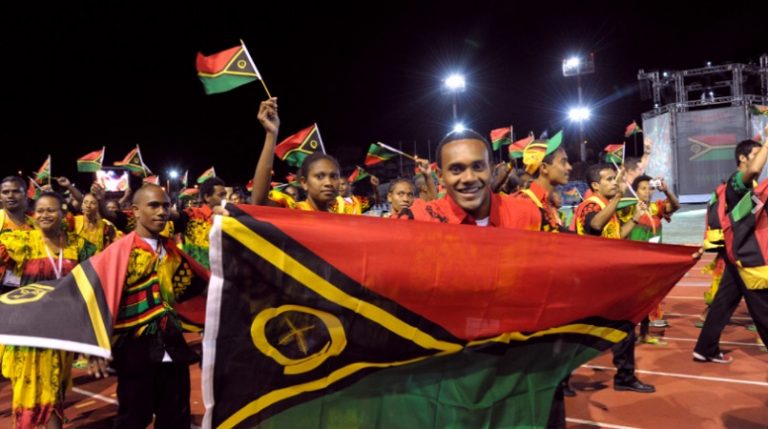
Either Tahiti or Vanuatu is set to be named as the host of the 2027 Pacific Games at the Pacific Games Council (PGC) General Assembly next month.

This was confirmed by PGC chief executive Andrew Minogue Saturday, who said the Executive Board elections and the host-selection process would be conducted on the second day of the PGC General Assembly, scheduled for 05 – 06 November.

“We want to wish Tahiti and Vanuatu all the best,” Minogue said at the Oceania National Olympic Committees(ONOC) General Assembly, confirming the two as the final candidates for he 2027 event.

Lumi is to manage the online voting and an auditor from Ernst and Young will act as the scrutineer of the votes.

Both Tahiti and Vanuatu were on a shortlist of six countries and territories which confirmed they were interested in holding the event two years ago, with others the others being Tonga, American Samoa, Fiji and Guam.

Tonga was due to hold the 2019 Games, but pulled out in 2017 citing financial concerns.

Samoa instead took its place.

Vanuatu’s bid is not far removed from the nation’s staging of the 2017 Pacific Mini Games.

In 2018, organisers of that event said they had created a surplus of US$700,000 (£514,000/€605,000).

Vanuatu previously bid for the 2015 Pacific Games, but was beaten in the race by Papua New Guinea and its capital city Port Moresby.

Tahiti has hosted the Pacific Games twice already, with Papeete being the central venue in 1971 and 1999, and previously failed to make it a third time after losing the 2023 bid race to the Solomon Islands.
Part of French Polynesia, Tahiti regained its PGC status in 2018 after a suspension was lifted.

The PGC deemed the French Polynesian Government had interfered in the autonomy and independence of sporting associations.

The sending of a letter to the Tahiti Nui Pacific Games Association, recognising its independence, also helped to have the suspension lifted.

SOURCE: INSIDE THE GAMES/PACNEWS

ChildFund Rugby works to tackle gender inequality in Oceania

0

ChildFund Rugby’s partnership with World Rugby in the build-up to and during Rugby World Cup 2019 in Japan created an outstanding legacy for the region where thousands more Asian girls and women are active in the sport in a safer and more inclusive environment.

Nearly 35,000 players have been registered with the Pass it Back programme, which is designed to ensure vulnerable children are equipped to overcome challenges through the kinship of rugby, and over half of those are female participants.

Meanwhile, ChildFund Rugby’s Reconnect initiative continues to play a vital role in improving access to sport and the learning opportunities and the multitude of benefits it brings as the world continues to struggle with the effects of the global COVID-19 pandemic. Again, the majority of those involved are girls and women.

As principal charity partner for Rugby World Cup 2021, playing in 2022, the rugby arm of the international development agency is now striving to make a similarly positive impact in the Oceania region, where gender inequality and violence against women and children are two ongoing issues that they plan to help address through the delivery of carefully constructed, measurable and collaborative programmes in partnership with Oceania Rugby.

“We are really excited looking forward to Rugby World Cup 2021, to be played next year in New Zealand, at how we can replicate that success (in Asia) but focusing on the Oceania region,” said Chris Mastaglio, a former Lao rugby international and one of the main driving forces behind ChildFund Rugby.

“The key issues we will be looking to pick up are issues around gender equality and some of the challenges around violence towards girls and women in the Oceania region.

“Our partners really want to leverage the power of rugby to take on this critical social issue.”

Promoting positive behaviour

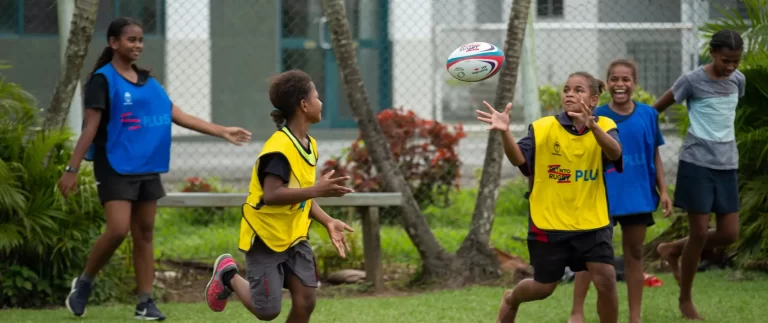
The impact of a partnership between ChildFund Rugby, Oceania Rugby, the governing body for rugby in the region, Fiji Rugby Union, UN Women and the Australian Government’s Team Up, is already being felt in Fiji, through Get into Rugby PLUS, an adaptation of World Rugby’s mass participation programme.

Get into Rugby PLUS commenced in Fiji in 2018 with 20 coaches reaching over 300 girls and boys. In 2020, over 500 players benefitted under the leadership of 32 trained coaches. The programme continues to expand and strengthen.

Adapted for the Pacific, Get into Rugby PLUS embeds life skills learning with rugby union to promote positive behaviour, for the betterment of the individual participants and the wider community.

“We worked with Oceania Rugby on creating the curriculum and trained the first group of coaches and trainers on this particular methodology and the programme,” Pinney adds.

ChildFund Rugby’s Sport for Development Programs and Partnerships Manager for Oceania, Caroline Pinney, says the impact of Fijiana’s bronze medal win at the Tokyo Olympics was immediate.

“Apparently, there were parents contacting Fiji Rugby Union immediately after the Olympics to get their daughters enrolled in rugby programmes, which is extraordinary to see in a country where rugby is still a male-dominated sport,” she reveals.

Clear and defined pathways in rugby and a safe environment when girls get there are key to capitalising on the interest that the “Olympic effect” can generate. Such collaborative partnerships have helped the Fiji Rugby Union put important elements in place to capture that interest and convert it into increased participation and retention figures.

Samoa’s version of Get into Rugby PLUS has just got off the ground and it is hoped this can be rolled out to other countries in the region.

“Our focus is on working with the national Rugby Unions. We don’t deliver the programmes ourselves, but we work with them on developing some curriculum products that are built around World Rugby’s Get into Rugby programme,” comments Mastaglio.

“We have built into that some learning around life skills that are particularly relevant to the issues around gender equality and ending violence towards women and children. And we are working with the national governing bodies on building their safeguarding practices and policies.

“Oceania Rugby have further developed their own safeguarding policy and practices and are now supporting the national unions to allow them to contextualise safeguarding in each of their countries.”

Life-changing experiences in Laos

While Fiji is an example of what can be done with the right partnerships and programmes in place, you only need to look to the southeast Asian country of Laos to see rugby’s capacity to be life-changing.

Rugby was unheard of in the mountainous country traversed by the Mekong river until it was one of four sports ChildFund introduced to children in partnership with the Lao Rugby Federation, who were, no doubt, initially perplexed by the oval-shaped object they had in their hands.

Mastaglio, who has lived and worked in Laos for the last 18 years, explains how the Lao Rugby Federation picked up the ball and ran with it.

“Four different sports – Volleyball, Soccer, Ratanball (a version of Volleyball but with feet) and Rugby – were introduced to five villages in northern Laos,” he explains.

“At that time, the way we delivered the rugby component was in partnership with the Lao Rugby Federation and that added a whole level of quality to the sport’s experience for the kids participating in that project.

“In the other sports, it was generally older male teachers who knew about the sport but didn’t know how to coach it so it wasn’t as enjoyable. And the Lao Rugby Federation has actually been really strong in providing an equal number of female coaches to the project, so there was a natural attraction for girls to go and play the sport because there were female coaches, and it really kicked on from there.”

The personal journey of Lao Khang shows what is possible when presented with the right direction and opportunities.

Raised in a small village in Nonghet District in the rural north of Laos, Khang had to finish school in her early teenage years to tend to the family farm and look after her sick father.

But in 2012, aged 20, her life was transformed when she was introduced to the world of sport through sport for development activities delivered by the Lao Rugby Federation in partnership with ChildFund. She took part in the first pilot of what was to eventually become Pass It Back.

Two years later, Khang was representing the Lao national women’s team at international tournaments in Thailand, Hong Kong, South Korea and Singapore including the 2014 Asian Games and the 2015 Southeast Asian Games.

For someone whose boundaries had previously been so small, that was quite something.

“As a girl, I was always very shy. Now I am a brave and confident young woman,” she says.

“Before I began playing rugby, I only knew people in my small village. Now I have friends all around the world.

Khang is also a World Rugby coach educator and now helps lead World Rugby courses in Laos as well as helping with coaching courses in Vietnam.

In 2018, Lao Khang was named by the BBC as one of its 100 most influential and inspirational women from around the world, chosen for their impact on their communities.

She remains a firm believer in the power of sport to change lives, especially children in developing communities.

“Rugby is an exciting way to educate children. When we play games, we teach children about things such as the importance of hand-washing, manners and respect for elders and friendship.”

And she is determined to see others benefit in the same way she has: “I want to help involve as many Lao girls and women from rural and remote communities as possible in rugby so they too can feel brave and strong.”

The power of partnerships

Khang is by no means on her own.

“We have a lot of players who complete our programme and move on into coaching, in a leadership position, and that’s what parents like to see,” Mastaglio points out.

“When you are talking around rugby values of respect, integrity and discipline, every parent wants their kid to show these values when they are at home, school and work, and those values are a really unifying thing that rugby has.”

Pinney adds: “It is obviously growing the game of rugby too, and growing the positive reputation of rugby. Families see there is more to it than just playing the sport.”

Rugby is a game based on partnerships – whether you are a prop lifting a lineout jumper or two half-backs working in tandem – and Mastaglio can’t wait to see what benefits ChildFund Rugby’s status as the first-ever principal charity sponsor for a women’s Rugby World Cup can bring.

“The opportunity to work with the team executing this event to get more girls and women in this sport and benefit from it in a really structured way, is really exciting. Hats off to World Rugby for doing that,” he says.

“Together with World Rugby, we believe in the power of girls playing sport. On the International Day of the Girl Child, we celebrate all the girls in the world playing sport. We are really confident that the partnership is going to deliver some really positive outcomes among girls in the Oceania region as well as, of course, in the host country New Zealand.”

SOURCE: WORLD RUGBY/PACNEWS
Moana Pasifika land marquee signing in former Wallabies playmaker Christian Lealiifano

0

Moana Pasifika has made their first star signing, with former Wallabies playmaker Christian Lealiifano set to join the new Super Rugby franchise for its debut season.

The Sydney Morning Herald can reveal Lealiifano is set to be announced as the club’s franchise star as early as next week.

Sources with knowledge of the situation told the Sydney Morning Herald the new, Auckland-based franchise beat Lealiifano’s former club, the ACT Brumbies, to the 34-year-old’s signature.

Lealiifano last played for the Wallabies at the 2019 World Cup, where he started at five-eighth in Michael Cheika’s final match as coach – a quarter-final defeat to England.

His rise back to the top of the playmaking tree within Australian rugby capped a remarkable comeback, as his career appeared to be over when he was diagnosed with leukaemia in 2016.

Following successful treatment, Lealiifano signed with Irish club Ulster, before returning to the Brumbies and eventually, the Wallabies.

He has plied his trade for Japanese Top League club NTT Communications Shining Arcs in the two years since the 2019 World Cup, but sources with knowledge of the discussion said the former Brumbies captain was eager to be closer to friends and family.

The coach who made Lealiifano Brumbies captain in 2019, Dan McKellar, told the Sydney Morning Herald the 34-year-old would excel at the foundation franchise.

“He’d be a great addition to the Pasifika side. He’s a proud Samoan man,” McKellar said.

“A new club, having a leadership role and a mentoring role and establishing what that club stands for, obviously with his own strong ties with his Samoan and Pasifika background – he’s going to love that challenge.

“He still has a lot to offer, there’s no doubt.”

McKellar believes there is no player better placed to lead a team that is about to be thrown into the deep end in the world’s best club competition.

“He’s a great captain, leads through his actions and he’ll have a real presence on that Pasifika group,” McKellar said.

“It’s great. Good, experienced players like that, that want to compete at this level, it’s good for the competition, and it’s good for the young players that will be able to bounce ideas around and learn off someone like Christian Lealiifano.”

While he is far closer to the end of his career than the start, sources with knowledge of the Wallabies’ thinking told the Sydney Morning Herald Lealiifano could force his way into the national fold, should his form justify a place in front of Quade Cooper, James O’Connor or Noah Lolesio.

Meanwhile, Will Skelton, Rory Arnold and Tolu Latu, who have already forced their way into the Wallabies’ squad from abroad, will be sent technical material by McKellar this week, so the trio can be integrated as quickly as possible into the Wallabies’ squad next month.

“It’s a challenge, there’s no doubt. The reality is over the next few days, I will start to send some information through to the players, around what we do, so they have some call sheets and lineout system that they can have a look at and have a read over before they come together,” McKellar said.

“The reality is, they’re going to have to work hard in the background to get themselves up to speed. Senior players and myself and the coaches, we have to work hard to ensure detail is locked away quickly as possible.

“Because the last thing you want to do as a footballer is be running around thinking about calls and systems and this sort of thing. You want a really clear headspace and clarity around what your role is.

“Then, you can go out and execute it. Those three guys, you play to their strengths. They bring genuine physicality, and they have a nasty edge to how they play. You don’t want to water that down by having them overthink what’s involved in the detail.” .

SOURCE: SMH/PACNEWS

New head coach for PNG Lewas

0

Newly retired Australian cricketer, Kath Hempenstall has been appointed as the new head coach of the women’s national cricket team, the Kumul Petroleum PNG Lewas.

Hempenstall, who has over a decade of experience, played for the Perth Scorchers in the Women’s Big Bash League (WBBL) before her retirement.

She was awarded by the Australian Cricketers Association, the Legacy Award in Western Australia 2019-2020.

The 33-year-old is an experienced coach having coaching experiences at clubs in Victoria and Perth, Australia and is looking forward to working more closely with the Cricket PNG coaching staff and the Lewas.

Currently based in Australia, she is working with the team on ground on progressive work for the women’s team, saying their home training matches are crucial and a chance for them to assess themselves.

As the COVID-19 pandemic continues to impact the world over, it is quite the same for Hempenstall and the Lewas.

This has caused cancellations and postponements of home matches for the Lewas squad, and has also kept Hempenstall in Australia and will mean she will likely first meet the team in person in Zimbabwe.

However, she has already met the team via Zoom and it was, as she says, a great opportunity to put faces to names.

As preparations for final selections will be done in Port Moresby with only four weeks to go, Hempenstall continues to work alongside the PNG team.

After the final team for the Lewas is announced, she will be meeting the team in Zimbabwe for the World Cup Qualifiers.

She says participating in the qualifiers will be great for the team because it has been quite a while since playing other international teams.

“The Kumul Petroleum PNG Lewas have great potential and the world Cup qualifiers in Zimbabwe will be a good time to test the team.”

Amid COVID-19 restrictions and new measures in country, the Kumul Petroleum PNG Lewas continue to train and prepare in compliance.

And new head coach Hempenstall is looking forward to meeting the team in Zimbabwe, with their sights set on qualifying for the World Cup next year in New Zealand..

SOURCE: POST COURIER/PACNEWS


Evidence of lost lands beneath Pacific

There is “good evidence” of once-inhabited lands lying beneath the Pacific ocean as geology aligns with Islander tales passed down by ancestors, says academic Patrick Nunn.

The fabled town of Atlantis is the most famous lost civilisation and while Plato’s tale is fictional, Professor Nunn believes the narrative drew on “all sorts of details” to make it seem plausible.

“There are submerged lands that were formerly inhabited … all around the coasts of the world and we have some great examples from Australia,” the University of the Sunshine Coast lecturer told AAP.

“Amazingly, we’ve got Aboriginal stories from at least 26 places now all around the coast of Australia that recall a time when the sea level was lower, when the coastlines were further out to sea, when what are now islands offshore were actually joined to the mainland.”

The perseverance of the stories points to the strength of Aboriginal cultures’ oral tradition, with tales surviving thousands of years.

“Seven thousand years ago the ocean surface around Australia got to its present level and has pretty much stayed there ever since,” Prof Nunn said.

During the last great ice age, the ocean’s surface was about 120 metres lower than it is today.

“When that land ice melted, the ocean’s surface rose by that same 120 metres and people were living in most parts of the world at that time,” he said.

In the South Pacific, where the threat of volcanoes and earthquakes is part of life and people didn’t arrive until after the Ice Age, the stories can be more dramatic.

Places like the Solomon islands, Fiji and Vanuatu have examples of land going down “quite abruptly”.

“A lot of this is to do with geological processes often associated with very large earthquakes or landslides,” Prof Nunn said.

“Again the stories are passed down orally but they are also supported by these amazing cultural protocols.”

Taking a boat over the place in which ancestors one lived is marked by signs of respect including slowing and removing headgear, he says.

“I would argue they’re not just quaint traditions that have been invented by people – they do in fact represent ways of remembering before it was possible to read and write.”

Prof Nunn will next week present a virtual talk on lands lost beneath the sea to the Boston Museum of Science off the back of his recently published book, Worlds in Shadow: Submerged Lands in Science, Memory and Myth.

“The mistake that we’ve made in the past is to dismiss all these kinds of stories as fictions … without asking the question why did people invent these particular stories,” he said.

“Of course they didn’t,” said Prof Nunn.

SOURCE: AAP/PACNEWS

Stay connected

529FansLike
172FollowersFollow
156SubscribersSubscribe
- Advertisement -