Despite the fallout, between members of the Micronesian sub region of the Pacific Islands Forum, it seems the region is committed to work in unison in the fight against the impact of climate change at the COP26 meeting underway in Glasgow.
Samoan Permanent representative to the United Nations and Chair of Pacific Small Island Developing States (PSIDS) Dr Fatumanava Pa’olelei Luteru told a virtual media space last night that the Pacific is working in solidarity to have their issues heard.
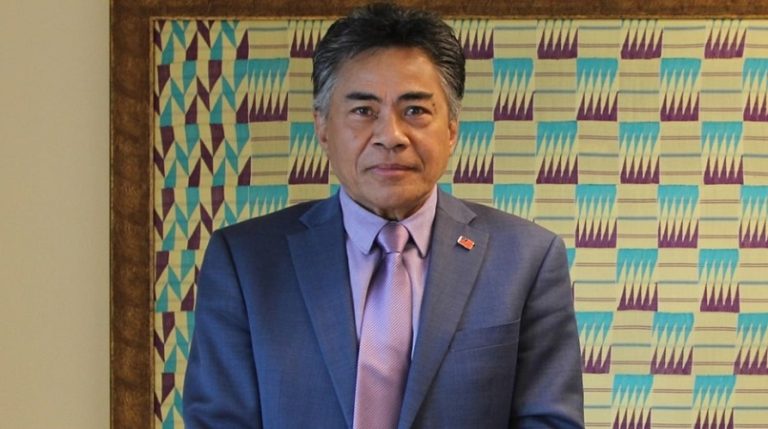
Ambassador Luteru said Palau President Surangel Whipps Jr from the Micronesia sub region is in Glasgow advocating on behalf of PSIDS.
“Absolutely I think your President (Palau) has been the flag bearer in terms of our PSIDS. He has graciously agreed to speak on behalf of the PSIDS in the absence of my Prime Minister. I think the message that he has deliver is very much consistent with the views of Pacific SIDS.
“I think the other politics in my humble view has not really dampen the enthusiasm and the commitment of our PSIDS group in terms of continuing the work of advocating and pushing for issues that are critical and at the centre of our concern with the climate change, whether it’s in climate finance, oceans etc … I know that’s a sensitive issue and that is the honest view I can give,” Ambassador Luteru told Pacific media.
He said although the COVID-19 pandemic has greatly affected the region representation at COP26, it’s not diminishing their ability to advocate and elevate Pacific plight.
“I seriously think that those that are able to come are doing a marvellous job in a very difficult situation. It’s not dismissing the ability of those who are here to advocate and elevate our image at COP26,” said Ambassador Luteru.
He said the main priority for the Pacific is to see the 1.5 degrees is kept alive.
“We need to stay with the 1.5 degrees, if we let go of that it’s very difficult to turn it around. It’s difficult to say any one issue because they are all interconnected…. when you look at 1.5, emission, ocean acidification etc… if you go to the heart of it it’s the 1.5. The warming I think something I don’t think we can’t afford unless we work on all front we are not going to be successful in fighting this,” said Luteru.
Ambassador Luteru will be providing key insights and updates throughout the COP26.
The inaction of world emitters to reach an agreement on the rapid reductions of fossil fuels has annoyed Pacific island nations on the front lines of climate change.
Palau’s President Surangel Whipps Jr, told world leaders at the COP26 in Glasgow, that his island nation is threatened by increasing sea level rise due to the use of fossil fuels, the primary source of man-made global warming.
“We are drowning, and our only hope is the life-ring you are holding.
“As large emitters with their insatiable appetite for advancement are continuing to abuse our environment, threatening our very survival. COP26 must light the fire.”
“We must hold each other accountable; it is incumbent upon the parties of this convention to concentrate on radical action, consistent mobilisation, rational outcomes as such Palau expects the set of rules guiding the implementation of the Paris Agreement be finalised as a priority outcome of COP26,” said President Whipps Jr in his address to world leaders.
He told the COP26 conference that the climate catastrophe and the traditional Palau fable of a youngster who grew into a giant and ‘wouldn’t stop growing… destroying all the natural resources’ had parallels.
The narrative, according to President Whipps Jr, is “eerily reminiscent” of today’s climate crisis.
“We see the scorching sun is giving us intolerable heat, the warming sea is invading us, the strong winds are blowing us every which way, our resources are disappearing before our eyes and our future is being robbed from us.”
“Frankly speaking, there is no dignity to a slow and painful death you might as well bomb our islands instead of making us suffer only to witness our slow and fateful demise,” he explained
President Whipps also said world emitters must increase their pledge on climate financing.
“We the islands that are devastated most, demand that your commitments of 100 billion annually be increased to meet the four trillion dollars the world bank reports are needed with substantial shares of climate financing to support costly adaptation needs,” he said.
Only three leaders from the Pacific including Fiji, Palau and Tuvalu are attending COP26 this year while the rest are staying back due to the closing of borders brought about by COVID-19 pandemic.
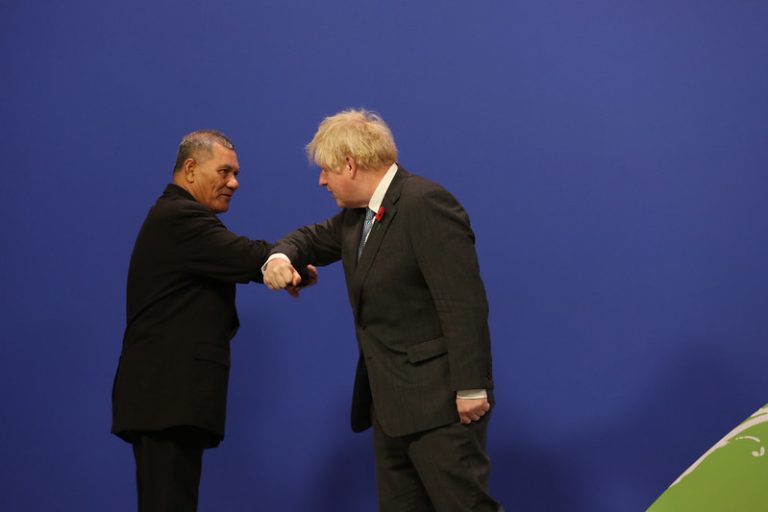
Tuvalu Prime Minister Kausea Natano says his people are living with the reality of climate change every day.
“Right now, 40 percent of the central district of Tuvalu’s capital Funafuti is already below sea level at highest tide measures. These are not predicted future measures; this is the reality we are living with today. We cannot wait; we must make bold decisions and take firm action to secure our future.”
“This COP must be a COP of action! We must act now to ensure that all States recognise their shared responsibility to protect the global community and to ensure that all States are held accountable for this responsibility.
“We must lead the charge to develop global norms, practices, and meaningful changes to avoid the most devastating impacts of climate change and sea level rise,” Natano told world leaders in Glasgow.
He also announced the pact signed between Tuvalu and Antigua and Barbuda to establish a Commission of Small Island States on Climate Change and International law.
“The Commission is authorised to request advisory opinions from the International Tribunal for the Law of the Sea (ITLOS) on the legal responsibility of States for carbon emissions, marine pollution, and rising sea levels.
“We must support initiatives of this nature to develop and implement fair and just global and environmental norms and practices, including compensation for loss and damage,” he said.
Natano said the existential threat of climate change and sea level rise has strengthened their resolve to preserve Tuvalu statehood and sovereignty.
“In this respect, we have embarked on international discussion on legal mechanisms that can recognise our maritime boundaries and assets as permanent despite the impacts of sea level rise.
“We must also ensure that legal mechanisms are in place to protect the cultures, languages, and heritages of nations like Tuvalu, including through digitisation and building mobile digital nations.
“We must uphold domestic, regional, and international endeavours to this effect, such as the Declaration on Preserving Maritime Zones in the Face of Climate Change-related Sea-Level Rise. This regional declaration was endorsed by Pacific Islands Forum Leaders this year and seeks to ensure that Forum Members’ maritime zones cannot be challenged or reduced as a result of climate change-related sea-level rise” said Natano.
“I want to make it plainly clear that, even if all GHG emissions ceased tomorrow, Tuvalu, and other low-lying atoll nations, are sinking and our land is fast disappearing.
“We must conclude negotiations on the Paris Rulebook and safeguard the integrity of the Paris Agreement by stopping measures that will stall progress on its objectives,” said Natano.
The former chair of the Pacific Islands Forum also urged global major emitters to commit to stronger climate action and to formulate mid-century long-term low emissions development strategies.
“The success of this COP depends entirely on the commitment of you, the global major emitters, and your readiness to help.
“In Tuvalu, we are already living the future impacts of climate change now. Consequently, soft adaptation approaches, such as nature-based solutions, help, but, at 1.9 meters above sea level, they will not save Tuvalu from sea level rise.
“Tuvalu urgently needs adaptation measures based on building physical infrastructure to save ourselves. We are investing in building raised reclamation lands to preserve our physical existence as a viable state. This is our utmost priority now. There is no point in investing in soft and piecemeal adaptation measures when we are losing our land territory at an alarming rate,” PM Natano emphasised.
On climate finance, Natano said too often, medium and long-term adaptation finance and implementation have been left to the private sector to handle.
“Private sector support is critical and should be enhanced, but it should not overshadow the important resources that can be offered through international public finance.
“We must mobilise large-scale adaptation financing now—financing that is not delayed by COVID-19; that prioritises the most vulnerable; and that is sourced through the Markets Mechanism and delivered through public and grant-based financing, rather than loans.
“Our success as Pacific SIDS depends on this. We must cooperate to conclude and finalise Article 6 of the negotiations that delivers substantial overall mitigation in global emissions, as well as substantial financial resources to assist vulnerable developing countries in meeting the costs of adaptation,” he explained.
He said for atoll nations, the ravages of sea level rise will defeat all of their efforts and development gains with regard to the 2030 Agenda for Sustainable Development and the 17 Sustainable Development Goals.
“Current global mitigation commitments and promises will not save us.
“For atoll nations like Tuvalu, we urgently require the means to build raised reclamation land to save ourselves. All other adaptation measures are secondary and should come only after we have secured the continued physical existence of our land territory despite the effects of sea level rise,” he said.
He said Loss and Damage is not an adaptation and they should be treated separately.
“We cannot allow the reallocation of adaptation funding to address loss and damage. We require stronger guidance on loss and damage financing, and we must develop new financing mechanisms or funding windows for loss and damage
“This would include consideration of the impacts of climate change on fisheries as part of loss and damage under slow onset events,” PM Natano said.
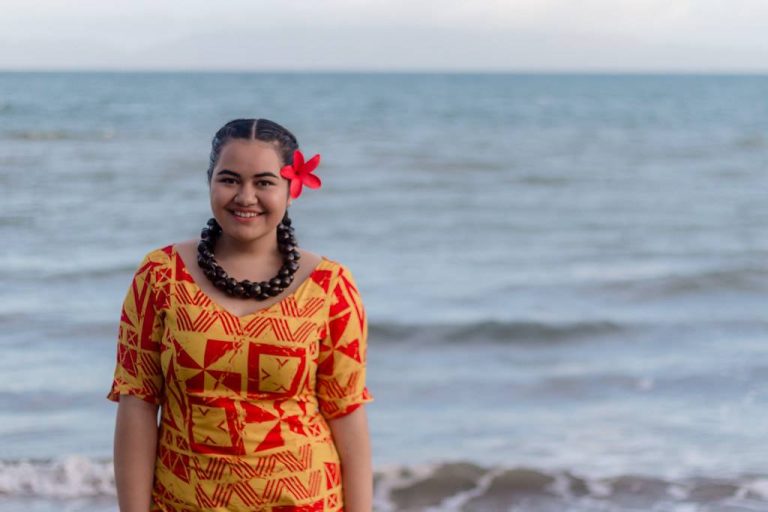
The Pacific voice rang loud and clear when Pacific climate activist Brianna Fruean, took the stage at the opening ceremony of the World Leaders Summit at COP26 in Glasgow Monday
Sounding the warrior call of Pacific youth, she declared that “We are not drowning, we are fighting.”
Speaking after the UK Prime Minister Boris Johnson, Fruean reminded world leaders that they all have the power at COP26, to be better – “remember that in your meeting rooms and drafting documents are more than just black and white objects’ to remember than in your words you wield the weapons that can save us or sell us out.”
Featured second during the opening ceremony, the Pacific voice was amplified during the special session that featured Antonio Guterres, the United Nations Secretary-General, David Attenborough, as well as the Prince of Wales.
“I felt proud to wear my Sei and carry the light of Pacific people,” said Fruean.
“I hope the world leaders will remember the words and faces of Pacific youth this COP. We have the most to lose but also the most to teach about how to treat the planet with more respect”.
Fruean has had vast experience in working to make a difference having first learnt about climate change while attending the Pacific Climate Change Roundtable in Samoa in 2008 as a child, waiting for her Mother, a former employee of the Secretariat of the Pacific Regional Environment Programme (SPREP).
Since then, she has presented at the first-ever SPREP Pacific Environment Forum in 2011, was part of the Pacific Media Team that provided coverage of the Rio+20 Conference on Sustainable Development in Brazil in 2012, she was the first SPREP Youth Ambassador in 2015 at 16 years of age and attended her first UNFCCC COP 21 in Paris, France with the SPREP team.
Brianna Fruean was also nominated for the “University of Canterbury Young New Zealander of the Year 2021 – Te Mātātahi o te Tau” Award as her climate activism has continued to grow.
Her statement made to world leaders at the opening of the World Leaders Summit today at COP26 challenged them to do the right thing.
“I don’t need to remind you of the reality of vulnerable communities. If you are here today, you know what climate change is doing to us. You don’t need my pain or my tears to know that we’re in a crisis
The real question is whether you have the political will to do the right thing. To wield the right words and to follow it up with long-overdue action.”
The High-Level Segment of COP26 will be held from 1 – 2 November. Pacific Island Leaders to present include Voreqe Bainimarama, Prime Minister of Fiji, Surangel S. Whipps, Jr, President of Palau and Kausea Natano, Prime Minister of Tuvalu.
Hosted in Glasgow, the Twenty-Sixth Conference of the Parties to the UN’s Framework Convention on Climate Change opened on 31 October and will end on 12 November.
The full statement of Ms Brianna Fruean, Pacific Climate Activist:
“When I was a little girl, I was taught the importance and impact of words
In my culture, in Samoa, there’s a proverb that goes – E pala le maʻa, a e le pala le upu.
It means that even stones decay, but words remain.
A lesson in knowing how words can be wielded how text can change everything how each word you use is weighted how switching one word or number could reframe worlds how climate action can be vastly different from climate justice how 2 degrees could mean the end and 1.5 could mean a fighting chance.
You all have the power here today to be better to remember that in your meeting rooms and drafting documents are more than just black and white objects to remember than in your words you wield the weapons that can save us or sell us out.
I don’t need to remind you of the reality of vulnerable communities. If you are here today, you know what climate change is doing to us. You don’t need my pain or my tears to know that we’re in a crisis.
The real question is whether you have the political will to do the right thing. To wield the right words and to follow it up with long-overdue action.
If you’re looking for inspiration on this look no further than the climate leadership of young pacific people.
We are not just victims of this crisis we have been resilient beacons of hope. Pacific youth have rallied behind the cry “we are not drowning, we are fighting” this is our warrior cry to the world – “we are not drowning we are fighting.”
This is my message from earth to COP I hope you remember my words today and look closely at your words as you go through COP because:
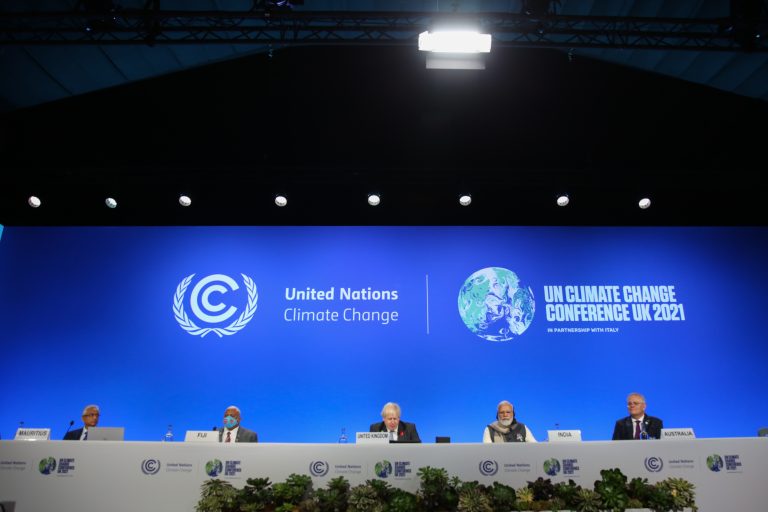
Fiji’s Prime Minister and current chair of the Pacific Islands Forum Frank Bainimarama has thanked his Indian counterpart, Prime Minister Narendra Modi for his leadership in the creation of Infrastructure Resilience for Small Island States, IRIS in a side-event on the second day of COP26 in Glasgow, Scotland.
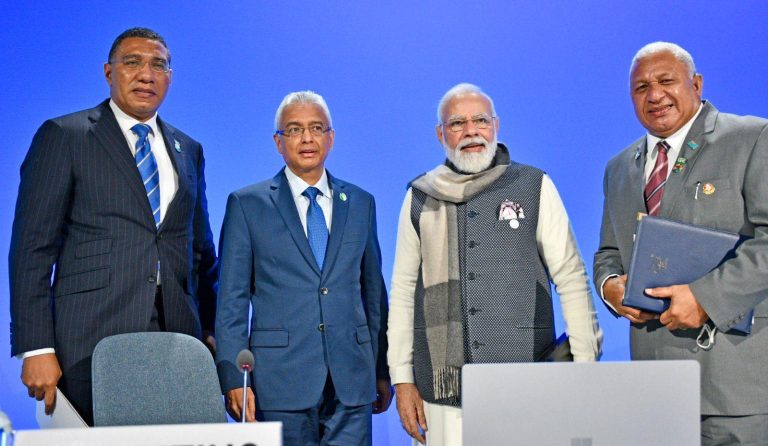
Being the brainchild of the Indian-led Coalition of Developing Resilient Infrastructure (CDRI), Bainimarama joined Mr Modi, Prime Minister Boris Johnson of the UK, Scott Morrison of Australia, Prime Minister Andrew Holness of Jamaica and Pravind Jugnauth of Mauritius at the launch of the IRIS project.
Fiji he said recognizes the need to adapt building codes and standards to the climate reality, and that it be inclusive to its green priorities.
“Whether its storms, floods or fires, the same hard lessons are being learned around the world: building to last century’s standards is building to lose.
“The world is warming, the impacts are terrifying, and the standards we build to must be defined by, and readied for those intensifying risks.”
“It takes resources to build resilience.
“But we either pay to adapt now, or pay a much higher price in the aftermath of climate-driven devastation.”
Bainimarama speaks of the financing gap between vulnerability and resilience, and suggests that public and private sector sources of funding could be a solution.
“We trust this initiative will reach well beyond technical assistance and capacity building to unlock trillions in private sector capital.
“It can do that by de-risking critical investments now that will build resilience for those on the front line of the climate crisis.
“Fiji’s Relocation and Displaced Peoples Trust Fund, which establishes a proven process to move at-risk communities and their infrastructure, is one example of where those funds can make an impact.
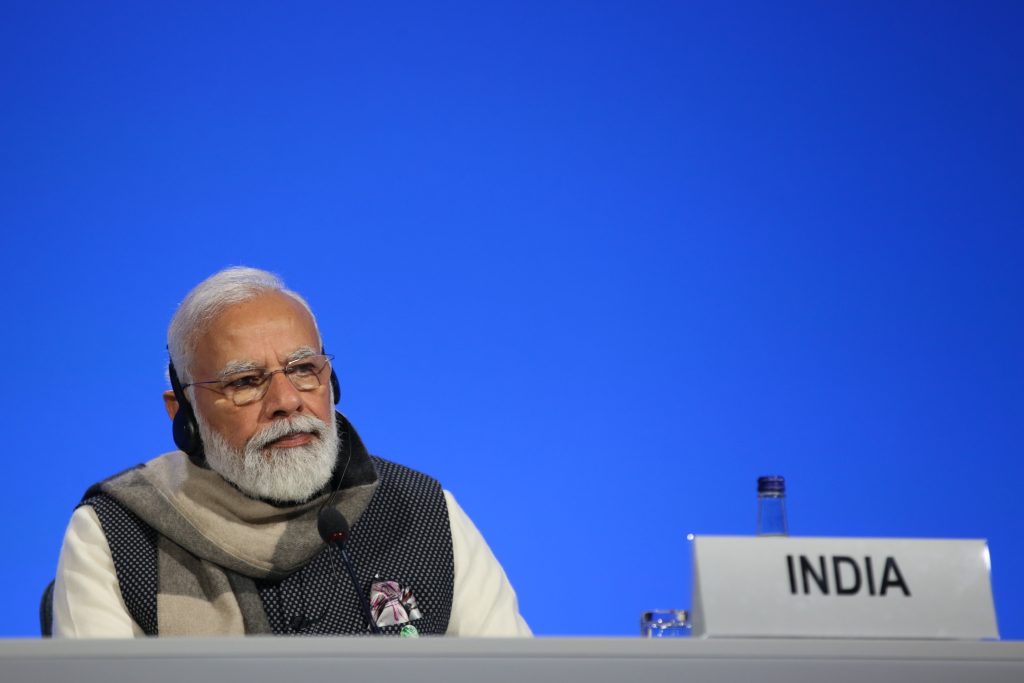
In his remarks, Prime Minister Modi spoke about the urgency to assist the resilience of infrastructure in small island states.
“The world looks at these countries as spatially populated small island states, however I consider them to be large ocean states with immense capabilities,” said Modi who spoke in Hindi and his remarks were interpreted into English.
“Just like a necklace of pearls from the sea enhances everyone’s beauty, in the same way small island states surrounded by the ocean, greets the world with their beauty.
“I assure you that India will fully support this new project and will work together with the CDRI, with other partner countries and with the UN for its success.”
Prime Minister Modi further announced that India’s Space Agency ISRO will create a “special data window for small island states,” which will supply timely satellite information on cyclones, coral reef and coastline monitoring and other related data to small island states.
India’s Prime Minister Narend Modi. Photo: UNFCCC
In his remarks, Prime Minister Morrison spoke of his government’s doubling of its climate financing contribution to $2billion, as well as a $10 million donation for the new IRIS initiative.
Bulk of Australia’s $2billion pledge would benefit its Pacific family of nation, Morrison said, ‘cutting out all the red tape and just getting all the projects on the ground.’
“If there’s anything we know, it is to stick with it, and to make a commitment to meet it and to beat it, and as our friends and family in the Pacific know and in South East Asia, we can be relied upon.
“We are helping our friends in PNG build resilient roads, bridges and wharves.
“We have helped with cyclone resistant produce markets for the Solomon Islands and Fiji, and last year our prefabricated schoolrooms in Vanuatu which withstood Tropical Cyclone Harold giving the community a place to shelter, as well as the kids a chance to return to schools sooner.
“All of us are here because we believe in a fair and practical action to address climate change and we are here because we are family, particularly our Pacific family.
“Look out for one another, look out for our mates as we say in Australia, lets stick together and lets get on with it.”
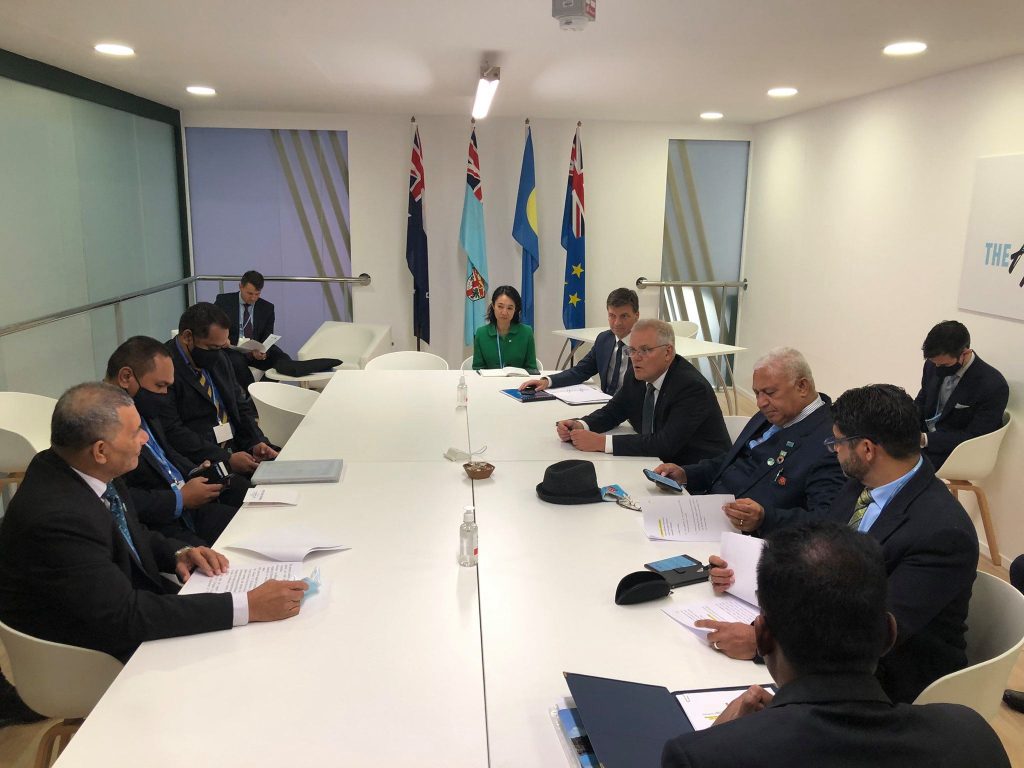
Meeting between Pacific leaders and Prime Minister of Australia Scott Morrison. Photo: Tuvalu Govt
Prime Minister Johnson of Britain spoke of his most “harrowing experiences” listening to the plight of people living in small island states over the last few weeks and months as part of his preparation for COP26.
“Its so obvious for some people, some communities, some countries of this COP, the transformation that has been happening now is not a matter for our children or grandchildren.
“This is something that is an existential threat as we speak and sit here in Glasgow today.
“Last year, 600 billion tonnes of ice melted away in Greenland, all that has to go some where, and its incredibly cruel that these vulnerable, small island states are right in the front line of the loss and damage, that is caused by global warming, and of course as our friends have said, they have done virtually nothing to cause the problem.
“They didn’t produce the huge volumes of CO2 that had been pumped into the atmosphere, so I could encourage every countries that have been guilty of pumping CO2 into the air over the last whatever it is, 250 years, to join this campaign and help.
“That’s why we have made the $10 billion commitment a year as a crucial part of the UK’s presidency.”
Prime Minister Johnson also shared his new learnings of how to gesture the ‘keep 1.5 alive’ slogan, something he said he learnt from Fiji’s Prime Minister and chair of the Pacific Islands Forum, Frank Bainimarama.
“I think that we got to do it.
“We got to help people to adept.
“We got to mitigate.
“But above all, we got to change the numbers, we got to bend the curve, we got to stop this remorseless increase in CO2 because there are people in this room, there are populations, vulnerable populations who have done nothing to deserve it, will be in the front line and will suffer catastrophic loss and damages.”
“To all leaders here; the message of the Pacific is simple: Our canoe is sinking. “Pick up your buckets and start bailing now before it’s too late.”
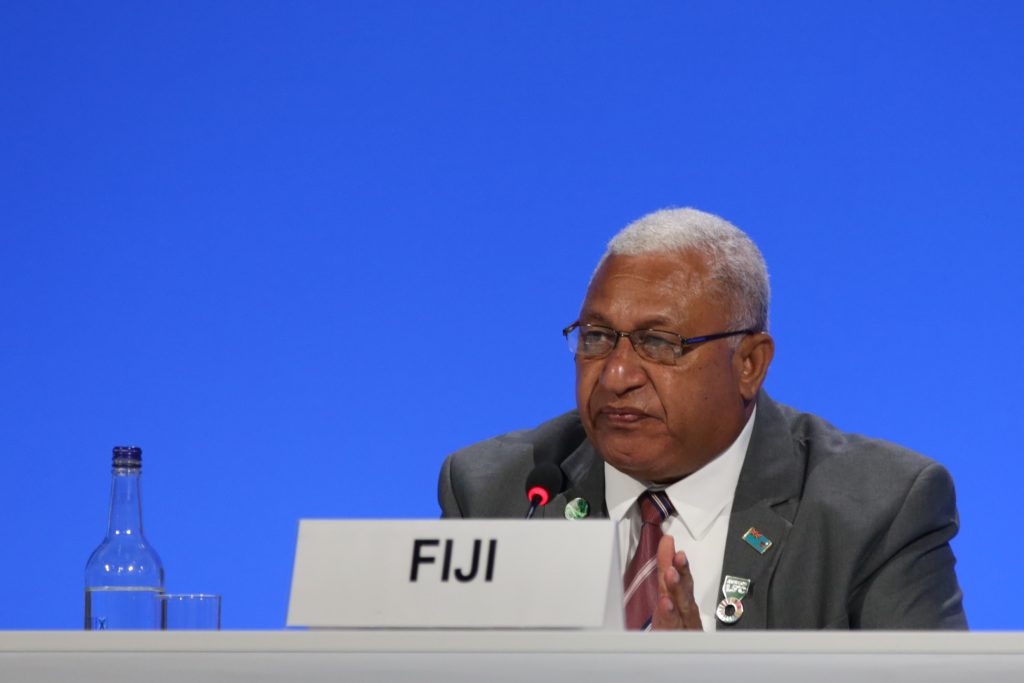
That simple message of canoe voyaging and the urgency to bail water was Frank Bainimarama’s message to world leaders that are currently in Glasgow, Scotland this week for COP26.
As Prime Minister of Fiji and current chair of the Pacific Islands Forum, Bainimarama used his two-minutes speaking slot at the world leaders summit in COP26 that was chaired by host Prime Minister Boris Johnson to share a Fijian seafaring proverb with his counterparts in the room, that also included among others, President Joe Biden of the United States, Narendra Modi of India, Angela Merkel of Germany and Scott Morrison of Australia.
He uses the analogy of a global ‘gap-filled’ canoe that is heading for storms, while seawater pours aboard:
“gaps in ambition, gaps in climate finance, and gaps in emissions reduction commitments.”
“It brings to mind an ancient adage – one I’ve since added to Fiji’s call to action: “Tu Na Inima Luvu Na Waqa,” which means quite literally, “the boat sinks despite the presence of the bailers.”
“Island nations like Fiji have teaspoons with which to bail water.
“The G20 nations have buckets.
“Yet too many are willfully ignoring the storms on the horizon and the holes in our canoe.
“They must cut emissions – now – to set our canoe towards the calm of carbon-neutral seas and they need to start bailing – now – by meeting their climate finance pledges before our canoe sinks to the seabed.”
Prime Minister of Fiji- Frank Bainimarama at COP26. Photo: UNFCCC
Bainimarama said the new US$100 billion goal by 2023 for the new climate finance delivery plan is welcomed, yet not lost on countries like Fiji were the fallen billions short of pledges of the past.
More so, SIDS have only been able to access a mere 2 per cent of the available finance, mostly delivered as loans – forcing small island states to pay high interest rates to address climate-driven impacts they did not cause in the first place.
“Wealthy nations must do more than pledge finance, they must make it affordable and accessible, and they must actually ensure that it reaches the communities it’s meant to aid –– for mitigation, but mainly for adaptation purposes.
“And by 2025, much higher levels of commitment will be required –– 750 billion dollars annually in climate finance, ten percent of which is dedicated to SIDS, as well as a dedicated mechanism for the losses and damages we have already sustained.
“Wealthy nations spend trillions on defence partnerships and on weapons that can level entire communities, surely we can spend billions to adapt them.
“How do we ensure that this is not yet another empty ask? “We can start by meeting the 2023 commitment.
“Another way would be to finalise Article 6, price carbon, and ensure emitters pay to adapt the communities they are devastating.
Bainimarama is heading Fiji and the Pacific Islands Forum delegation to COP26 and earlier today participated in a forum that saw the launch of the Initiative for Resilient Island States (IRIS) by the Coalition of Developing Resilient Infrastructure led by India’s Prime Minister Narendra Modi.
Among other leaders that spoke at the launch were Prime Minister Boris Johnson of Britain and Scott Morrison of Australia.
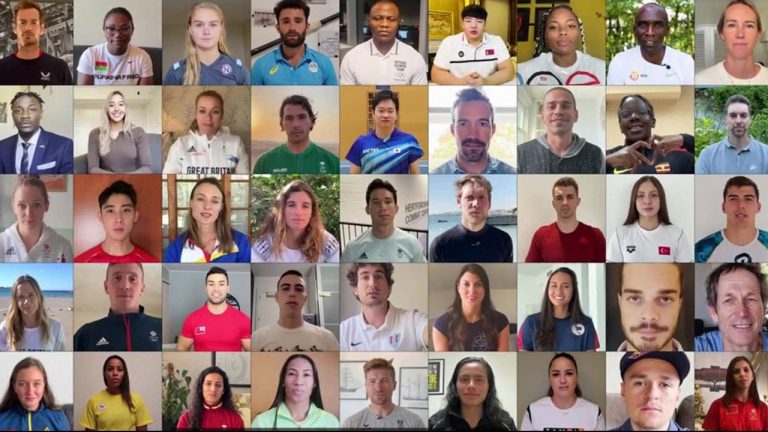
A group of more than 50 Olympians and Paralympians have called on world leaders to deliver on climate action during the COP26 summit in Glasgow in a video backed by the International Olympic Committee (IOC).
The athletes, including Kenyan marathon star Eliud Kipchoge and retired Spanish basketball legend Pau Gasol, warn of the impact of climate change on sport and the threat it poses to their futures.
A group of more than 50 Olympians and Paralympians have called on world leaders to deliver on climate action during the COP26 summit in Glasgow in a video backed by the International Olympic Committee (IOC).
The athletes, including Kenyan marathon star Eliud Kipchoge and retired Spanish basketball legend Pau Gasol, warn of the impact of climate change on sport and the threat it poses to their futures.
The video, initiated by British double Olympic sailing champion Hannah Mills and Olympic rower Melissa Wilson, was released to coincide with the start of the summit in the Scottish city, considered one of the most important climate change conferences ever held.
They called COP26 “the Olympics of climate summits”.
Leaders attending the conference are expected to outline their climate commitments at the event, due to run until 12 November.
“Tokyo and the people of Japan delivered, when many thought it impossible,” the athletes say in the video.
“Each Games seeks to deliver a lasting legacy.
“But how do we pass on that legacy, if there isn’t a safe and healthy planet to experience it?
“Heat, humidity and extreme weather conditions mean many of our sports are already under threat.
“And sport is just one part of a much greater global picture.
“We did our utmost this summer, and we know that when we strive to achieve our best, others come with us.
“Now, it is your chance to deliver.”
Mills – who in 2019 launched the Big Plastic Pledge, an athlete-driven movement to eliminate the use of single-use plastic within and beyond sport – claimed athletes “are counting on world leaders to take accelerated climate action at COP26”.
“This is the race we need to win, and the speed of the race is determined by each of the participants in it,” the athletes in the video added.
“At COP26, the Olympics of climate summits, we need you to lead us.
“To show real ambition and courage.
“Working together to secure the future that we all depend on.
“Anything less won’t win this race.
“Over the next fortnight, we will be looking to you, and supporting you, to forge the ultimate legacy: a healthy, safe earth for all.”
IOC President Thomas Bach last week called for more cooperation from Governments to combat climate change, warning the world was “in a race against time which nobody can win alone”.
The IOC has committed to reducing its direct and indirect greenhouse gas emissions by 50 per cent by 2030.
Its action plan includes reducing emissions in the areas of travel, energy use and procurement.
In March last year, the IOC took the decision to make the Olympic Games climate positive.
From 2030 onwards, each Organising Committee for the Olympics will be contractually obliged to minimise and compensate its direct and indirect carbon emissions and implement lasting zero-carbon solutions for the Games and beyond.
All upcoming Olympic Games have committed to carbon neutrality, with Paris 2024 aiming to become the first climate-positive Games even before the 2030 deadline.
“The IOC is delighted to support this initiative, and help Olympic athletes use their powerful voices to create a more sustainable future for everyone,” said Bach.
“Climate change is one of the biggest challenges humanity has ever faced, and the IOC is proud to be leading the Olympic Movement’s response to this crisis.
“Our recent commitment to reduce our carbon emissions by 50 per cent by 2030 and our support for this initiative are part of this effort.
“Sport has the power to make the world a better place, and today we have an opportunity to use this power in the face of climate change, said Bach.
It’s been eight years since the Northern Marianas were awarded hosting rights for the 2021 Pacific Mini Games.
Super typhoons, the withdrawal of government support and Covid-19 have combined to throw plenty of caution to the, err, wind – so much so that the event will now take place in 2022.
But with the government back on board and close to 90 percent of the territory’s eligible adult population having received at least one dose of the Covid-19 vaccine it’s all steam ahead in Saipan.
Pacific Games Council CEO Andrew Minogue said the successful staging of the Tokyo Olympics has given them a lot more hope that other major sporting events can also be viable.
“We’re not out of the woods yet – obviously there’s still a lot of work to do between now and June next year – but I think we all take great comfort in the fact that Tokyo happened, that an Olympic Games was delivered successfully,” he said.
“They kind of showed us all the way and we can see now since Tokyo that, particularly in Europe and the Americas, a lot of sport is opening back up to spectators and to the public and for athletes and teams to be able to move around.
“I think for us next year that’s going to be a remaining challenge is to make sure that we can get athlete representatives from all our countries.”
The CEO of the Games Organising Committee, Vicente Ben Babauta, previously worked in luxury travel retail, so is well versed in the impact caused by the global pandemic.
He hoped the Mini Games would provide a much-needed boost to the CNMI’s tourism industry, including on Rota and Tinian. With the territory having recently opened a travel bubble with Korea, he said there was a belief on the ground that people can visit the territory safely and that major events can proceed with the appropriate protocols.
“Right now the entire community is very very positive, looking forward, very excited for these Games,” he said.
“We’re starting our bubble travel with Korea…so we’re receiving an average of 2,000 travellers last month so by December of this year (it will be) closer to 7,000 travellers, so it’s a good dry run basically for next year’s (Pacific Mini) Games.”
Babauta said under the territory’s current Covid-19 protocols, athletes and officials attending the Mini Games would be required to return a negative PCR test before boarding their flight to Saipan.
Upon arrival fully vaccinated people would still have to quarantine for five days upon arrival in Saipan, while unvaccinated travellers would have to spend up to two weeks in managed isolation.
He said the CNMI is ready to facilitate a very safe environment during the Mini Games.
“As soon as they land we are responsible but of course on the athlete side and official side going back to our protocols they will be sharing before departure all their PCR, vaccine completed, other health requirement other than their immigration requirements that they will need but on arrival we will take it from here.”
The Pacific Games Council has yet to consider making Covid-19 vaccinations a requirement to participate in Saipan but Andrew Minogue said that could change.
“Our message would be to get vaccinated for your own protection, for protection of your family and your community,” he said.
“I think that’s a message that all sporting bodies around the world will advocate to their membership and their stakeholders, but as for sort of hard and fast rules around that we haven’t go to that point yet. It may come. I don’t think they got there for the Olympics but by June of next year it might be different.”
The Northern Marianas Sports Association originally bid to host the 2017 Pacific Mini Games, but lost out to Vanuatu. Unperturbed, they immediately signalled their desire to bid for the next instalment in 2021.
After 11 long years of waiting, plus an additional year-long Covid-induced delay – Ben Babauta said the CNMI cannot wait to play host to their Pacific neighbours.
“This is one event that we’re making history on, first and foremost, and just welcoming our South Pacific family into Saipan, into NMI, it’s quite important. We are working really hard behind the scenes in terms of all the protocols.”
The recent Tokyo Olympics is estimated to have cost over US$15 billion, making it the most expensive Olympic event in history.
By comparison, the CNMI Government has budgeted a mere US$4 million to stage the Pacific Mini Games, which will feature nine sports being contested across one blockbuster week of competition.
Andrew Minogue said while Japan had resources the Pacific could only dream of there was still plenty the region could learn from what happened in Japan.
“The way they managed the flow of athletes in and out of venues, how they had them perfectly quarantined in the Games Village,” he said.
“It’s something we’re going to have to work through with the on the ground conditions – things like masks, social distancing, making sure athletes have a plan in terms of where they’re going to go if it’s not at competition or the village or the training venue.”
The Pacific Games Council will wait to see what conditions are like in the first quarter of next year before making any final decisions on what restrictions and assistance will be required, Minogue said.
“How easy is it to travel? What are the quarantine rules when you get there? and we will put the plans in place accordingly for the Games.
“I’m hopeful that travel will be a lot more freely available by June of next year and we can actually get there from all the countries of the Pacific fairly easily. We will just have to be very careful with how we all manage ourselves on the ground.”
The first shipment of six va’a boats arrived in the CNMI from Fiji earlier this month, with another dozen boats from Hawaii due to reach Saipan in December.
And with less than eight months to go until the opening ceremony, Ben Babauta said the CNMI was already counting down the days.
“We have a huge countdown clock in front of our sports complex and everybody is keeping an eye on it,” he said.
“I’m like a movie star now in the community. (Everyone is saying “hey Ben good luck…you’re doing a great job.”
“It’s quite exciting seeing all the flags and presentation is important, keeping the entire community engaged, so that’s the next step is outreach. We have posters for volunteers, we’re going on the radio, we’re going on TV and just showcasing our event for next year, said Babauta.
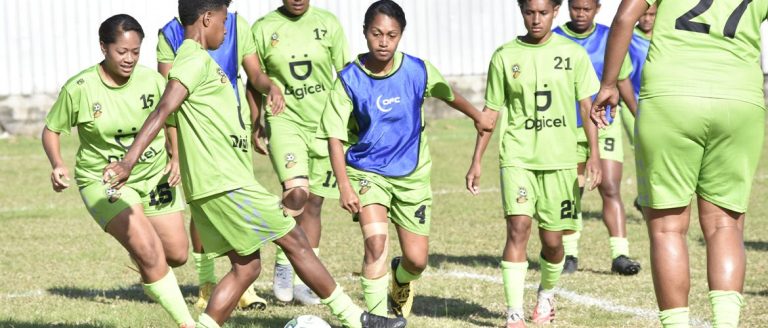
The Digicel Fiji national women’s team gathered in camp at the end of last month, spending some valuable time together before the players headed back to their respective clubs for the resumption of the Digicel Women’s Super League last weekend.
Twenty-eight players attended the camp at the Fiji Football Association (FFA) Academy in Vatuwaqa, with FFA Technical Director Timo Jankowski, who has taken charge of the team following the departure of former coach Marika Rodu, leading the sessions.
Jankowski said the spirit among the group was particularly pleasing to see.
“I am really impressed with the team spirit. I am really happy with the progress shown by them,” Yankowski said.
“The first week of camp was really good, even better than we thought it would be, because it was quite difficult to estimate the level of the girls after this long break.
“We don’t have any injuries which shows the players are progressing well.”
Digicel Fiji national men’s coach Flemings Serristlev attended parts of the camp too, as the team builds towards the 2022 OFC Women’s Nations Cup.
Yankowski said the players have adapted well to a new style.
“I would say it is a little bit different [to what the players are used to], but the method I am using is a proven method which helps the players to develop their abilities.
“For me there are some players with top potential and it is really nice to work with them and they are learning very quickly, said Yankowski.
A month after being dethroned by South Africa, New Zealand are back on top of the World Rugby Men’s Rankings.
Saturday’s 54-16 win over Wales earned them 0.39 of a rating point which was enough to take them above the Springboks, who now trail New Zealand by 0.23 of a point.
Fittingly, Beauden Barrett produced a man-of-the-match performance on his 100th cap, scoring the first and last of his side’s seven tries.
TJ Perenara, Will Jordan, Dalton Papali’i, Sevu Reece and Anton Lienert-Brown also crossed for the All Blacks with Jordie Barrett kicking 19 points.
Fiji is currently the highest ranking Pacific rugby nation – at 11th place after Japan. Samoa is at 13th place and Tonga in 15th place. Cook Islands is on 54, ahead of Guam on 73rd place. Papua New Guinea is on 83rd position, Niue at 98th place, one place ahead of Tahiti. Solomon Islands, Vanuatu and American Samoa are placed 104, 109 and 110 places respectively.
Papua New Guinea is the only Pacific nation to fall one place in its ranking, from 82nd place to 83rd.