



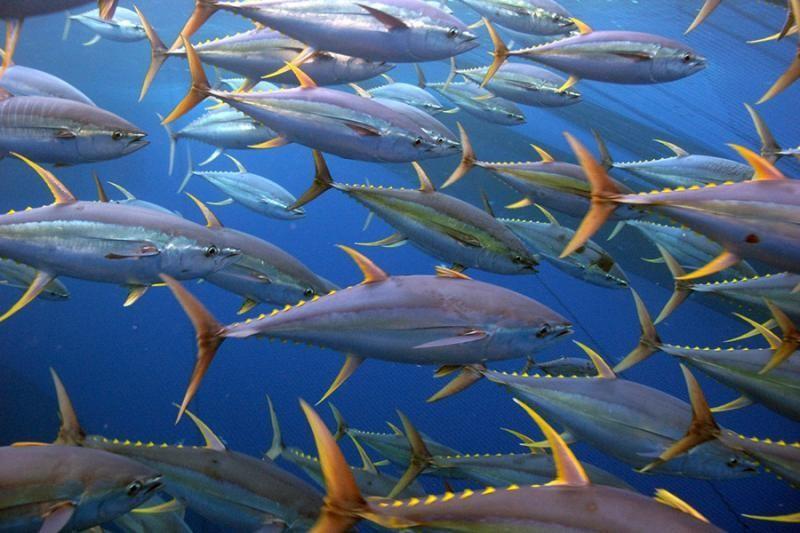
Yellowfin tuna stocks in the Western and Central Pacific Ocean are unlikely to recover to their proposed management target under the tuna management measures being considered by the Western and Central Pacific Fisheries Commission (WCPFC), despite projections showing the stock has at least a 95 percent probability of remaining above its limit reference point.
A new scientific analysis prepared by the Pacific Community (SPC) for the first Special Session of the WCPFC Scientific Committee in Port Vila warns that the proposed management arrangements for skipjack, bigeye and South Pacific albacore will not be enough to achieve the yellowfin tuna management objective of maintaining spawning biomass at the 2012–2015 average level.
The analysis, presented in paper WCPFC-SSSC01-2026-WP05, found that the probability of yellowfin achieving that target was only between nine and 17 percent across the six candidate bigeye management procedures assessed.
However, all six options maintained at least a 95 percent probability of keeping yellowfin stocks above the limit reference point, exceeding the Commission’s minimum requirement of 80 percent.
The findings highlight a challenge for Pacific fisheries managers as they prepare to consider a management procedure for bigeye tuna at the Commission’s annual meeting in December.
Under the WCPFC’s mixed-fishery framework, yellowfin does not have its own management procedure. Instead, fisheries catching yellowfin are controlled mainly through management procedures for skipjack, bigeye and South Pacific albacore.
SPC’s projections examined how the combined measures would affect yellowfin over 30 years, using 144 operating models and different fishing scenarios.
The analysis found that the choice of bigeye target reference point would have the greatest impact on yellowfin catches from longline fisheries.
Under bigeye management options designed to achieve the lower target reference point, projected long-term yellowfin catches from longline fisheries were about 55,000 tonnes higher than under the upper target option.
The lower target scenarios allowed greater longline fishing effort, resulting in yellowfin catches exceeding historical levels, while catches under the upper target scenarios were similar to recent longline catches.
Purse seine catches, by comparison, showed little difference between the proposed bigeye management options, with slightly higher yellowfin catches under the upper target reference point.
The analysis also found that vulnerable biomass, used as a proxy for catch rates, was projected to decline below 2019–2021 levels across all candidate management procedures for both longline and purse seine fisheries.
This suggests fishing fleets could face lower catch rates in the future, even if the stock remains above its limit reference point.
The study also tested two additional scenarios involving increased fishing effort in domestic fisheries in the region and a sustained 10 percent reduction in yellowfin recruitment.
Increased domestic fishing effort resulted in about 25 percent more yellowfin catches compared with the reference projections, rising from an average of 182,000 tonnes to 240,000 tonnes.
The increased catches reduced projected longline catches from 161,000 tonnes to 126,000 tonnes in the long term, while purse seine catches declined from 360,000 tonnes to 345,000 tonnes.
Despite these pressures, the probability of yellowfin remaining above the limit reference point stayed above 80 percent under both sensitivity scenarios.
SPC said the effects of increased domestic fishing effort and reduced recruitment should be considered as part of the Commission’s monitoring strategy.
The analysis also found that the six candidate bigeye management procedures were compatible with a yellowfin target reference point of between 0.68 and 0.76 of the 2012–2015 average spawning biomass depletion level, depending on the management option.
SPC has invited the Special Session of the Scientific Committee to endorse the approach used to assess yellowfin outcomes, consider the findings when discussing the adoption of a bigeye management procedure, and take the projected yellowfin stock depletion into account when determining desirable target reference points.
The findings will inform discussions at the Special Session of the Scientific Committee in Port Vila on 27–28 November ahead of WCPFC23.