
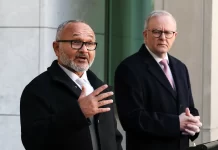
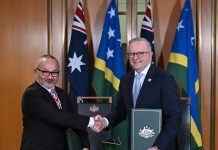

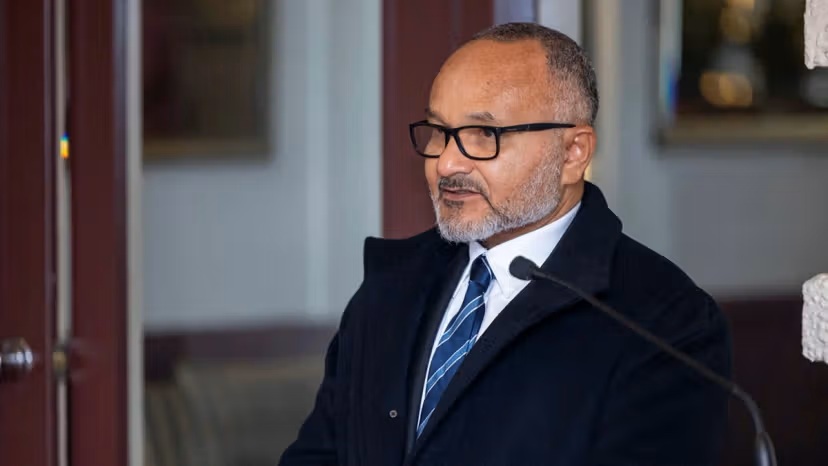
Solomon Islands Prime Minister Matthew Wale says his government wants to end years of regional uncertainty and establish a relationship of trust and certainty with Australia following the signing of a new bilateral treaty in Canberra.
Wale said the Australia-Solomon Islands Treaty would reset relations between the two countries and establish a long-term partnership based on mutual trust, reliability and regional cooperation.
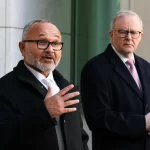
Speaking at a joint press conference with Australian Prime Minister Anthony Albanese following the signing, Wale said Solomon Islands was determined to restore confidence among its neighbours.
“Solomon Islands has been for a number of years a source of uncertainty and doubt in the region. Those days are done. Gone. We don’t want to be there again,” Wale said.
He said being a trusted partner was important not only in relations with Australia and New Zealand but also with the wider Pacific Islands region.
Wale said the two governments had set an ambitious target during his visit to Australia in June to conclude a treaty by late November or early December.
He congratulated Albanese for completing the negotiations ahead of the December deadline.
“We have looked forward to this day for a few months. When I was back here in June, we set an ambitious goal, and that is to conclude a treaty between Australia and Solomon Islands by early December, perhaps late November,” he said.
Wale described the agreement as one that would elevate the relationship into an enduring partnership and provide greater certainty for both countries.
Questions over Solomon Islands’ existing security arrangements with China featured prominently at the press conference.
Asked about the status of the 2022 security pact and policing agreement with China, Wale said he could not disclose details because of confidentiality provisions in the agreements.
“Unfortunately, there is a non-disclosure clause in the treaty with China, the Security Pact and the policing agreement. So, I am unable to talk about that,” he said.
“We have ongoing discussions with China, but of course today is about our relationship with Australia and the Treaty that we’ve signed today.”
Wale was also questioned about whether the treaty would remain in place beyond his leadership, particularly given an attempted motion of no confidence against his government earlier this year.
He said the decision to sign the agreement had the unanimous backing of his government.
“The decision to sign this Treaty is a decision taken by my caucus and my entire cabinet. There was unanimity to sign and so that’s what we’ve done,” he said.
Wale said the agreement would formalise and strengthen cooperation Australia had already been providing to Solomon Islands.
“What it does is that it cements what Australia has already been doing, but it codifies it in the Treaty,” he said.
He also indicated that his government would take steps to secure the treaty through domestic legislation after the national budget process.
“In January or February, after we’re done with our budget, we will put legislation on the floor to bed down the Treaty,” Wale said.
The Solomon Islands leader said he welcomed another motion of no confidence, responding to questions about possible future leadership challenges.
The signing marks a new phase in Australia-Solomon Islands relations, with both governments seeking a formal framework for their future partnership amid continuing regional attention on security cooperation and the Pacific’s strategic environment.