


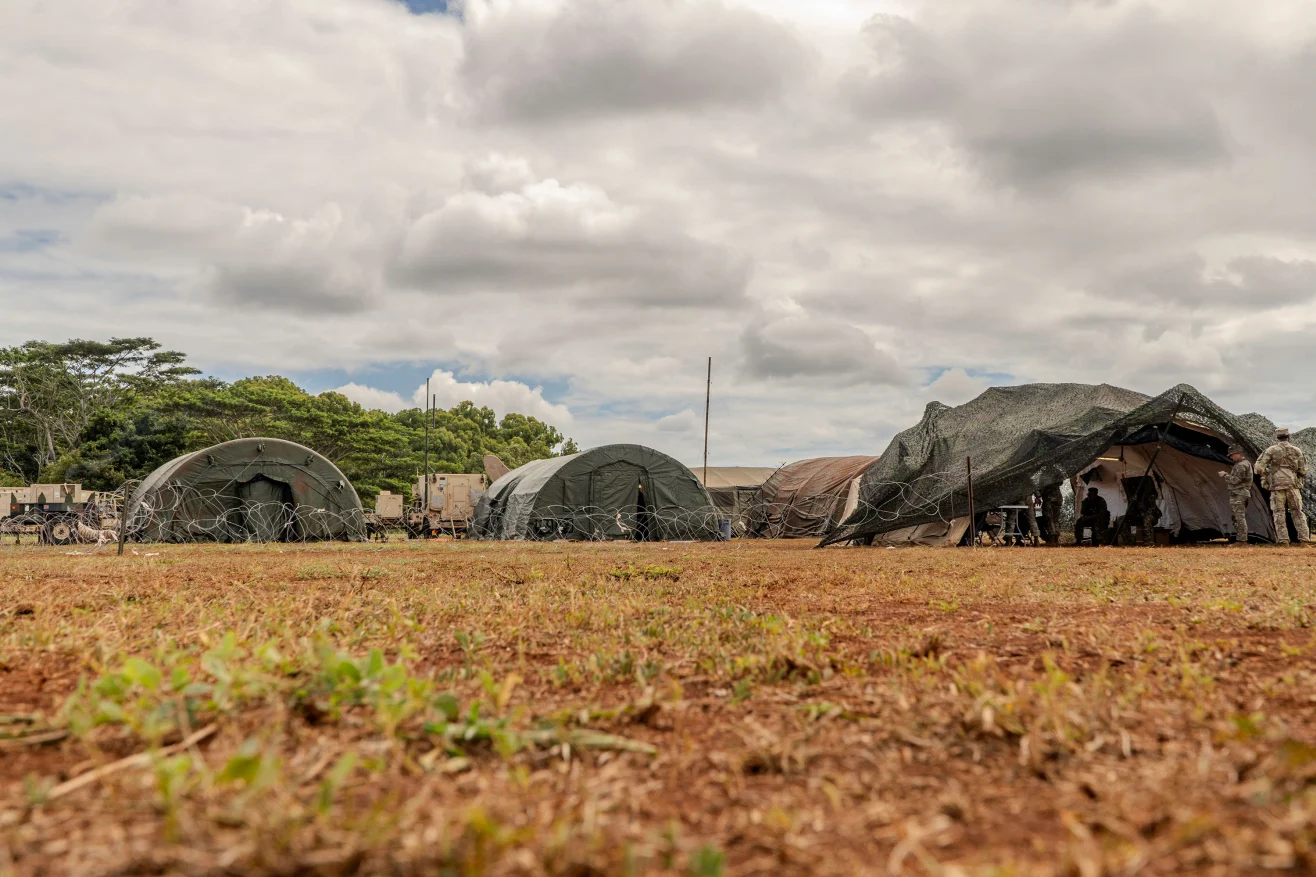
The U.S Army’s internal audit agency fears the service may not be able to quickly deploy forces from its Hawaii bases as planned in the event of war with China in the western Pacific, according to a report that CNN obtained via the Freedom of Information Act.
The report by the Army Audit Agency, completed in April, found “unaddressed infrastructure and equipment issues” and administrative confusion over the responsibilities of a field support battalion charged with supporting deployments from Hawaii.
Auditors concluded that there is risk that Army units “won’t be able to effectively deploy from Hawaii in support of a no-notice contingency or other real world mission.”
Auditors highlighted problems at the service’s deployment support facilities such as lackluster logistics equipment readiness, deployment support training gaps and flooded maintenance bays.
Hawaii plays a vital role in the U.S military’s Pacific war plans, and its roughly 47,000 active-duty troops include those of the 25th Infantry Division, U.S Army Pacific headquarters and U.S Indo-Pacific Command (also known as Pacific Command), among other elements.
U.S planners consider the islands an unsinkable site of relative safety through which troops and equipment can flow to the western Pacific in the event of war with China, whose many missiles threaten U.S and allied bases closer to the Asia mainland.
Unusually, auditors noted that a top official from the Army’s Pacific headquarters requested the review “because USARPAC leaders lacked confidence in U.S.Army Garrison (USAG) Hawaii’s ability to function as a power projection platform.” A spokesperson for the command acknowledged to CNN that the audit revealed “identified opportunities to strengthen unit movement support at the multifunctional deployment facility in Hawaii.”
Michael Mazza, a defence strategy expert at the nonpartisan Institute for Indo-Pacific Security think tank, emphasised the importance of Hawaii to U.S war planners in an interview with CNN.
“The 25th Infantry Division (in Hawaii) is the most forward Army unit designed to deploy … into the region,” Mazza said.
The expert argued that the jungle-specialised division’s absence “would impact the Army’s ability to get into a fight” in the western Pacific if there were delays or even breakdowns in Hawaii deployment processes.
The USARPAC spokesperson said that the Army “consistently evaluates its readiness and ability to project combat power, especially given the immense surface area and tyranny of distance in the Indo-Pacific region.” The command “remains fully prepared to meet global contingency requirements,” the spokesperson added.
In response to auditors’ findings and recommendations, various Army headquarters initially disagreed on whose responsibility it was to devise and fund solutions to the deployment support shortcomings.
The USARPAC spokesperson said that the service “has taken actions to strengthen deployment support,” and the report included action plans for addressing the administrative issues. The command also said that the Army “continues to address infrastructure and equipment requirements at the (deployment) facility through established prioritization, coordination, and resourcing processes.”
The Army plans to treat training exercise missions as “recurring opportunities to deploy forces and equipment (and) rehearse sustainment,” the command said.
The report comes as the U.S military works to evolve how it would support a conflict in the western Pacific.
Historically, Mazza said, the U.S has planned to “rely on a very limited number of large bases in order to flow all sorts of materiel and personnel” from the U.S mainland into the Pacific theater. Those sites have included Hawaii, Guam and bases on Japanese soil.
China’s investment in ballistic and hypersonic missiles, as well as a larger seagoing navy, has led U.S planners to “move towards a far more distributed footprint so that China” has a more complex targeting picture if war were to break out, Mazza said.
China also has developed what experts call a strategy of “anti-access area denial” that aims to use anti-ship and anti-air missiles to force U.S troops to fight their way into the western Pacific’s closer island chains and constantly defend against missile attacks once there.
In response, the U.S Air Force’s core battle approach calls for units to disperse across many smaller bases, and the service is rehabilitating airbases in the region, including the former World War II airfield on Tinian in the Marianas Islands that launched the atomic bomb strikes.
The Army is dispersing previously shipboard prepositioned equipment — designed to enable U.S troops to rapidly deploy and receive key gear upon arrival — to “strategically located land-based locations” in the region.
Hawaii, in this context, “becomes more important once the shooting starts because of its relative safety,” Mazza argued.