

Pacific fisheries scientists are considering new fishing controls for bigeye tuna that could set catch limits for longline fleets and restrictions on fish aggregating devices (FADs), as the Western and Central Pacific Fisheries Commission (WCPFC) moves towards adopting a management procedure by the end of this year.
The proposed management procedure (MP) is designed to keep bigeye tuna stocks around agreed target levels by adjusting fishing opportunities for longline and tropical purse seine fleets.
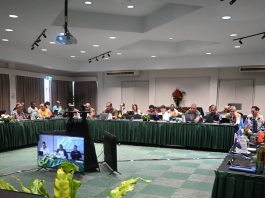
The proposal is outlined in a scientific paper prepared by the Pacific Community’s Oceanic Fisheries Programme (SPC-OFP) for the WCPFC Scientific Committee’s First Special Session, scheduled for 27–28 November in Port Vila, Vanuatu.
The meeting will consider different combinations of longline catch limits and FAD closure periods, with scientists assessing how each combination affects the long-term status of the bigeye tuna stock.
The paper identifies three possible approaches to applying the management procedure across the Western and Central Pacific Ocean (WCPO).
These include managing all longline fisheries across the WCPO; excluding catches by vessels flagged to Small Island Developing States (SIDS); or excluding both SIDS-flagged vessels and the Hawaiian longline fleet.
The proposed options reflect ongoing discussions about which fisheries should fall under the management procedure.
The paper says the output must be a catch limit rather than an effort limit because the management procedure will cover longline fisheries across the WCPO and must avoid potential conflicts with the South Pacific albacore management procedure, which already sets catch limits for longline fisheries operating south of 20 degrees south.
Two target reference points (TRPs) are also being considered.
These are 0.94 and 1.06 times the average spawning biomass depletion recorded between 2012 and 2015. Both options are being assessed using a 50 percent probability formulation.
The target reference points will guide how the management procedure adjusts fishing levels to maintain the stock around the agreed biological targets.
To assess the options, SPC developed a series of projections known as the nuclear grid, examining how different longline catch levels and FAD open periods affect bigeye tuna spawning biomass over the long term.
The projections use 1,152 operating models and include variations in future recruitment to account for uncertainty in stock productivity.
Each model was projected over 30 years, with different longline catch levels and purse seine FAD open periods applied to measure their impact on future stock status.
The results differ depending on which fisheries are included in the management procedure, meaning the three spatial scenarios produce different outcomes.
The paper also presents the projections using approximate scalars from the Tropical Tuna Measure, allowing the proposed options to be considered against existing management arrangements.
Based on discussions at the second Bigeye Management Workshop (BMW02), SPC has also proposed a harvest control rule (HCR) using a step-based structure similar to the one adopted for the WCPO skipjack tuna management procedure.
The harvest control rule would provide a mechanism for adjusting fishing controls in response to changes in the status of the bigeye tuna stock.
The Scientific Committee is being asked to consider the nuclear grid projection results and endorse the proposed shape of the harvest control rule.
The work is part of the WCPFC harvest strategy workplan, which schedules adoption of the bigeye tuna management procedure by the end of 2026.
A separate SPC paper, WCPFC-SSSC01-2026-WP04, will present evaluations of the candidate management procedures.
The decisions will help determine how fishing opportunities for longline and purse seine fleets are managed to maintain bigeye tuna stocks across the WCPO.