

A month ago in Nadi, world leaders and climate negotiators gathered in Fiji, and visited neighbouring Tuvalu.
There, they witnessed first-hand the impacts of climate change on Pacific communities.
At the end of the Pacific pre-COP, President of COP31, Murat Kurum, delivered a promise: “We will see you in Antalya from 9-20 November where we will welcome the whole world. Hopefully, we will succeed together, and the voice of the Pacific will be heard strongly.”
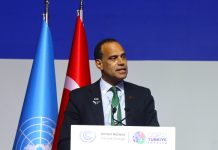
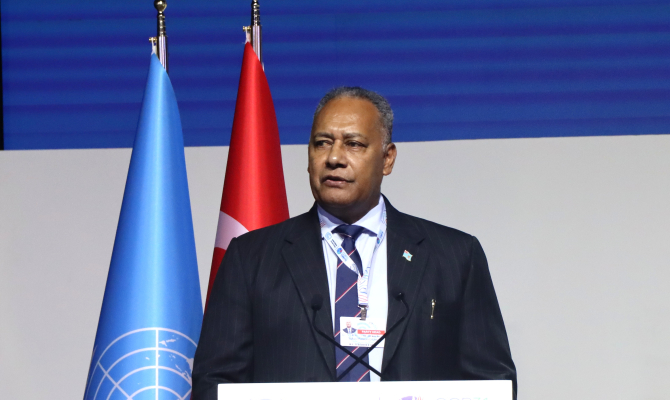
Fast forward to today, and thousands of miles on the other side of the globe in Türkiye, Fiji Minister of Foreign Affairs and External Trade, Sakiasi Ditoka, stood on climate change’s biggest global platform and reminded about the shared commitment made in Fiji and Tuvalu, bolstered by the Taku Pakasoa Declaration, to safeguard the 1.5°C goal.
“For Fiji, the Pacific and SIDS, keeping 1.5°C alive is a lifeline,” he said.
“It is also a legal obligation, a moral responsibility, and a duty by all Member States that we owe to present and future generations.”
Fiji and the Pacific’s work at COP31 centres around four pillars. They are Keeping 1.5°C within reach, enhancing access to climate finance, Elevating the Ocean-climate nexus and Amplifying Pacific voices and leadership.
COP31 follows the UNEP Limiting Overshoot report which warns that global warming will overshoot the headline limit of 1.5 °C. Discussions in Türkiye have largely been about how to deal with the overshoot. Along with cutting emissions, this includes practical ways of removing massive volumes of carbon dioxide from the atmosphere.
“Let us be clear: 1.5°C is not a negotiating position,” Ditoka said.
“We should avoid the overshoot through ambitious action including progress on the transition away from fossil fuels, deep methane reductions, and adherence to the best available science. The IPCC must remain the sole credible science.”
Fiji, as the Chair of the Pacific Small Islands States (PSIDS), also reminded world leaders, that the ICJ Advisory Opinion affirmed that limiting warming to 1.5°C is the primary temperature goal, and the UN General Assembly has called for accelerated climate action in response.
“COP31 must now deliver outcomes consistent with that responsibility.”
A critical part of such outcomes should provide Pacific communities with adequate grant-based climate finance.
“Every fraction of a degree of overshoot increases adaptation needs and amplifies loss and damage,” said Minister Ditoka. “There can be no effective adaptation without climate finance.
“Fiji reaffirms the NCQG (New Collective Quantified Goal) as the principal multilateral framework for mobilizing and providing international climate finance and the climate finance gap must be addressed.”
Fiji also called for support for the Pacific Resilience Facility to deliver resilience finance directly to vulnerable communities.
On the Ocean, Fiji said this should be at the centre of climate action.
“We must also advance climate justice and uphold the dignity, rights, and sovereignty of our peoples. Here in Antalya, we must move beyond recognition of threats and advance a clear pathway for Ocean-based climate action and accountability.”
Time is of the essence, COP31 was reminded.
“For Fiji and the Pacific, climate change threatens our people, our development, and our very existence,” he said.