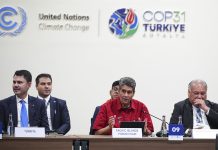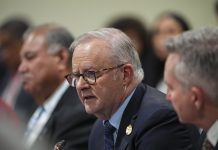



Tuvalu Prime Minister Feleti Teo says his country is not preparing to abandon its homeland but is demanding stronger climate action to protect its people, identity and sovereignty as rising seas threaten the future of Pacific island communities.
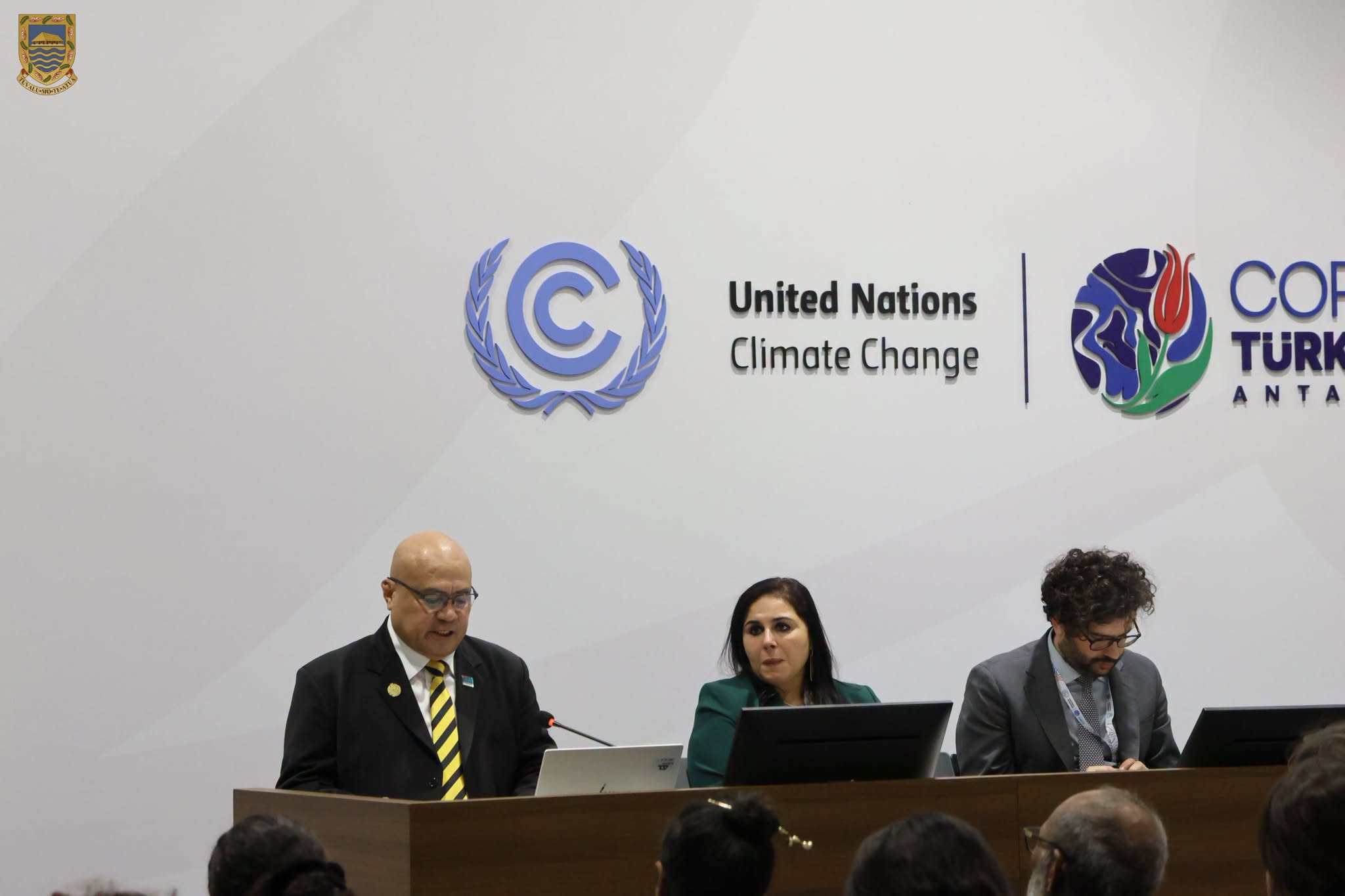
“We are not planning to abandon our homeland. We are planning to protect our people, our identity and our future,” Teo said at a COP31 side event convened by the International Organisation for Migration (IOM) and the United Nations High Commissioner for Refugees (UNHCR) in Türkiye.
Teo said climate change displacement was already a reality for Tuvalu, with rising sea levels, coastal erosion, saltwater intrusion and increasingly severe weather affecting homes, livelihoods and communities.
He said the right of Tuvaluans to remain safely on their ancestral land remained the country’s priority, with adaptation measures including coastal protection, land reclamation and stronger community resilience.
Teo said any discussion about climate-related movement must recognise that home was more than a physical location for Tuvaluans.
It represented their identity, culture, ancestors, language and sovereignty.
However, he acknowledged that where displacement became unavoidable, people must be able to move with dignity, protection of their rights and freedom of choice.
Tuvalu is developing a National Plan on Climate Change Displacement and Human Mobility to protect affected communities and establish pathways that safeguard family unity, education, healthcare, employment and fundamental human rights.
Teo stressed that communities must have a central role in decisions about their future, with women, young people, persons with disabilities and older people included in planning and decision-making.
“Because there may be many places where a person can live, but there is only one place they truly call home. For us, that place is Tuvalu,” he said.
Tuvalu is calling for international climate action that protects people’s right to remain on their land while guaranteeing dignity and rights for those forced to move.
At a separate COP31 side event at the Australian Pavilion, Teo called for Pacific climate and energy commitments to be translated into investment, infrastructure and practical results.
“For the Pacific, the time for ambition alone has passed. The priority now is turning commitments into real investment, infrastructure and results,” he said.
Speaking at the event, titled From Ambition to Implementation: Data-Driven Pacific Energy Transitions, Teo outlined Tuvalu’s efforts to strengthen energy security, reduce dependence on imported fossil fuels and develop a more resilient energy system.
He highlighted the development of Tuvalu’s Energy Transition Masterplan, supported by the Australian Government through the Australia-Pacific Partnership for Energy Transition.
The plan is intended to strengthen energy planning, improve data systems and guide investment decisions as Tuvalu works towards a more sustainable energy future.
Teo said Pacific countries must have a leading role in determining their energy priorities and designing solutions that reflect their national circumstances.
“The Pacific does not need solutions designed for us without us. We need solutions designed with us, led by us, and owned by us,” he said.
He called for greater investment and stronger partnerships to support practical energy transitions across the region.
Tuvalu’s interventions at COP31 highlight the need to protect communities and their right to remain on ancestral lands while securing investment to build climate-resilient and sustainable economies.