The midterm elections in the United States could bring closer scrutiny of Washington’s growing military footprint and push to secure seabed minerals across the Pacific.
This comes as island leaders warn that national security cannot come at the expense of local communities.
As of Thursday, Democrats had control of the U.S Senate with 237 seats to Republicans’ 147, according to media reports. All 435 seats in the House of Representatives and 35 of the 100 seats in the Senate are contested to determine the 120th United States Congress.
The landslide ‘blue wave’ victory gives the Democrats a clear majority in the upper chamber. The final balance of power in the House of Representatives is also key to determining how much of President Donald Trump’s agenda can move through Congress.
The results have also produced a mixed picture across the U.S Pacific. In Guam, Republican Vicente Ada won the governorship with 51 percent of the vote to Democrat Therese Terlaje’s 48 percent while Democrats took eight of the 15 seats in the local legislature and Alicia Limtiaco defeated Republican congressional delegate James Moylan.
In the Northern Mariana Islands, Republican Ralph Torres won back the governor’s office with 49 percent of the vote to independent Blas Attao’s 38 percent while Republicans also regained control of the local Senate.
The new U.S Congress will have powers over federal spending and oversight as plans move ahead around the Mariana Trench, American Sāmoa and other parts of the Western Pacific.
One of the biggest questions for Pacific communities is who gets to decide what happens to their land and waters as the U.S steps up its response to China.
At a regional security forum hosted by the Pacific Centre for Island Security (PCIS), Joe Enlet former Federated States of Micronesia Consul General and marine affairs researcher warned that U.S security plans must not override the rights of traditional landowners.
“Strategic denial does not replace the free, prior and informed consent of traditional clan landholders.”
Enlet was speaking about planned defence expansion in Yap where he said security needs to be viewed more broadly than military hardware and spending.
He pointed to the Chuukese concept of tumwun, which takes a wider view of protecting people, land and sea.
Enlet says that means US investment should also support areas such as independent courts, control over digital data and cleaning up environmental damage.
The debate is also reaching into plans for new energy systems at U.S military bases.
American defence planners are looking at Small Modular Reactors and microreactors as a way of providing power to bases without relying on civilian electricity networks.
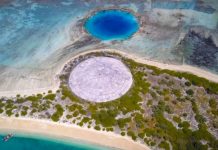
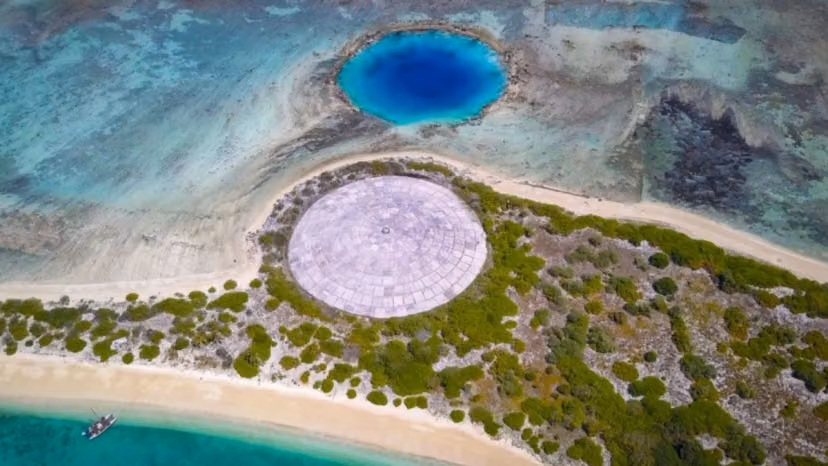
Pacific climate leaders point to the vulnerable Runit Dome in the Marshall Islands as a stark reminder of Cold War environmental costs as new defence and nuclear initiatives face scrutiny following the U.S midterm elections. Photo/Global School of Sustainability
But the idea is facing strong opposition from Pacific climate leaders.
Dr Kathy Jetñil-Kijiner, Climate Change Envoy for the Marshall Islands, warned that nuclear technology was not the answer for small island communities.
“SMRs are too expensive, slow to build, and hazardous for small island grids compared to proven solar and wind renewables.”
Her concerns are also shaped by the Marshalls’ history of U.S nuclear testing and the continuing problems around the Runit Dome where nuclear waste from the testing era remains stored.
Meanwhile, investigative journalist Rob Perez has highlighted the long-term impact of U.S military activity on Guam.
Perez’s findings point to contamination from historic military sites including toxic waste and persistent chemicals that have affected local drinking water and communities over decades.
The concerns come as Washington looks to strengthen its military position across the Pacific through new infrastructure, weapons systems and energy projects.
The U.S also wants greater access to critical minerals including resources beneath Pacific waters.
For island communities, the issue is not simply whether those resources have strategic value. It is whether decisions about them are being made with the people who live on and around those waters.
The new U.S Congress will now have an opportunity to use its spending and oversight powers to examine how those projects are being planned, funded and carried out.
Pacific leaders and advocates are calling for that scrutiny to include environmental protection, local consent and indigenous rights alongside US security interests.