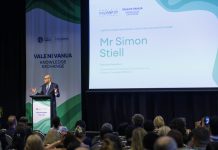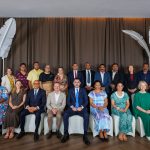

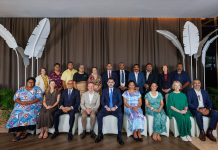
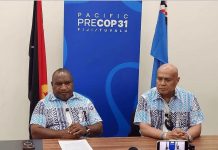
Solomon Islands Prime Minister Matthew Wale has called for stronger political action and accountability from major greenhouse gas emitters, warning that climate change is already an existential threat to Pacific Island countries.
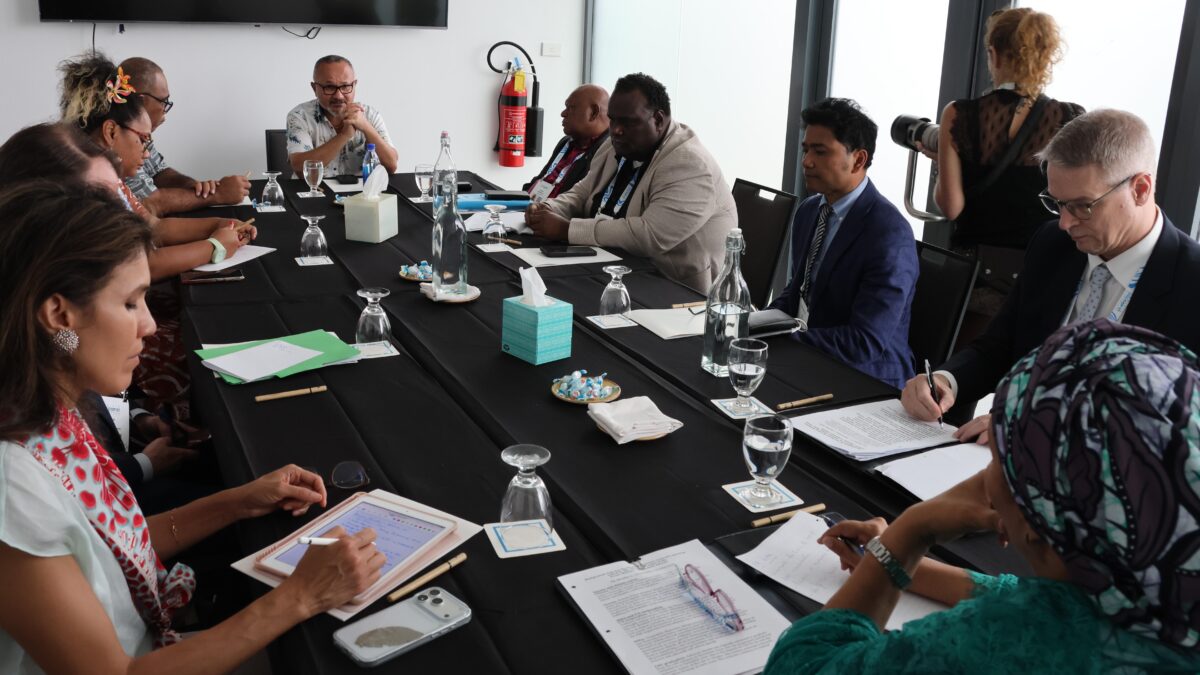
Wale raised the issue during a meeting with United Nations Deputy Secretary-General Amina J. Mohammed on the margins of Pre-COP31 in Nadi.
He called for concrete action to keep the Paris Agreement’s 1.5°C target alive and urged greater engagement with major political groupings, including the G7, G20 and BRICS.
Wale proposed research into historical and current emissions to help inform accountability mechanisms based on the polluter-pays principle.
He questioned whether the current United Nations Framework Convention on Climate Change (UNFCCC) process provides sufficient pathways to address historical emissions and hold major emitters accountable.
The Prime Minister also called for greater political attention to fossil fuel subsidies and continued investment in fossil fuels.
“The Pacific Ocean serves as a major carbon sink, removing carbon from the atmosphere and providing a global environmental service, while major emitters continue to benefit from this natural function without adequately compensating vulnerable Pacific countries,’ Wale said.
Mohammed acknowledged the need for greater engagement with major political groupings and pointed to multilateral development banks, including the International Monetary Fund(IMF) and World Bank, as potential drivers of change where political will and capital are available.
Wale also advocated wider adoption of the Multidimensional Vulnerability Index to improve access to development and climate finance for Small Island Developing States, including grants and concessional financing.
Mohammed acknowledged the lack of progress in global climate ambition and the need for stronger action ahead of COP31.
At a separate high-level political session of the Pacific Action for Climate Transitions (PACT) Pre-COP31 event, Wale called for greater investment in nature-based solutions as part of the Pacific’s climate response.
He said coral reefs, mangroves and other coastal ecosystems should be recognised as critical infrastructure alongside conventional engineered solutions.
“In the Pacific, coral reefs protect 41 percent of hazard-exposed coastal people, the highest share of any region,” Wale said.
He said engineered seawalls can cost between US$15 million and US$20 million per kilometre, while investment in natural coastal protection can provide multiple benefits.
“Investing in reefs, coastal protection and mangroves is cost-effective adaptation, disaster-risk reduction and food security in one,” he said.
Wale cited the 2026 State of Finance for Nature report, which estimates about US$220 billion is invested annually in nature-based solutions, compared with approximately US$7.3 trillion flowing into activities that harm nature.
He said the imbalance showed the need to redirect investment towards approaches that strengthen environmental and economic resilience.
For Pacific countries, Wale said climate finance should support locally led and Pacific-designed mechanisms rather than complex systems that small administrations struggle to access.
He highlighted opportunities for Solomon Islands in marine planning, blue-carbon initiatives, community-based marine management, forest restoration and conservation.
“We do not ask the world to save our Blue Pacific Continent. This ocean already works for us: it feeds us, shelters us, and holds our culture and history,” Wale said.
He called for partnerships that allow Pacific countries to sustainably manage and invest in their natural capital on terms that reflect their circumstances and priorities.