

The message came in the middle of the night.
Waves whipped up by a hurricane thousands of miles away, near Hawaii, were washing over a dock in the Republic of the Marshall Islands (RMI), a dock built to withstand higher seas.
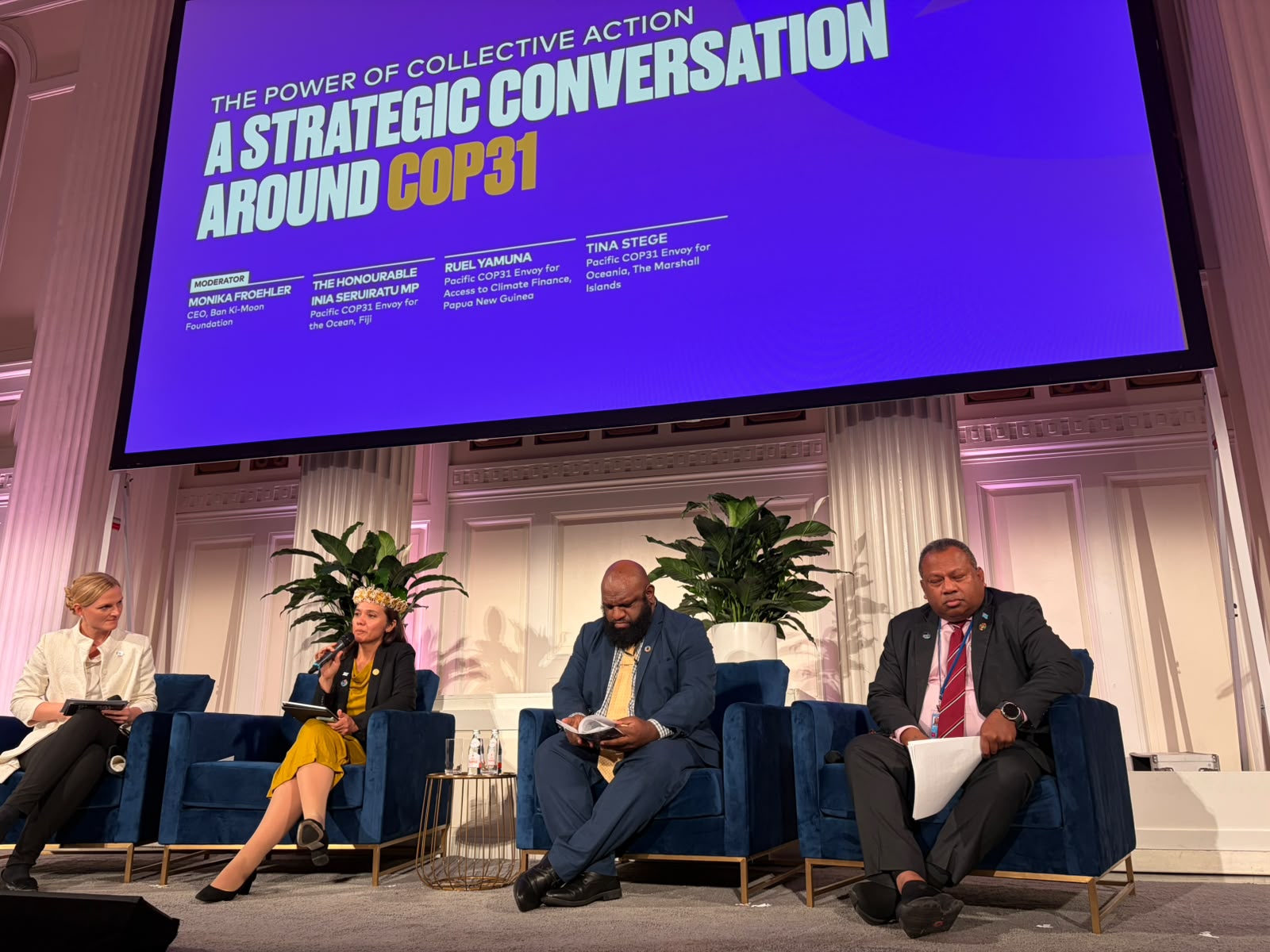
This is what 1.5 degrees Celsius looks like for Kristina Stege, the Pacific Climate Envoy from RMI. “In the Pacific, 1.5°C is not an abstract benchmark. Fighting for 1.5 is the fight for our homes and our communities.”
Across the region, the climate crisis is not a future scenario. It is already here, in coastlines washing away, in warming seas, and in damaged ecosystems where communities live and work.
That is what makes the call to keep 1.5°C or below so urgent. But ambition alone will not protect vulnerable communities. Investment has to reach the places where climate impacts are already being felt.
That gap is the focus of Ruel Yamuna, the Pacific Climate Envoy for Access to Climate Finance. He said the world needs to rethink how climate finance reaches frontline countries.
“The problem is not simply whether climate finance exists. It is whether countries and communities on the frontline can actually access it.”
For Pacific island countries, the obstacles are many from complex application processes, fragmented funding systems, limited capacity, high transaction costs to the realities of remoteness. Any of them can stand between a global funding pledge and the project it was meant to pay for.
“Ultimately, success is not money approved in Washington, New York or elsewhere. Success is finance reaching communities and changing lives on the ground.”
And so often, what that finance protects is tied to the ocean.
Inia Seruiratu, the Pacific Climate Envoy for Oceans, said the ocean cannot be treated as separate from climate, resilience or human security. “In the Pacific, the ocean is not simply an environmental issue or a sector of the economy. It is who we are.”
The ocean feeds families, sustains livelihoods, supports economies and cultures, and helps regulate the global climate. Yet it is under mounting pressure from warming, sea-level rise and the loss of ecosystems.
That is why the Pacific wants investment that does more than protect communities from climate impacts. It is calling for money that backs what the ocean itself can offer which is from resilient fisheries and sustainable ocean management to clean shipping, renewable energy, conservation and nature-based solutions.
“Protecting the ocean means protecting people,” Seruiratu said.
As the UN Climate Change Conference (COP31) approaches, the Pacific is bringing a message grounded in lived experience: climate finance must move from commitments to communities, 1.5°C must remain the guiding ambition, and the ocean must be recognised as part of the solution.
For Seruiratu, the measure of success at COP31 is simple. “Success is no more dialogue. We need to go into implementation. Dialogue will not save the planet – we need to go into action. Action now, so we will save the world and leave it a better place for our children in years to come.”
The waves that washed over that dock in the middle of the night were a warning. They were also a reminder of what is at stake, and that is the reason the Pacific will not wait.
The 81st session of the United Nations General Assembly and Climate Week New York was held from 20 to 28 September 2026.