

By Pita Ligaiula in Savusavu
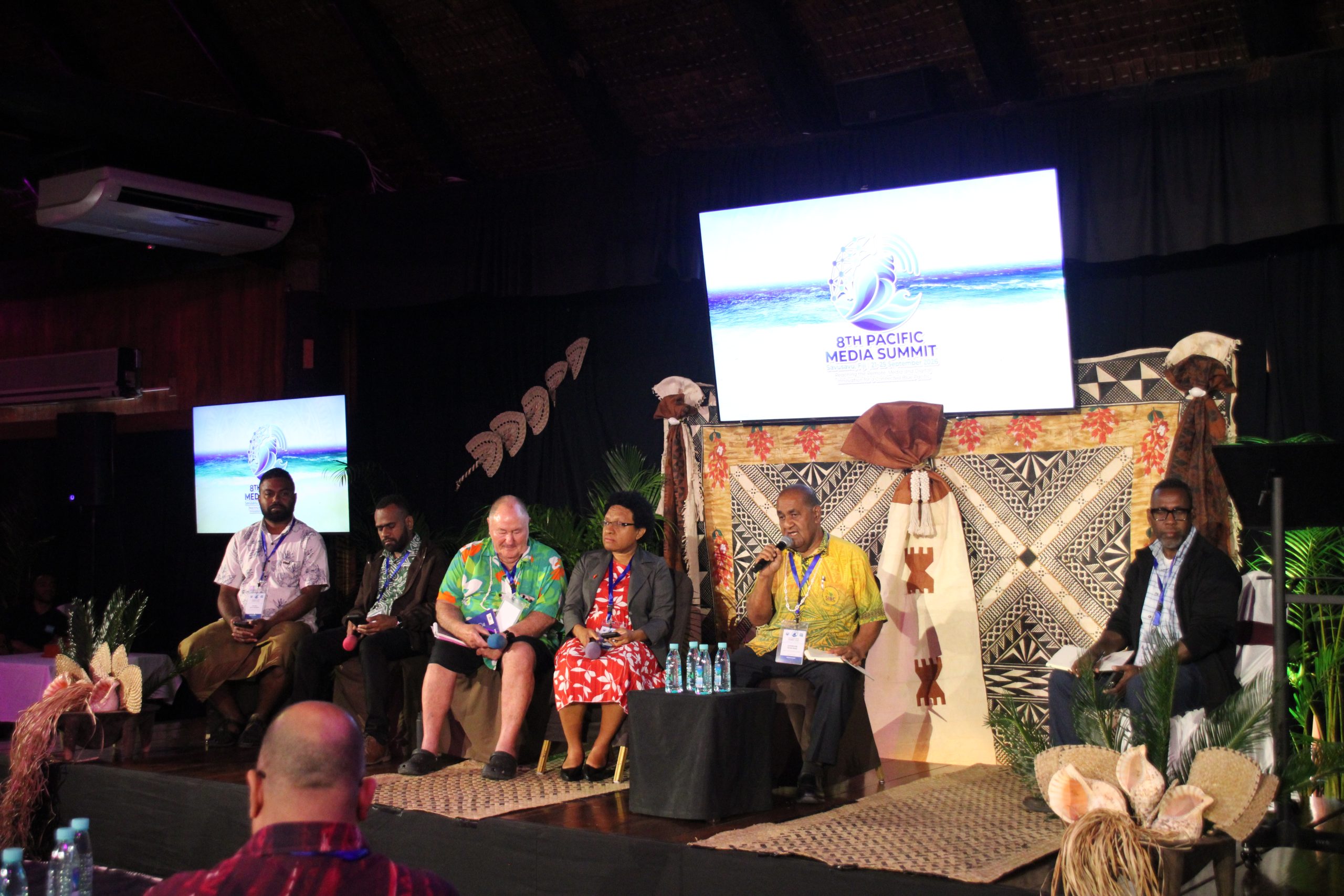
Pacific newsrooms must protect their core values while finding practical ways to reach remote communities, speakers at the Pacific Media Summit in Fiji have said.
President of Vualiku Media and Fijian Media Association North member, Peceli Naviticoko, said journalists covering Fiji’s Northern Division faced long distances, high transport costs, poor connectivity and small newsroom numbers, but continued to find ways to report from communities.
“The North has no shortage of stories. The challenge is reaching them,” Naviticoko said.
Naviticoko said journalists covering Cakaudrove, Bua and Macuata often travelled for hours by road and boat to reach communities, with some assignments taking them into areas with little or no connectivity.
He said the Northern Division’s maritime communities also faced high fuel and transport costs, while cyclones and floods could cut off access to outer islands.
“Being resourceful, we find a way,” he said.
Naviticoko said community networks had become an important part of reaching remote areas, allowing journalists to identify stories, arrange interviews and maintain contact when conventional communication was difficult.
He said journalists also had to make the most of whatever equipment was available.
“Resourceful is not having everything, it is making the most of what you have,” Naviticoko said.
He said collaboration between journalists could improve access to communities and information, but should not compromise editorial independence.
“We can share access, we can share knowledge, we can share resources, but our journalism remains,” he said.
Naviticoko said journalists could travel together and share logistical resources while still producing independent reports and different angles on the same story.
“We can collaborate on access without collaborating on the journalism itself,” he said.
He said the need for journalists to physically reach communities remained important as old or inaccurate information continued to circulate online.
“We are the one on the field,” he said, stressing the role of local journalists in verifying information and providing updates from communities.
Naviticoko also highlighted the importance of modern technology, training and investment in regional newsrooms.
He said journalists in the North needed greater access to professional development, equipment, digital tools and opportunities to participate in regional and international programmes.
Publisher of Cook Islands News, John Woods, said his newspaper had also relied on innovation and diversification to survive difficult economic conditions.
Woods said Cook Islands News nearly collapsed during the COVID-19 pandemic after the country’s economy effectively shut down.
“We nearly died during COVID,” Woods said.
He said the company’s owners had injected personal funds to keep the business operating before shifting more strongly towards digital journalism.
The newspaper continues to print a nightly tabloid edition, with families working through the night to hand-fold and distribute copies to subscribers.
Woods said the publication’s website now had more than 50,000 regular readers, many of whom paid for access, while its digital strategy also targeted about 100,000 Cook Islanders living overseas, mainly in New Zealand, and another 50,000 in Australia.
He said technology had also helped the newspaper reach Cook Islands communities outside the main island.
The Cook Islands consists of 15 islands spread across about 2,000 kilometres, making reliable communication and distribution a major challenge.
Woods said Starlink had helped the newspaper reach outer islands after repeated problems with the government-owned undersea cable.
“We can reach our outer islands,” he said.
President of the Media Association of Vanuatu, Sale Sumbe, said trusted journalism became even more important when disasters disrupted communication systems.
Referring to the 7.3 magnitude earthquake that struck Port Vila on 17 December 2024 and killed 14 people, Sumbe said mobile networks and other infrastructure were badly affected.
He said people continued searching for information despite communication disruptions, creating a greater risk of rumours and misinformation.
“People don’t stop looking for information simply because the mobile network is down,” Sumbe said.
Sumbe said connectivity tools could help restore communications during emergencies, but journalists still had to ensure the information being distributed was accurate and verified.
“Technology can help us reach the remote, but also trust is what allows us to reach the world,” he said.
He said audiences were increasingly turning to social media for information, but established media organisations continued to be trusted, particularly during crises and major public events.
Sumbe said Pacific media should not try to compete with social media only by being faster.
“We should not try to compete with social media simply by being faster but by being more accurate, more trusted and also more relevant to our communities,” he said.
He said remote communities should not only consume information but should also have opportunities to tell their own stories, raise concerns and contribute to national discussions.
“Technology can help us reach further and faster, but our values determine whether people can trust what we deliver,” Sumbe said.
He said the development of artificial intelligence and changing patterns of media consumption would continue to reshape journalism, but the fundamental responsibility of journalists would remain unchanged.
The speakers said the challenge for Pacific media was therefore not simply reaching remote audiences, but doing so while maintaining independence, accuracy, relevance and public trust.