
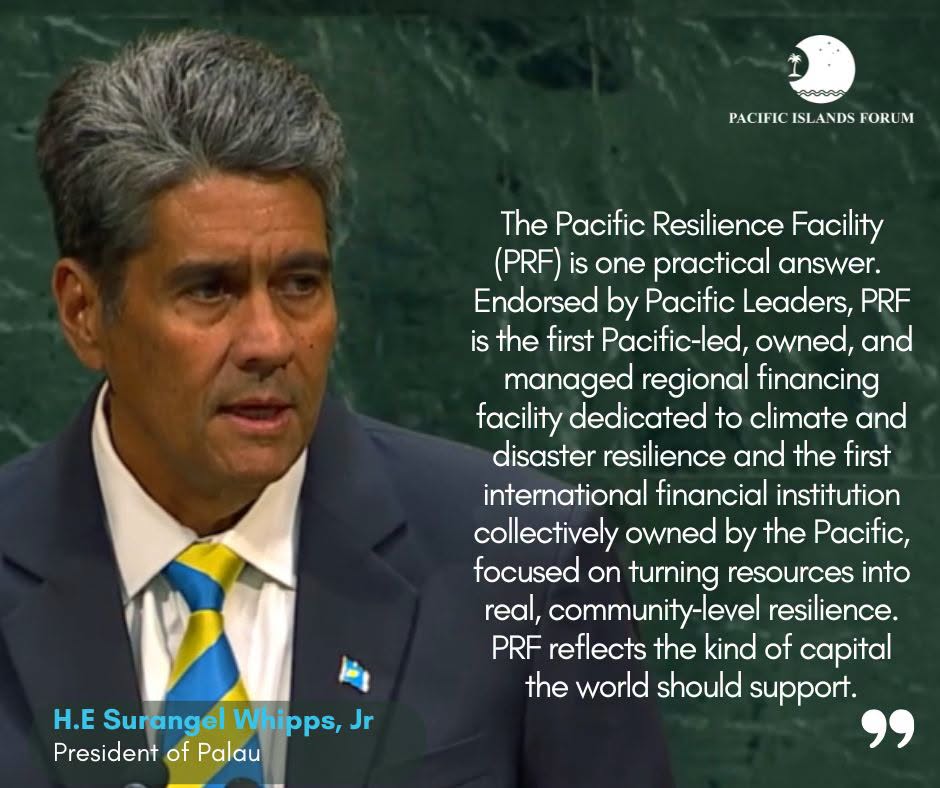
Palau President and Forum Chair, Surangel Whipps Jr has warned that the Pacific must not be treated as a theatre for geopolitical competition, calling for respect for Pacific sovereignty, international law and the region’s right to determine its own future.
Delivering Palau’s High-Level Statement at the 81st United Nations General Assembly(UNGA), Whipps said the Pacific was home to people, communities, cultures, fisheries and ecosystems and should remain an Ocean of Peace.
“The Pacific is our home, not a theatre for geopolitical competition.
“It must remain an ocean of peace where nations meet in cooperation, international law is respected, and the security of the Pacific peoples is never compromised,” Whipps said.
Whipps said Pacific leaders had raised concerns at the 55th Pacific Islands Forum Leaders Meeting in Palau over China’s ballistic missile test overflying several Pacific nations without adequate notice.
“Let me remind you: our region must never be treated as an empty expanse for strategic competition or test of military power,” he said.
He said the Pacific’s approach to security was to address tensions before they became crises, create space for dialogue and uphold respect, restraint and international law.
“The Pacific way is to address tensions before they become crisis, make room for dialogue before disagreement becomes conflict, seek inclusion rather than isolation, and uphold respect, restraint, and international law,” Whipps said.
Whipps said the Pacific’s security was also tied directly to climate change, ocean health, energy and access to finance.
He said the latest findings from the UN Environment Programme showed the world was now certain to exceed the 1.5°C temperature threshold, making delivery on climate commitments more urgent.
“This reality must strengthen our resolve to deliver what we have promised, prepare our communities for the impacts science tells us are inevitable,” he said.
Whipps highlighted the Pacific’s Unlocking Blue Pacific Prosperity initiative, launched at COP28 and reinforced by the Pacific Leaders’ Ocean Statement adopted in Palau.
He said the initiative brings together 22 Pacific countries and territories to mobilise investment for sustainable ocean management, food systems and resilient livelihoods.
Palau was translating the regional vision into national action through its Sustainable Ocean Policy, which commits to science-based and adaptive management of its ocean.
But Whipps said the key issue was now delivery.
“The task now is delivery,” he said.
“We need financing that reaches communities without adding debt, adaptation finance that is accessible to countries already bearing the cost of the problems they did not create, and full support of the loss and damage and the special circumstances of SIDS.”
He called for grant-based and concessional finance, support for energy systems and investment that reflects the circumstances of small island developing states.
“Those who contributed the least to this climate crisis yet confront the worst threats of rising sea levels must not be burdened with debt simply to purchase a life jacket for their survival,” Whipps said.
He also backed the Pacific Resilience Facility as a Pacific-led mechanism to turn resources into community-level climate and disaster resilience.
Whipps said energy security was also climate and national security.
“Energy security is climate security and national security,” he said.
He highlighted the Mana Bara Call to Action, through which Pacific leaders reaffirmed a vision of 100 percent renewable energy and a just and inclusive transition away from fossil fuels.
Palau’s latest national commitment targets a 44 percent reduction in fossil fuel use by 2035, supported by renewable energy generation and policies aimed at making the transition affordable and reliable.
He said reducing dependence on imported fuel would also reduce vulnerability to external shocks and prices that Pacific countries could not control.
Whipps said Palau would continue to work with partners but would not compromise its sovereignty.
“Partnership must never become pressure, and assistance must never come at the cost of the nation’s values, institutions, or the freedom to choose.
“Sovereignty is not isolation; it is the freedom to cooperate through mutual respect, transparency, accountability, dialogue, and international law,” he said.
He said Palau remained “a friend to all” and would choose partners based on shared values including democracy, human rights and a rules-based international order.
Whipps reaffirmed Palau’s support for Taiwan’s meaningful participation in the international system, saying the UN should recognise the rights and voices of its 23 million people.
He said small states had the same sovereign right to determine their future, choose their partners and pursue development that served their people.
Whipps said the Pacific’s concerns extended beyond climate and ocean issues to global peace and security.
He cited the Russia-Ukraine war and tensions around the Strait of Hormuz as reminders of the consequences of conflict and the need for diplomacy and international law.
Whipps said the Pacific continued to call for dialogue over escalation and for differences to be resolved peacefully.
He said the region’s vision was ultimately about protecting future generations.
“Our children and their children deserve a world that is safe, healthy, and clean.
“Knowledge is like ocean waves. It comes in many forms and sizes, yet no wave overpowers another, and they ultimately reach the same shore.”
“Let us leave this Assembly committed to multilateralism that honors every voice, values every form of knowledge, and carries us toward a safer, healthier, and more peaceful world,” Whipps said.