

Team of local and international experts will conduct the first comprehensive baseline analysis of Tokelau’s nearshore reefs, offshore and deep sea environments.
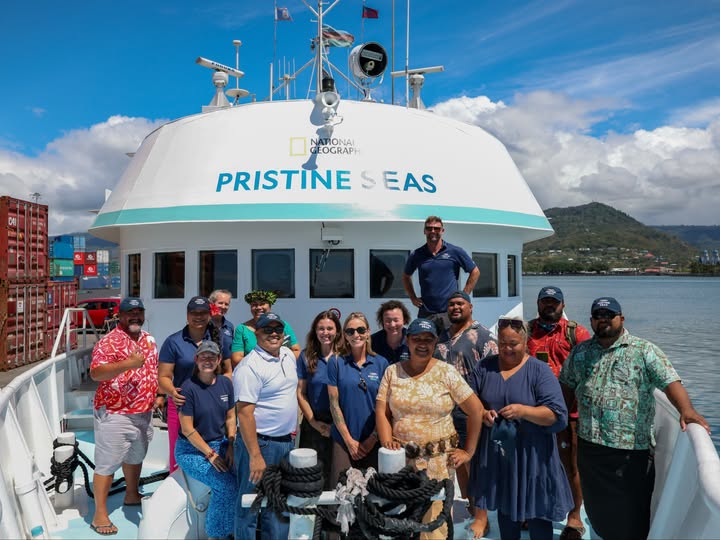
National Geographic Pristine Seas begins an expedition this week in Tokelau. At the invitation of Tokelau’s government and in partnership with its Ministry of Climate, Ocean & Resilience (MiCORe), the team of scientists and filmmakers will study the nation’s marine ecosystems to identify vital areas for protection.
Surveying biodiversity in reef, mid-ocean, and deepwater sites, researchers will provide data to support Tokelau’s ongoing conservation efforts, including the development of a future National Ocean Policy and marine spatial plan.
A Pacific Island nation that is a non-self-governing territory of New Zealand, Tokelau has vast marine resources and a deep commitment to sustainability.The island chain comprises three coral atolls with a combined land area of roughly 12 square kilometers. Its ocean territory, spanning approximately 319,000 square kilometers, makes its Exclusive Economic Zone (EEZ) over 25,000 times larger than its total land area. In 2011, the territory declared its entire marine zone a shark sanctuary, demonstrating its profound commitment to ocean conservation.
“We have a line from one of our songs that captures our enduring relationship with the ocean: ‘Tautai koe o te moana, manatua te kaifenua’ — Master fishermen of the ocean, remember the sustenance of the people,” said Paula Faiva, Director of the Ministry of Climate, Oceans and Resilience (MiCORe).
“For Tokelau, the moana is more than a resource; it is our identity. As Tagata Tokelau, we are ocean people. The ocean sustains our livelihoods, nourishes our families, and underpins our food security through the resources harvested from our lagoon and the vast Pacific Ocean. It is our pathway between our atolls and outer islets, connecting our communities and linking us to the wider world.”
The nation’s lagoons host giant clams with vivid neon-blue and green mantles, endangered green and hawksbill sea turtles, and blacktip reef sharks. Its open ocean serves as a migratory corridor for whale sharks. And the enormous and endangered humphead wrasses still call the steep outer reef drop-offs home.
“Tokelau’s commitment to ocean conservation is an inspiration and we’re honored to support its vision for future marine management,” remarked Kelly Moore, head of Pristine Seas’ expedition to Tokelau. “We hope our efforts studying the stunning waters near Nukunonu, Atafu, and Fafaofo will provide leaders and communities with information they need to continue prospering from and protecting the sea.”
The team of local and international experts will live and work aboard Pristine Seas’ ship, the Argo, to gather information from the depths of the sea floor to the skies above. Scientists will survey marine life while SCUBA diving, drop deep sea cameras to collect overnight footage, float video systems ten meters below the surface to document the marine life swimming by, and assess bird life above the waves. Using environmental DNA (eDNA) sampling, the team will filter small bits of matter that can later be sequenced to identify organisms not always seen with cameras or the naked eye.
Strapped inside Pristine Seas’ state-of-the-art submersible, the Argonauta, expedition team members will plunge into the depths off Tokelau’s coast to observe first-hand the “twilight zone,” a frontier of deep-sea biodiversity teeming with marine life. The Argonauta is outfitted with mud and water samplers, a nearly 360 underwater view, imaging sonar and more, allowing the team to gather valuable data from one of the least understood parts of the planet.
“The underwater realm surrounding Tokelau is virtually unexplored by scientists. Every dive, water sample, and film clip brings us closer to documenting and understanding their marine environment ,” said Molly Timmers, Pristine Seas’ research lead for the expedition to Tokelau.
“By filling in foundational data gaps, we are providing their leaders with essential information to support their marine conservation goals.”
Throughout the expedition, Pristine Seas filmmakers will capture footage for a documentary film about Tokelau’s special relationship to the ocean. Filming in communities and aboard the Argo, the documentarians aim to illustrate the importance of ocean conservation across the atolls.
Although Tokelau emits virtually no carbon emissions, rising sea levels pose an existential threat to the nation’s three low-lying atolls, even as global warming drives increasingly severe cyclones and intense coral bleaching. Tokelau’s marine environment also faces imminent threats from overfishing, pollution, and invasive species.
“Our expedition to Tokelau wraps up just days before the next global biodiversity conference — where the world will evaluate progress on the Global Biodiversity Framework (GBF),” said Kevin Chand, Sr. Director of Pacific Ocean Policy for Pristine Seas.
“This expedition was sparked by early conversations with Tokelau’s MiCORe on the importance of marine biodiversity conservation in line with commitments under the GBF and we hope the data this expedition collects will support Tokelau with its ocean protection and management goals.”
Precious Resources & Community Education
Education about Tokelau’s marine ecology and ocean conservation is a key component of the upcoming expedition, which will engage directly with classrooms and communities.
“This is a once-in-a-lifetime opportunity for our students, not only to experience being on the research vessel, but also to participate in hands-on scientific activities and experiments that they would otherwise have very limited access to in Tokelau,” remarked Tupa’i Nicki Perese, Curriculum and Assessment Coordinator for the nation’s Department of Education.
Working with the Tokelau Department of Education, Pristine Seas is supporting an innovative and experiential education program for secondary students, helping the country foster a future generation of ocean guardians. Pristine Seas will also run educator training on eDNA, while supporting student research and activities on climate change and ocean literacy. And a major highlight for local students: During the four-week expedition, Pristine Seas will invite every student in Tokelau to tour its ship.
“The ocean has sustained our ancestors for generations and remains fundamental to our future,” reminds Director Faiva. “Its health and resilience are inseparable from our own wellbeing and prosperity. As we respond to the challenges of climate change, we continue to draw upon the wisdom, knowledge, and values passed down through our ancestors, combining them with modern science to ensure that we remain faithful stewards of our ocean. Protecting the moana is not only essential for our survival; it is critical for our ability to thrive as a people, now and for future generations.”
Pristine Seas started its Global Expedition in 2023 with a mission to spend five years exploring the tropical Pacific and supporting communities and governments in their efforts to protect the ocean. Since 2023, the team has explored and studied the Southern Line Islands, Tongareva, Niue, The Republic of the Marshall Islands, the Federated States of Micronesia, Palau, Papua New Guinea, Samoa, Solomon Islands, Fiji, Tuvalu and Vanuatu.