
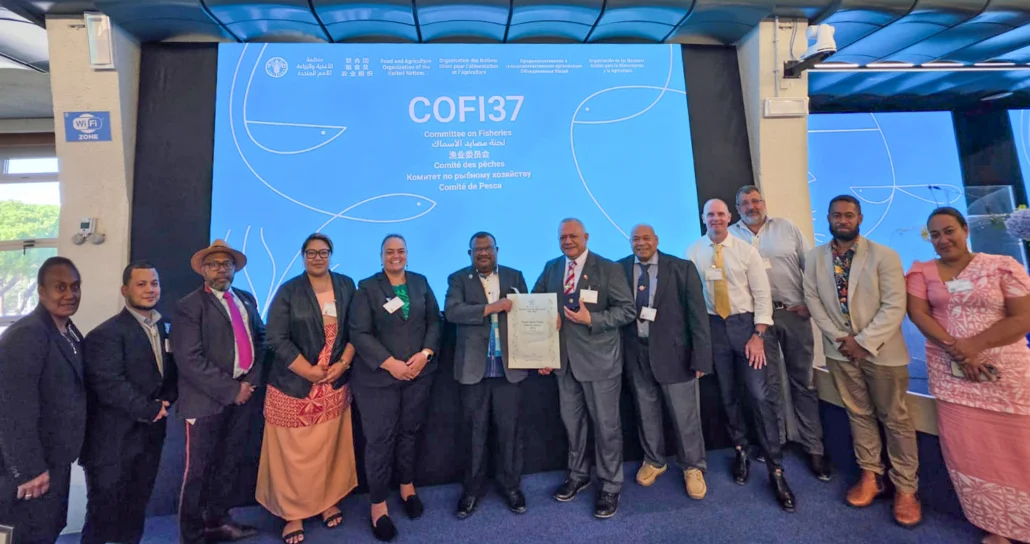
Pacific Island countries and territories have reinforced their collective leadership in sustainable fisheries management at the 37th Session of the Food and Agriculture Organisation (FAO) Committee on Fisheries (COFI37) at FAO Headquarters in Rome Italy, calling for stronger international recognition and support for Pacific-led strategies, regional cooperation and the unique needs of Small Island Developing States (SIDS).
Representatives of the Pacific Islands Forum Fisheries Agency (FFA) and Pacific Community (SPC), and Members from the Cook Islands, Samoa, Tonga, Papua New Guinea, Marshall Islands, Vanuatu, Palau, Fiji, New Zealand and Australia had a high profile at COFI137, including through New Zealand representative Adam Berry, who ably chaired the meeting.
FFA Members highlighted the Pacific’s strong record of regional cooperation, science-based fisheries management and effective monitoring and compliance systems.
The region’s experience demonstrates that coordinated action, supported by science and effective governance, can sustain valuable tuna fisheries while delivering lasting economic, social and food-security benefits for Pacific communities.
Pacific leadership was on display throughout the week. FFA was awarded the Margarita Lizárraga Medal in recognition of its contribution to sustainable fisheries management—an achievement reflecting decades of collective effort and cooperation across the FFA membership. Pacific representatives also featured prominently in high-level panels and side events throughout COFI37, including the panel marking the 10th anniversary of the Port State Measures Agreement and events on BBNJ and fisheries, World Trade Organisation, climate change and youth, helping bring Pacific experience, achievements and priorities to the forefront of global fisheries discussions.
The Pacific called for international support to strengthen existing regional systems and initiatives, including fisheries science, data, monitoring, compliance, enforcement, traceability and capacity development. Support for SIDS should be practical, country-driven and delivered through established regional institutions, ensuring that international assistance complements rather than duplicates existing Pacific arrangements.
Climate change was highlighted as one of the most significant threats to Pacific fisheries and aquaculture, with changing tuna distributions and growing pressures on coastal fisheries posing risks to food security, livelihoods, government revenue and economic development. Pacific representatives called for increased financial and technical support for climate adaptation and mitigation, including improved data and monitoring, resilient fisheries management and support for communities on the front line of climate impacts.
The Pacific also emphasised the importance of coherent international fisheries governance. New and emerging international commitments and measures should complement existing regional and subregional fisheries arrangements, respect the mandates of regional fisheries management organisations and avoid creating unnecessary or duplicative reporting and compliance burdens for small administrations.
Strong regional cooperation was further highlighted as essential to combating illegal, unreported and unregulated (IUU) fishing. Pacific initiatives in regional surveillance, electronic reporting and electronic monitoring, information-sharing and electronic Port State Measures demonstrate the value of collective approaches to protecting fisheries resources. The Pacific called for continued international support to strengthen these systems, build national capacity and improve the ability to identify and respond to emerging IUU risks.
The Pacific message at COFI37 was clear: international support must build on Pacific leadership and strengthen the regional systems already delivering results. Sustaining healthy fisheries requires continued investment in science, people, technology and resilient communities, while ensuring that Pacific Island countries retain and increase the long-term economic, social and food-security benefits of their fisheries resources.
The Pacific countries represented at COFI37 reaffirmed their commitment to working collectively through FFA, SPC and other regional and international partners to advance sustainable, climate-resilient fisheries and ensure that the benefits of the Pacific’s fisheries continue to support present and future generations.