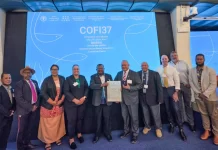
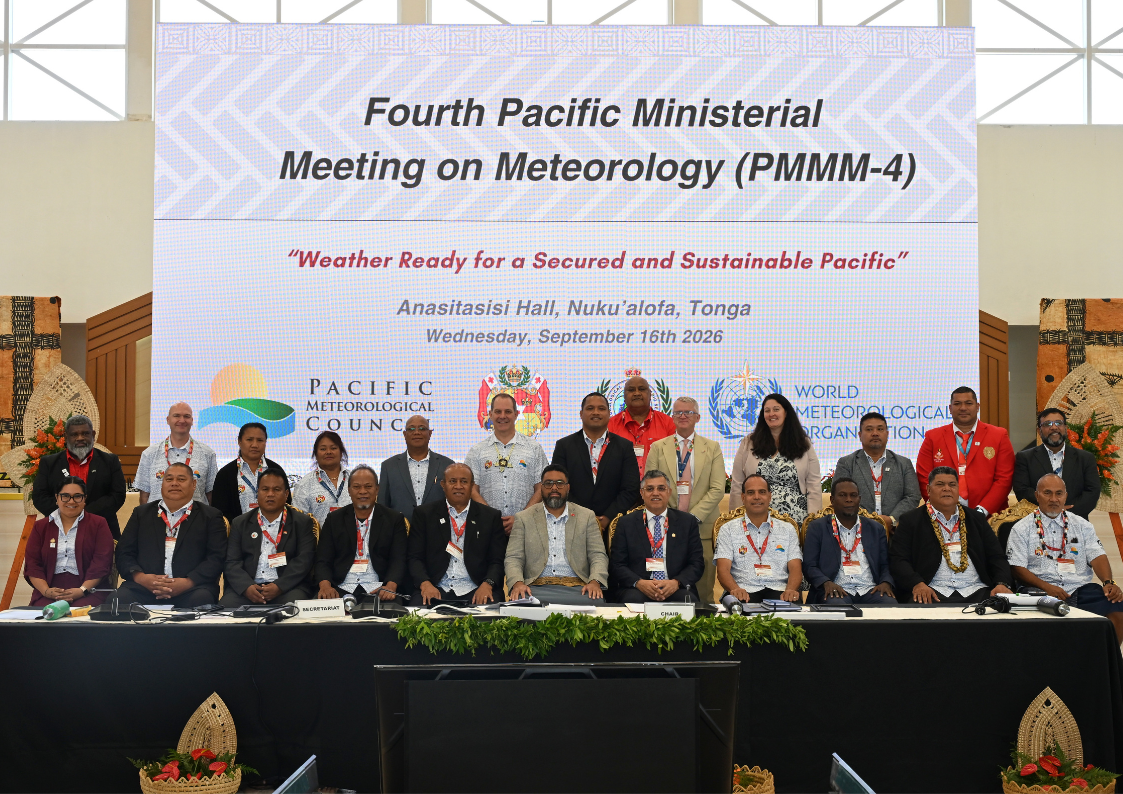
The fourth Pacific Ministerial Meeting on Meteorology (PMMM-4) officially concluded Wednesday with a renewed political commitment to strengthening sustainable weather, climate, ocean, and water services in the Pacific.
The Siu-i-Alaimoana Ki Likutapu Declaration reaffirmed Pacific Ministers’ commitment to the Weather Ready Pacific Programme as the Pacific-led mechanism for strengthening hydrometeorological services and multi-hazard early warning systems, and called on governments, development partners, regional organisations, and the private sector to align investments.
The Prime Minister of Tonga, newly appointed Chair of the PMMM-4, and Weather Ready Champion, Lord Fatafehi Fakafanua, said he takes the responsibility entrusted to him by Forum Leaders to serve as Weather Ready Champion very seriously.
“My message to the Forum Leaders in Koror only weeks ago was simple – Weather Ready Pacific is not a proposal under development. It is a regional priority endorsed by Leaders in 2021, reaffirmed in 2023 as the Pacific’s vehicle for delivering Early Warnings for All, and underpinned by an agreed investment framework and a proven return on investment.”
Fakafanua stated that the programme is already delivering, with the commissioning of a new C-band radar for Tonga as the first deliverable of its Regional Radar Strategy, with Samoa and Solomon Islands to follow, as well as hundreds of observing stations across fifteen countries and territories that have been assessed for upgrades in its bid to reverse the long decline in Pacific weather and climate data.
He called on multilateral partners, including the development banks, to join the Governments of Australia, New Zealand and the United Kingdom in aligning their investments behind the Weather Ready Pacific programme in recognition of the Leaders’ endorsement.
The Declaration also recognised the growing risks posed by severe weather, climate change and geohazards, and that they are interconnected through the Earth System and cannot be managed in separate rooms.
Fakafanua, spoke about the Hunga-Tonga Hunga-Ha’apai eruption as an example and reminder that the hazards faced by the Pacific do not arrive one at a time.
“A volcano, a tsunami, and ash cloud, and the severing of our communications came together within hours,” Fakafanua said.
“Our region sits on the Ring of Fire and in the path of the cyclone belt. Meteorological, hydrological, oceanic, and geographic hazards are interconnected, and they compound and cascade.”
“I therefore welcome the commitment to an integrated Earth-system approach under the new Pacific Islands Meteorological Strategy (PIMS) 2026 – 2037, drawing our meteorological, hydrological, ocean, geological, and disaster management agencies into closer collaboration on observations, data, and coordinated warnings,” he added.
The Ministers welcomed the new PIMS, which was endorsed at the recently concluded eighth meeting of the Pacific Meteorological Council (PMC-8) as the new framework that will guide the Pacific’s vaka towards stronger weather, climate, oceans, and water services for the next decade.
The Declaration also recognised the increasing vulnerability of Pacific island countries to the current intensifying El Niño, and called for stronger, resilient infrastructure systems to strengthen and sustain Pacific-led programmes and platforms to ensure resilience for Pacific peoples and communities.
The PMMM-4 convened under the auspices of the Pacific Meteorological Council, and was hosted by the Government of the Kingdom of Tonga and the Secretariat of the Pacific Regional Environment Programme (SPREP).
Fakafanua expressed his appreciation for the support provided by the Secretariat to his Government, and for the enduring partnerships that helped make the PMMM-4 a reality.
“I extend the sincere appreciation of my Government to SPREP for coordinating these meetings on behalf of its Members, and for the confidence placed in Tonga to host so important a convening.
Lord Fakafanua also acknowledged the World Meteorological Organisation for its enduring partnership, and the Tonga Meteorological Service and every member of the Secretariat and support teams whose quiet work made the two weeks possible.
“To host both the Eighth Meeting of the Pacific Meteorological Council and this Ministerial Meeting, and to assume the Chairmanship for both meetings, is a responsibility that Tonga has accepted with humility and with resolve.”
“The strength of this community lies in its unity, and in the trust that has grown between our services, our Ministers, and our partners,” he added.
“May the work we have done here protect lives across our Blue Pacific Continent, and may God bless us all,” he concluded as saying.
The Pacific Meteorological Council is a specialised subsidiary body of the Secretariat of the Pacific Regional Environment Programme (SPREP) established to facilitate and coordinate the scientific and technical programme and activities of Pacific National Meteorological and Hydrological Services.