
Small Island Developing States (SIDS) are calling for simpler access to climate and biodiversity finance, more grant and concessional funding and greater investment in nature-based solutions as they face growing climate and environmental pressures.
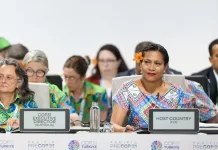
The call came at the OACPS SIDS High-Level Dialogue on Climate Finance and Nature-based Solutions in Brussels, which brought together representatives from Small Island Developing States in Africa, the Caribbean and the Pacific, OACPS leadership, European Union institutions, development partners, researchers and practitioners.
The meeting focused on how to unlock greater climate and biodiversity finance for island-led solutions, with participants warning that existing financing remains insufficient, fragmented and often too short-term.
A key outcome was agreement to develop a joint OACPS SIDS statement on Climate Finance and Nature-based Solutions to strengthen the collective voice of island states ahead of Pre-COP31, CBD COP17 and COP31.
Participants said coral reefs, mangroves, seagrass meadows, forests and other ecosystems should be treated as essential infrastructure because they protect communities, support fisheries and tourism, strengthen food security and reduce climate risks.
The dialogue identified the need to move from isolated projects to coherent, investment-ready pipelines.
Priorities include simplified access to climate and biodiversity funds, dedicated project-preparation support, greater grant and concessional financing and eligibility criteria that recognise the multiple vulnerabilities faced by SIDS.
Participants also discussed blue bonds, reef insurance, debt-for-nature swaps and blended finance, while stressing that financing mechanisms must not deepen the debt burden of vulnerable island economies.
Biodiversity-related official development assistance committed to SIDS was estimated at about US$1.3 billion between 2016 and 2021, or around US$200–250 million annually.
Sandra Freitas, an AESA expert on access to financial resources, said marine and coastal ecosystems should be viewed as economic infrastructure rather than simply environmental assets.
She said these ecosystems underpin fisheries, tourism, food security, coastal protection and climate resilience, yet continue to receive a disproportionately small share of global climate and biodiversity finance.
Freitas said closing the financing gap required stronger valuation of natural capital, investment-ready project pipelines, reliable data and monitoring systems, and greater capacity to demonstrate the economic value of ecosystems.
Zoe Brown, a PhD researcher with the Nature-based Solutions Initiative at the University of Oxford, said evidence showed nature-based solutions could deliver measurable benefits for SIDS.
A systematic review of 53 interventions across 26 SIDS found that 72 percent reported positive climate outcomes, alongside benefits for biodiversity, livelihoods, food security, local economies and women’s economic empowerment.
In Jamaica, restored mangroves reduced wave heights by between 13 and 68 percent, while in Fiji, mangrove restoration created new livelihood opportunities for women.
Brown said such projects should be viewed as investments in climate resilience, economic security and community wellbeing.
The dialogue also agreed to re-establish the OACPS SIDS Forum under revised Terms of Reference and to organise an OACPS SIDS side event at COP31 in Antalya.
The OACPS SIDS Statement is expected to be finalised and circulated ahead of COP31, while discussions will continue with the European Union on a joint statement supporting SIDS resilience.
Participants will also explore holding a pre-COP32 SIDS event in the Caribbean in early 2027.
The meeting concluded with a call to move from dialogue to coordinated action, with a focus on accessible finance, stronger institutions, resilient economies, restored ecosystems and delivery of practical solutions for SIDS.
A central message from the meeting was that investment in nature is investment in resilience, and that SIDS should be at the centre of global climate and biodiversity finance discussions.