

By Nic Maclellan
“If I have to walk to the polling booth on election day, I’ll do it,” said Josiane. “But my mother is elderly and it’s too far for her to walk. Without public transport, how can she vote? It’s not fair.”
Josiane lives in Valée du Tir, a suburb on the outskirts of Noumea, the capital of New Caledonia. Like other residents of working-class suburbs in the north of the city, she’s concerned about the reduction of the number of polling booths across the municipality for this month’s provincial elections.
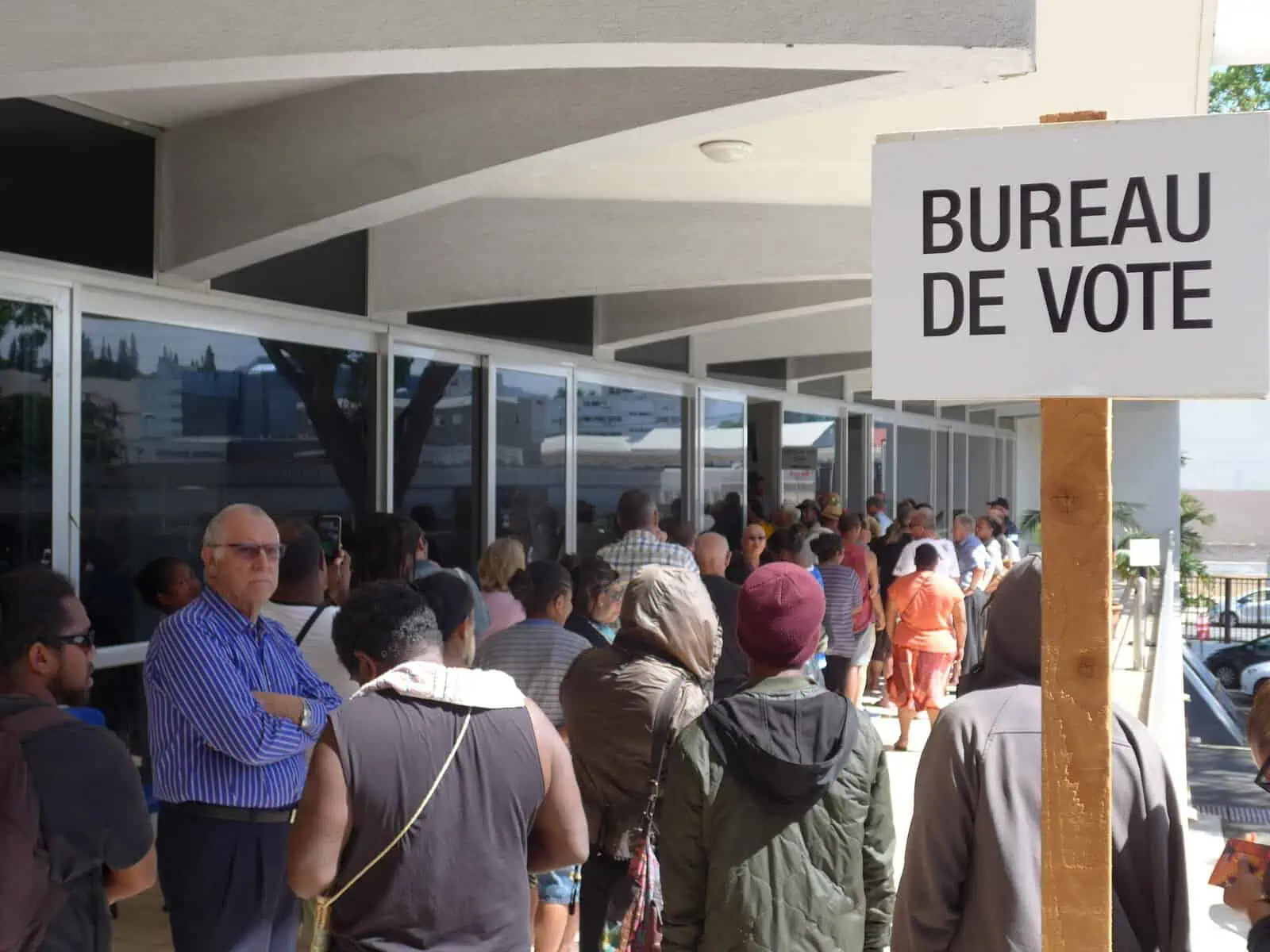
Election day 28 June is a Sunday – but on Sundays, the city’s Taneo bus service doesn’t operate. If you don’t have access to a car, it can be a long walk to a voting booth, after French authorities cut the number of polling stations in the municipality of Noumea by 84 per cent.
New Caledonia’s last provincial elections were held in May 2019, but the normal five-year term was extended beyond May 2024, at a time of violent clashes between Kanak protestors and more than 6,000 French gendarmes, police and anti-terror squads. Since then, the poll has been delayed three times, as the French State attempted – unsuccessfully – to finalise a new political statute for New Caledonia to replace the 1998 Noumea Accord.
However, later this month, New Caledonian voters will elect 76 representatives for three provincial assemblies in the North, South and Loyalty Islands. A proportion of these provincial representatives then make up the 54-member Congress of New Caledonia, which in turn selects the 11-member government of the French Pacific dependency.
The French High Commission in New Caledonia first made an administrative decision in June 2024 to reduce the number of polling stations in the capital Noumea from 57 to seven, for elections to the French National Assembly. Polling stations are normally located in town halls, high schools and other public buildings across each commune, but at the time, French police were hard pressed to control the streets, and some schools had been damaged, looted or burnt.
Since then, New Caledonia has returned to calm, but the reduction of polling sites has been maintained. In the lead up to recent municipal elections in March, a small pro-independence party MNIS sought to overturn the High Commission decision to maintain a reduced number of polling sites. However, their case before Noumea’s Administrative Tribunal was unsuccessful.
Access to the polls
Once again for this month’s provincial election, the French High Commission has decided that the number of voting sites in Noumea will again be reduced, although there are now nine rather than seven locations, after a northern booth at Ko We Kara was split in two last month.
High Commission officials have resisted calls to increase the number of polling stations in poorer suburbs, citing increased costs at a time of economic crisis. High Commission Secretary General Benoît Huber has also argued that “voter turnout in the neighbourhoods in question is still significantly lower than that seen across the city of Noumea as a whole. Even Noumea itself traditionally has a much lower turnout than the rest of New Caledonia. Voter turnout is always lower in working-class neighbourhoods. This is not unique to New Caledonia; it is the reality throughout France.”
This is hardly a ringing endorsement of civic rights, especially as the right to vote is hotly contested in these provincial elections.
Elections for the French presidency, National Assembly and municipal elections are open to all French nationals of voting age registered to vote in New Caledonia. In contrast, elections for the local political institutions – the three provincial assemblies and national Congress of New Caledonia – are held with a restricted electorate of New Caledonian citizens.
For the independence movement, and other parties that are supported by working-class voters, the issue is important in a city dominated by conservative anti-independence parties. Beyond this, the French National Assembly voted on 20 May to add another 10,575 locally born voters to the restricted electoral roll: of these 9,240 are resident in the Southern Province, including 4,185 in Noumea.
On 3 June, Senator Robert Xowie, one of two New Caledonians in the French Senate in Paris, questioned France’s Overseas Minister Naïma Moutchou about the policy. The pro-independence senator highlighted the issue of access to voting sites for poorer voters, many of whom are indigenous Kanak or islanders of Wallisian, Tahitian or ni-Vanuatu heritage.
Xowie criticised “the consolidation of 57 polling stations into nine centralised sites, far from the homes of Kanak and working-class voters.” Noting that this reduction took place during the 2024 state of emergency, he argued that “the emergency is over, the security situation has calmed down, the schools have been repaired, but the exceptional arrangement remains.”
This criticism is echoed by other political and community leaders, whose supporters in Noumea are affected by the lack of public transport on Sundays.
As the issue was debated in the Congress of New Caledonia, Milakulo Tukumuli – president of the Éveil océanien party – raised concern that a reduction of polling sites “across the municipalities of Greater Nouméa into a limited number of sites is grossly disproportionate to local circumstances and…likely to undermine the integrity of the election.”
Eveil océanien draws much of its support from the Wallisian, Futunan and Tahitian communities living in New Caledonia. Noting the lack of public bus services on Sundays, Tukumuli argued that High Commission’s decision affects poorer members of the islander community, as “the majority of residents in working-class neighbourhoods do not own a car.”
Census data shows that there are significant differences in car ownership across the city: 30-40 per cent of households in the northern suburbs do not own a car, more than double the rate for the wealthier southern suburbs.
Measuring disadvantage
The debate around turnout is a crucial issue for candidates in these elections – especially because an electoral list can only win a seat if it reaches the threshold of 5 per cent of registered voters (not those actually voting). In the Southern Province, with 11 competing electoral lists, this means a threshold of around 6,350 votes, no easy task for smaller parties or coalitions.
On top of this, voting is not compulsory in New Caledonia: at the last provincial elections in May 2019, only 67.23 per cent of voters turned out across the Southern Province.
High Commission data from the 2019 poll shows there was already a disparity in turnout between different parts of Noumea, even with more than 50 polling sites. For example, in the wealthy southern suburb of Anse Vata, polling booth number 8 at Fernande Leriche high school saw a voter turnout of 73.70 per cent, higher than the provincial average. In contrast, polling booth number 29 at the Gustave Mouchet school, near the public housing towers of Montravel, saw a turnout of just 47.99 per cent, nearly 20 per cent lower than the provincial average.
In a recent statistical study on the Contours blog, cartographer Jonas Brouillon has measured the effect of combining 57 polling booths into nine. Brouillon models the walking time to a polling station, reporting “the consolidation of polling stations has a tangible impact on access to voting at neighbourhood level.” In his data analysis, Brouillon finds that “the grouping of sites has the greatest impact on the tail of the distribution: in the nine-centre scenario, 17.2 per cent of the population is more than a 30-minute walk away, compared with 5.2 per cent in the baseline scenario” [i.e. with 57 booths].
Speaking to Islands Business, Brouillon explained that “what we’re seeing is that there’s a significant increase in journey times in my model. There are neighbourhoods where the proportion of households without a car is almost one in two; in these neighbourhoods, therefore, the issue of walking journey times is even more pressing.”
Based on his modelling, “the average walking time has gone from 13 minutes to about 22 minutes – give or take – which means a return trip takes nearly three-quarters of an hour. You’ve got to be pretty motivated to walk for three-quarters of an hour just to go and vote. What’s more, these are already areas where it’s not easy to get around without a car.”
This raw data just scratches a much more complex reality, in a city marked by enormous inequalities in social, cultural and economic life. As Brouillon stresses, “these indicators describe a situation; they do not claim to, nor are they sufficient to, identify a single cause for abstention.”
The decision whether to turn out to vote involves people’s level of interest in politics, education levels, literacy, access to electoral information, or ability to organise a proxy vote. In New Caledonia, as across the globe, there is growing mistrust of the political class, especially amongst many young people (as highlighted by the young age of the rioters and protestors during the 2024 crisis). But the current policy seems to add yet another layer of disparity between business people, public servants, poorer workers and people living in squatter settlements, suggesting the distance to the nearest polling booth can be one element affecting the turnout.
“I would point out that, at the moment, there are no buses running on Sundays to take people to the polling stations,” Brouillon said. “So how are people supposed to get there, apart from walking or by carpooling? It’s important that people go and vote – or are we just making it even harder for them to do so? The reduction of voting sites is, after all, a rather unusual measure. In fact, I don’t think there are any other places in the French Republic where there has been such a reduction in the number of physical polling stations.”
Legal challenge
Earlier this month, the largest pro-independence party Union Calédonienne (UC) lodged a request for an injunction before Noumea’s Administrative Tribunal, seeking to overturn the reduction in polling locations. However, on Friday 12 June, the Tribunal rejected the application on form, without addressing the substance of detailed arguments.
While awaiting a final ruling on the case, which may not be made until after the 28 June election, UC has lodged an application for interim relief against the municipality of Noumea, the bus company Taneo and the French High Commissioner, “in order to secure the provision of a shuttle service on Sunday 28 June 2026.”
With less than two weeks to election day, UC and other parties are also organising on the ground, calling on voters in working-class neighbourhoods to self-organise transport to assist the vulnerable to exercise their right to vote.
In a statement, UC Secretary General Dominique Fochi said: “The public transport service provided by Taneo does not operate on Sundays. Some voters will have to travel up to 4 kilometres to reach their polling site. This will particularly affect the elderly, pregnant women and families without a car.”
“The transport issue remains unresolved for the municipality of Noumea,” Fochi said, “but it is also encountered in inland municipalities and in the islands at every election. In the current context of economic and social crisis, it is the most disadvantaged sections of the population who continue to be at a disadvantage when it comes to exercising their right to vote on an equal footing.”