

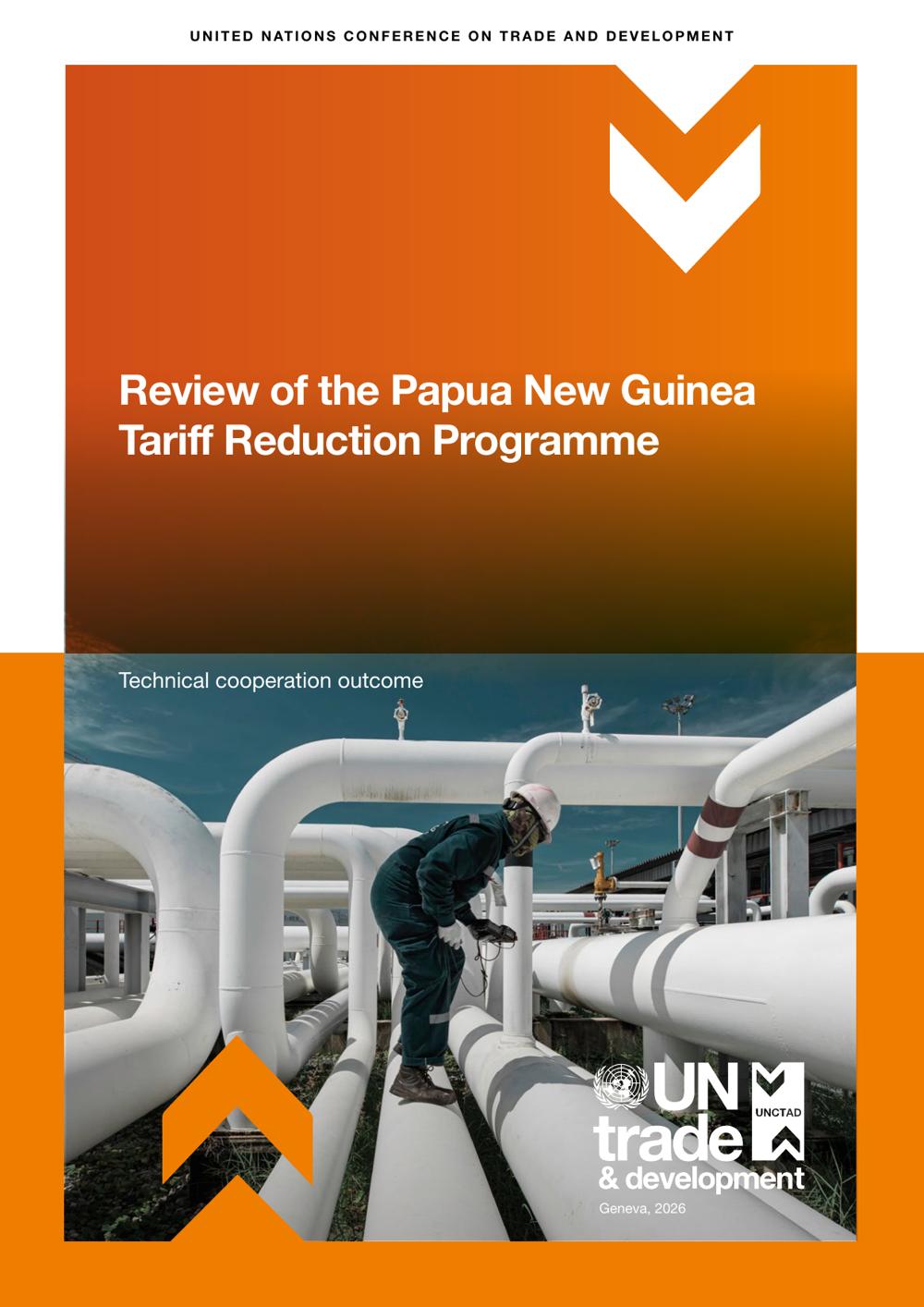
A review by the United Nations Conference on Trade and Development (UNCTAD) has found that tariff reductions alone are not enough to make Papua New Guinea’s economy more competitive, pointing instead to high transport costs, expensive energy, regulatory complexity and policy uncertainty as major barriers facing businesses.
The report, which examined Papua New Guinea’s Tariff Reduction Programme (TRP) from its implementation through to its suspension and partial reversal after 2018, concluded that while tariff policy plays an important role in economic development, it cannot by itself address deeper structural challenges in the economy.
“The report reviews Papua New Guinea’s tariff reduction programme, known as the TRP, from its liberalisation phase to its suspension and partial reversal after 2018.”
“Its central message is clear: tariff policy matters, but tariffs alone cannot build competitiveness. Businesses also face structural barriers, including high transport costs, energy expenses and regulatory complexity.”
The review found that Papua New Guinea used the TRP to lower tariffs and open its economy, reducing average tariff levels to around 3.2 percent by 2015 and making the country one of the most open economies in the Pacific region.
However, the final phase of tariff reductions was suspended in 2018, with the government subsequently increasing tariffs on selected products to protect infant industries and generate revenue.
According to the report, the policy shift reduced certainty for businesses.
“The policy shift created uncertainty. 61 percent of surveyed firms said ad hoc tariff revisions from 2018 to 2020 affected their investment decisions. The report says future tariff policy should be gradual, predictable and evidence-based.”
UNCTAD found that economic growth was stronger during the active TRP period, with Papua New Guinea recording average annual growth of 6.3 percent, compared with 2.0 percent following the programme’s suspension.
However, the report cautioned against attributing that difference solely to tariff policy.
“Commodity cycles, major resource projects and the COVID-19 pandemic also shaped the results.”
The review noted that imports declined from a peak of about US$8 billion in 2012 despite ongoing tariff reductions, while exports expanded, largely driven by the mining, oil and gas sectors.
Modelling conducted for the report showed that a one percent increase in tariffs was associated with an average 2.1 percent decline in import values. However, tariff changes had only limited effects on trade with major partners, indicating broader economic factors played a larger role.
Business responses to the tariff programme were mixed.
“During the TRP period, 36 percent of firms said they benefited from tariff reductions, mainly through lower input costs. But 55 percent said they saw no benefit.”
Following tariff increases after 2018, 53 percent of surveyed firms reported negative impacts.
The report said firms identified deeper challenges including high transport and logistics costs, expensive imported inputs, unpredictable policy settings and regulatory burdens.
“The report says Papua New Guinea should focus less on shielding firms and more on helping them compete. This means improving infrastructure, power supply and customs processes, while lowering costs for key imported inputs.”
The review also found that tariff liberalisation had only a limited impact on government revenue.
“Simulations show tariff cuts during the TRP reduced revenue by about US$7.8 million a year, or just over 1 percent of tariff revenue.”
Although higher tariffs introduced after 2018 were expected to boost collections, actual revenue was estimated to be about US$15.6 million lower than it would have been under 2018 baseline tariff rates.
The report attributed this largely to reductions in tobacco duties, declining import volumes and possible incentives for tariff evasion.
UNCTAD also identified trade-offs for consumers.
“Simulations show a net welfare loss of around US$5.9 million during 2010–2018, driven mainly by sustained high tariffs on beverages and tobacco.”
The report recommends that Papua New Guinea adopt a predictable and evidence-based tariff framework supported by broader reforms aimed at improving competitiveness.
Recommendations include gradual tariff rationalisation, targeted support for infant industries, measures to protect consumer welfare and food security, stronger regional integration, enhanced trade defence capacity and regular policy reviews.
“The broader lesson is that Papua New Guinea needs an open but strategic trade policy. Tariffs can support development goals, but only if they are stable, targeted and backed by action to reduce the real cost of doing business.”