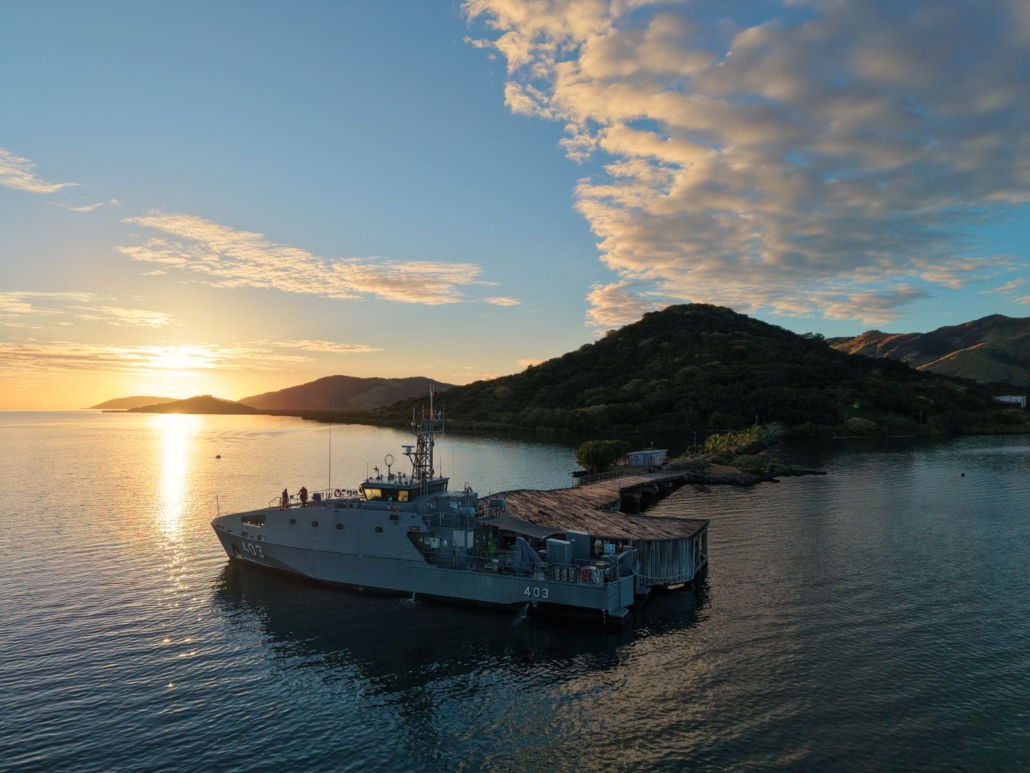
Before dawn breaks over the Pacific, Lieutenant Ratu Meli Baivatu often finds himself standing quietly on deck, surrounded by nothing but ocean and darkness. Out there at sea, far from home and family, the work can be exhausting. But for Meli, every patrol, every deployment, and every long night carries purpose because protecting the Pacific is personal.
The 33-year-old Fiji Navy officer from Nasautoka in Tailevu was one of the many Pacific officers taking part in Operation Tui Moana 2026, a regional fisheries surveillance operation led by the Pacific Islands Forum Fisheries Agency (FFA) bringing Pacific countries together to combat Illegal, Unregulated and Unreported (IUU) fishing and protect one of the region’s most valuable resources: tuna. But behind the uniform and operations briefings is a story shaped by family, sacrifice, and service.
Growing up in Fiji, Meli always knew the Navy would become part of his life. His late father served in the Fiji Navy, and as a young boy, Meli looked up to him with admiration.
“Ever since I was a kid, I wanted to be just like my father,” he says.
That dream eventually became reality.
After attending Suva Methodist Primary School and Queen Victoria School, Meli’s life took him far beyond Fiji’s shores. A scholarship opportunity saw him spend more than two years studying mathematics and physics in Morocco – an experience he describes as life-changing.
“It opened my eyes to the world,” he recalls. “I came back knowing how to handle myself out there.”
But while many would have stayed overseas to continue building their future, Meli made a different choice – he came home. His grandparents were getting older and unwell, his parents were nearing retirement, and his sisters were still studying at University. As the middle child, he felt responsibility calling him back to Fiji.
“I had to make that sacrifice,” he says quietly. “Family comes first.”
Back home, he balanced caring for his grandparents while continuing to pursue rugby – another passion that saw him represent the Fiji Warriors in 2015 against Argentina and Uruguay. Soon after, he enlisted for the Fiji Navy.
Nearly 10 years later, Meli now serves as a Seagoing Officer, helping safeguard Pacific fisheries through surveillance operations and regional cooperation efforts.
Ironically, some of the biggest lessons early in his career came far from the Pacific. Following recruit training, Meli was selected to undertake officer cadet training in the United Kingdom – one of the few Fiji Navy officers in over a decade, to receive the opportunity and the experience challenged him in unexpected ways.
“The accent was different and difficult,” he laughs. “They spoke so fast.”
But beyond navigating life in England, the training taught him confidence, especially the importance of asking questions, speaking up, and trusting teamwork.
“In our field, trust is everything,” he says. “If you pretend to know something when you don’t, people will see it.”
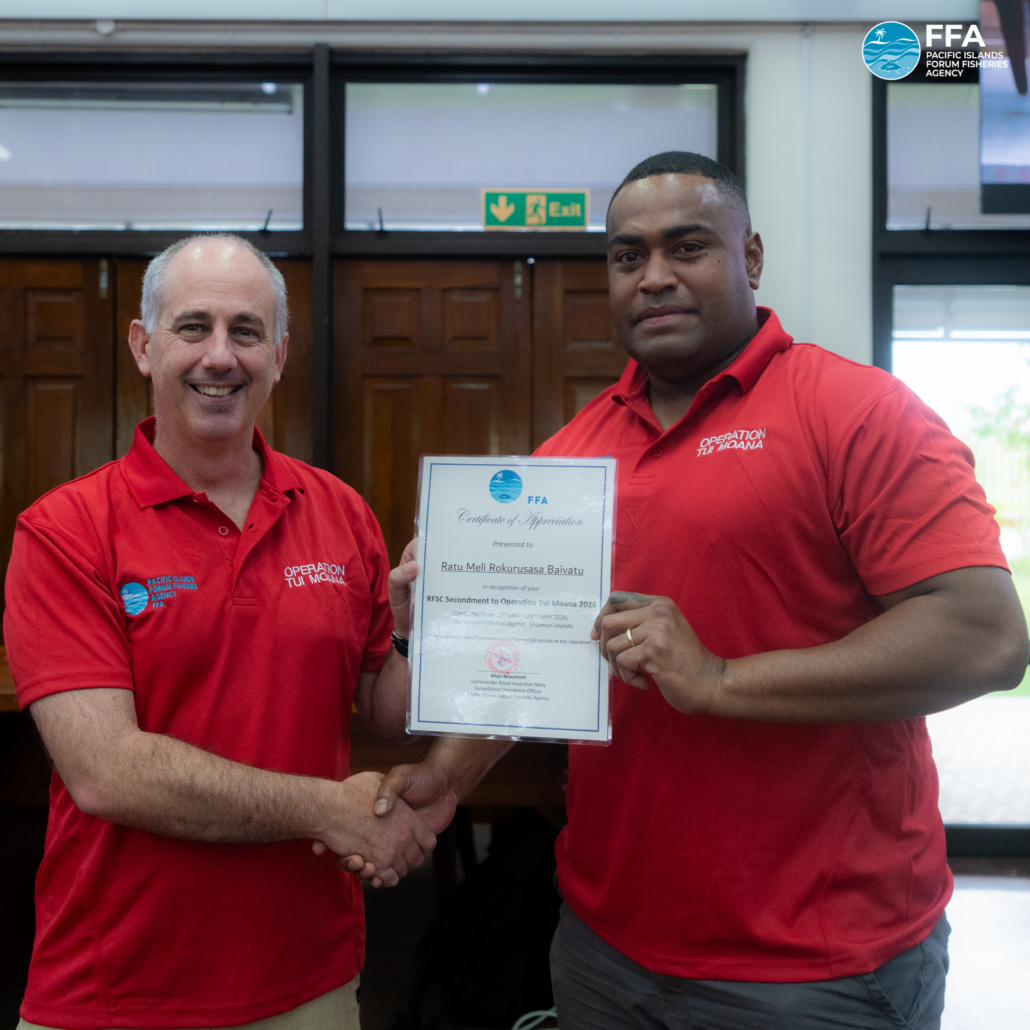
Today, those lessons continue to guide him during regional operations like Tui Moana. For the three weeks from 4-22 May 2026, Meli has been working alongside fisheries and surveillance officers from across the Pacific at the Pacific Islands Forum Fisheries Agency (FFA) Regional Surveillance Centre in Honiara, Solomon Islands, learning how intelligence, technology, and information-sharing help combat IUU fishing across the region.
For someone used to working at sea, seeing the other side of operations has been eye-opening.
“It’s full circle for me,” he explains. “I’ve been out there on deployments, but now I understand the bigger picture behind the scenes.”
He speaks passionately about the importance of protecting fisheries resources, not just for governments or economies, but for ordinary Pacific families.
“We are island people,” he says. “The ocean feeds us. It’s part of who we are.”
That belief became even more personal before travelling for Operation Tui Moana. Just weeks before the operation began, Meli lost his father. For a moment, the grief weighed heavily but coming to the operation, working alongside Pacific colleagues, and focusing on service helped him move forward.
“It was a good escape for me after the funeral,” he admits softly.
Even through loss, his motivation remains strong. Every deployment, every boarding, every long shift at sea is driven by one thought: protecting the future generation of Pacific Islanders.
“I have nephews growing up now,” he says. “I want them to experience the same Pacific we know today.”
For Meli, the mission is bigger than any one country. Fish move across borders. Criminal networks move across borders. And increasingly, Pacific nations understand that protecting the ocean requires working together – and that is what gives him hope.
“To see Pacific countries working together like this, it makes me believe we are moving in the right direction,” he says.
As Operation Tui Moana came to an end on Friday 22 May, Meli knew the work was far from over. But somewhere between the ocean patrols, the intelligence rooms, and the quiet moments away from home, he found clarity in what service truly means – Doing your small part.
“If each of us does our little part right,” he says, “the bigger picture will take care of itself.”
Operation Tui Moana 2026, led by the Pacific Islands Forum Fisheries Agency (FFA), brought together fisheries, maritime and law enforcement personnel from across the region to strengthen efforts against Illegal, Unreported and Unregulated (IUU) fishing and other transnational maritime crimes.
The operation covered the Exclusive Economic Zones (EEZs) of 10 Pacific Island countries and adjacent high seas areas, combining maritime patrols, aerial surveillance, intelligence analysis and compliance monitoring. At the heart of the operation was the FFA Regional Fisheries Surveillance Centre (RFSC) in Honiara, where 21 secondees from Member countries, partner agencies and MCS organisations worked together to coordinate intelligence, planning and surveillance activities.
During the three-week operation, authorities conducted 61 vessel inspections, verified more than 200 vessel detections, identified four vessels of interest and made two apprehensions linked to suspected fisheries-related offences.
Operation Tui Moana also strengthened regional cooperation under the Niue Treaty Subsidiary Agreement through joint surveillance activities, boarding exercises and intelligence sharing. As compliance challenges continue to evolve, operations such as Tui Moana remain critical in protecting Pacific fisheries resources, supporting sustainable management of tuna stocks and ensuring the benefits remain with Pacific people, in line with the 2050 Strategy for the Blue Pacific Continent.