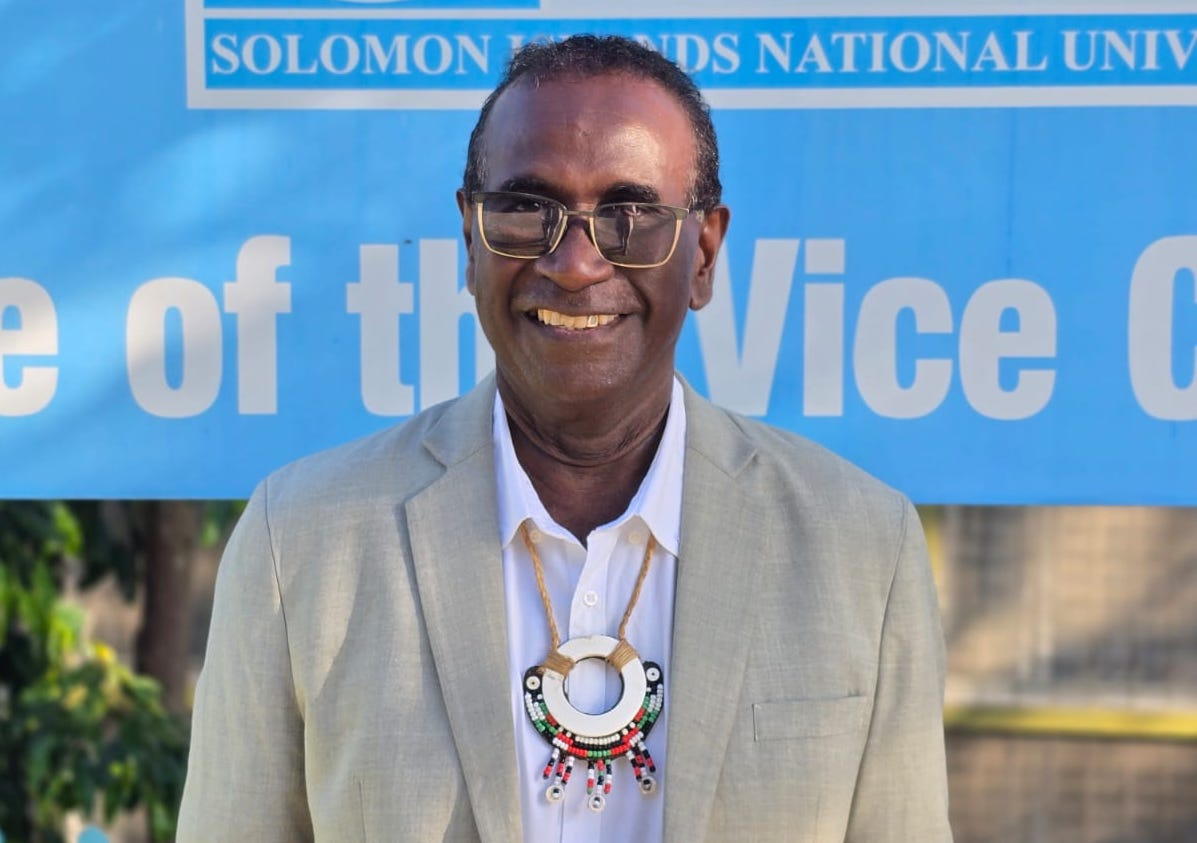
Solomon Islands National University (SINU) Vice Chancellor Dr Transform Aqorau has questioned the heavy reliance on foreign consultants in shaping the country’s education system, warning that the future of Solomon Islands children “cannot be outsourced.”
Following a chance meeting with a consultant involved in an Asian Development Bank (ADB)-supported review of the Solomon Islands high school curriculum, Dr Aqorau said the encounter highlighted a broader concern about who is making decisions that will shape the nation’s future.
“Too often, those who are closest to the lived realities of our people are pushed to the margins, while external consultants and global companies are placed at the centre of decisions that shape our national future,” he said in a social media post.
Dr Aqorau stressed that curriculum development goes beyond technical planning and is central to nation-building.
“Curriculum is not a technical document alone. It is not simply a list of subjects, learning outcomes, assessment standards, or classroom activities. Curriculum is a statement about who we are as a people,” he said.
He described curriculum as “the architecture of the national mind,” arguing that it determines what children learn about their culture, history, environment, economy and place in the world.
The SINU Vice Chancellor said Solomon Islands once had a Curriculum Department that developed locally focused educational content grounded in the country’s realities.
“They understood that education in Solomon Islands cannot simply be imported as a finished product from elsewhere,” he said.
While acknowledging the value of international partnerships and technical assistance, Dr Aqorau said local expertise should be at the centre of decisions affecting the country’s future.
“The concern today is not merely about one project, one consultant, or one contract. It is about a pattern. It is about the growing tendency to treat our own institutions and experts as secondary in matters of national development.”
“That is not partnership. That is dependency dressed up as development,” he added.
Referring to the reported US$26 million curriculum review project, Dr Aqorau said decisions about the education of future generations should be led by Solomon Islanders.
“That future should not be shaped primarily by people who are only passing through, however well-intentioned they may be. It should be shaped by Solomon Islanders, supported by friends and partners where necessary, but never displaced by them,” he said.
Dr Aqorau said the issue was ultimately one of national sovereignty and intellectual self-determination.
“No country can outsource the formation of its next generation without losing something of itself.”
He argued that external experts should support local institutions rather than bypass them.
“They must strengthen local institutions, not bypass them. They must listen before prescribing. They must learn before teaching.”
Dr Aqorau also questioned why Solomon Islands National University(SINU) had not played a larger role in the curriculum review process, pointing to the university’s expertise across education, culture, science, language, agriculture, fisheries, economics and teacher training.
“Our academics may not always speak in the polished language of international consultants. They may not always package their knowledge in the formats preferred by global companies. But they carry something far more important: proximity to the realities of our people,” he said.
He said a national curriculum must reflect the needs of children across all provinces and prepare them for both modern opportunities and community life.
“It must prepare our young people for the modern world, but it must not cut them off from the world that formed them.”
Dr Aqorau called for greater national ownership of curriculum development and urged Solomon Islanders with relevant expertise to take part in the process.
“These are not questions that can be answered by templates. They require national ownership,” he said.
He also challenged SINU to assert itself more strongly as the country’s leading institution for curriculum development, teacher education and research.
“If we do not assert that role, others will continue to occupy the space that should rightly belong to national institutions.”
Dr Aqorau said international partnerships remained important but should be based on respect and local leadership.
“We should welcome partnership, but partnership must be based on respect. It must build local capability. It must strengthen institutions,” he said.
He warned that education should not be treated as a project managed from outside the country.
“The future of our children is too important to be left to those who are only passing through,” he said.