
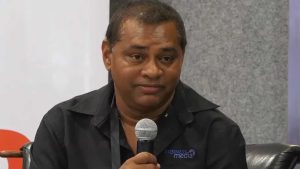
Fiji Media Association (FMA) General Secretary Stanley Simpson has accused Australia of failing to properly support Pacific media, saying funding has focused more on Australian organisations than helping local newsrooms survive and grow.
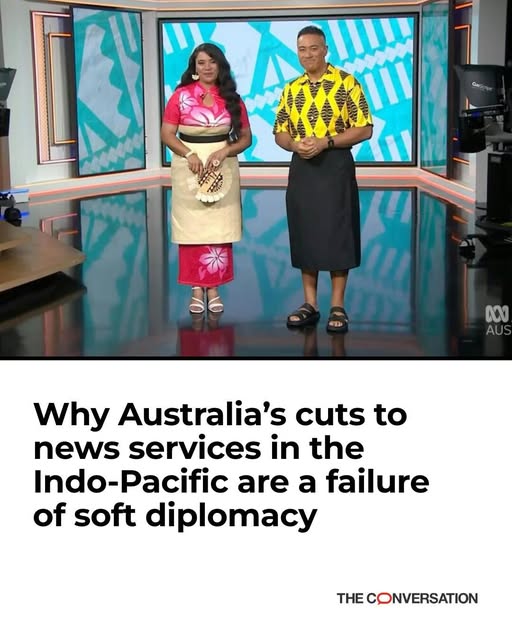
Responding to an article published in The Conversation titled Why Australia’s cuts to news services in the Indo-Pacific are a failure of soft diplomacy, Simpson said Pacific media organisations had spent years asking for practical support but were repeatedly ignored.
“Too much ‘lets help ourselves and give more money to ourselves so we can help the Pacific’ and not enough ‘let’s work with Pacific media so they can help themselves and be our partner.’”
Simpson said he had raised the issue with Australian High Commission officials in Suva and diplomats in Canberra over many years.
“Have had this discussion with successive Australian High Comm officials in Suva and diplomats in Canberra – who have asked ‘we are ready to help, we are here to listen, tell us what you need’ and after we tell them what we need ‘Sorry we cant help you with that right now.’”
He questioned why Australia could fund military and security projects in Fiji while media organisations struggled for basic equipment and infrastructure.
“Somehow Australia can find $100 million (US$71 million) to fund the Blackrock camp in Nadi, and $20 million (US$14 million) to fund a patrol boat that ends up on the reef but can’t get themselves to contribute at least $500k (US$250,000) a year for Fiji media.”
“At the most we are supported with around 100k (US$50,000) in coordinator and training support except recently when we have got some valuable content funding.”
Simpson said while he supported funding for Fiji’s military and security forces, there had been little investment in independent journalism and accountability.
“I have no problem with the funding to the military – they deserve the money they get to secure our country and protect our borders, but it must be also reminded that they have killed people in custody, committed human rights abuses and even taken over the government.”
“Where is the funding for those who try to hold them accountable?”
“We are being given crumbs and peanuts.”
He also criticised Australia’s response during years when Fiji media organisations faced censorship, intimidation and economic pressure under the Bainimarama government.
“When we were being beaten, threatened and censored, and almost closing down due to political and economic pressure – where was Australian support for the Fiji media?”
“Did they keep quiet because they wanted to be friends with the Bainimarana government and stop them from getting close to China?”
Simpson said media organisations received training programnes but little direct support for equipment or newsroom development.
“All we got was a few supporting words here and there and training programmes, support for our coordinator position, but no real equipment, funding and investment.”
He said Australian-funded programmes at times failed to consult local journalists on what they actually needed.
“Around 2018-2019 we stopped attending media training programmes the Australians were organising without consulting us.”
“They even tried to launch ‘A Parliamentary Reporting Guide for Fijian Journalists’ without consulting Fijian journalists.”
“We said ‘no more.’”
Simpson acknowledged improvements in engagement through the PACMAS programme, including support for the Fiji Media Association’s operations and targeted training.
“The response was positive, and we have worked well with PACMAS since then.”
“They helped the FMA get back on its feet with support for audits, and a coordinator post – a huge help for a group run by volunteers with already stressed-out full-time jobs.”
But he said repeated requests for equipment and infrastructure support were rejected.
“We were told, unfortunately that can’t be done by PACMAS as it is not within its scope.”
“We have to talk to Department of Foreign Affairs and Trade (DFAT) or the High Commissioner in Fiji or to the people making the decisions in Canberra.”
Simpson revealed that about two years ago the FMA was offered AUD$700,000 in support but turned it down because the package focused mainly on training through Australian organisations.
“I was so excited until we looked properly and saw that it was $700,000 (US$499,863) in more training, done by Australian organisations and consultants and none of it for equipment or directly enhancing Fiji media.”
“The FMA rejected it.”
“If its just training and not coming with equipment, its not meeting our needs.”
“After we made the decision, we pinched ourselves and asked, ‘Did we really just reject $700,000 (US$499,863)?’”
“And the answer was Yes. Because we want funding that makes a real difference and meets our needs.”
Simpson said there had been some progress through newer content funding initiatives, particularly the ABC International Development (ABCID) Content Fund managed by PACMAS.
“The ABCID Content Fund managed by PACMAS is a great representation of something we have long asked for.”
“Funding for Pacific made content and programmes, with collaboration and advice support from Australian partners, and importantly – 40 percent of funding can go towards equipment.”
He highlighted Mai TV’s The Brunch Show as an example of how targeted investment could strengthen Pacific media.
“With equipment funded from that (cameras, software etc less than 100k(US$50,000)) we are able to cross Live to Labasa, Nadi, Dubai, Vancouver, Sydney and PNG.”
“An example of how investment in the right areas can go a long way and make real impact.”
Simpson warned that Pacific media organisations would continue to seek support elsewhere if Australia and New Zealand failed to respond properly.
“If there is no support, we will have to find ways to survive on our own.”
“Australia and NZ are always our first choice but there are also other partners we can look to for support. Including China.”
“But Australia and NZ are the media landscape and democracy we aim to emulate.”
“We can’t just keep repeating ourselves,” said Simpson.