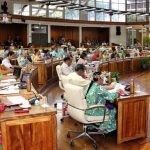

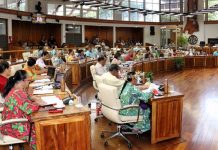
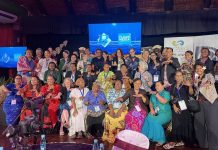
Leaders and security officials from across Micronesia gathered Tuesday in Guam for the first day of a regional security dialogue that laid bare an unsettling reality: others have already mapped these islands into their own strategic designs.
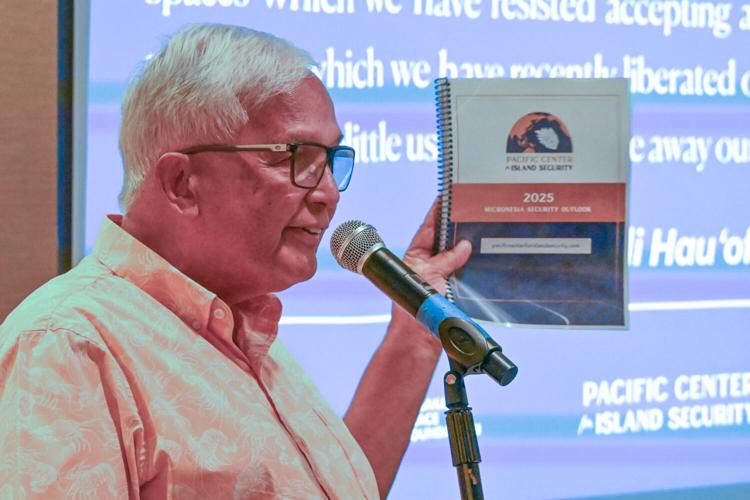
“All of you are in somebody’s strategic plans, whether you know it or not, whether you like it or not,” said Pacific Centre for Island Security (PCIS) chair and former Guam Delegate Robert Underwood opened the two-day Micronesia Security Dialogue hosted by PCIS, the Richard F. Taitano Micronesian Area Research Centre, and sponsored by Japan’s Sasakawa Peace Foundation.
The event brought together government officials from Guam, Palau, the Federated States of Micronesia, the Republic of the Marshall Islands, and the Commonwealth of the Northern Mariana Islands, along with security analysts and academics to examine what Underwood has called one of the most consequential moments for the region since World War II.
The morning session opened with brief remarks and a demonstration of PCIS’s Micronesia Security Monitor, an online platform that tracks military bases, vessel movements, weapons ranges, and maritime activity across the second island chain.
PCIS director Leland Bettis walked attendees through the tool’s mapping layers, pointing to Chinese research vessels conducting deep oceanographic surveys near areas hosting U.S nuclear attack submarines and along critical north-south sea lanes between Australia and Japan.
“If you’re looking for critical minerals, you’re also mapping the seabed floor, which could be of assistance to your submarine operators,” Bettis said, adding that the research vessel is also a mothership for submersibles.
“There’s some really serious deep-ocean research going on here.”
Bettis also highlighted a U.S autonomous vessel, Saildrone 3002, contracted by NOAA, which had been heavily mapping areas west of the Marianas, an area where the Bureau of Ocean Energy Management recently expanded its proposed seabed mining lease boundaries. The vessel’s data streams directly to satellite in real time, he noted.
For attendees from smaller island states, the presentation made visible what had long felt abstract.
“I learned something very interesting, not only on defence security but (also) on understanding the concerns of our islanders and also learned about these research ships (and) vessels, very interesting,” said former FSM President Emanuel Mori, who attended as an advisory council member of PCIS.
Mori, who is no longer in government, said he hoped to bring what he learned back to his community.
He also flagged a practical need the monitor could serve beyond geopolitics.
“The next thing I want to ask Robert (Underwood) is an alert system for our people for typhoon(s), for any emergencies,’ he said.
“This is a very good time to discuss about not only for military purposes but for typhoon purposes and whatever.”
Kosrae Governor Tulensa Palik offered a candid assessment of his state’s position.
While Kosrae has engaged politically with China in ways distinct within the FSM, he said the compact relationship with the United States remains its anchor.
“We do have political ties, our diplomatic relations with China, mainland China, but we do have another relationship that is in place with the U.S, which has been sustaining us for the past 40-plus years now,” Palik said.
“That’s through the compact trust fund, and that is what will sustain us for the foreseeable future.”
He said the dialogue opened perspectives he had not fully considered.
“This dialogue opens up other avenues of concern that we have to take into consideration as a nation,” Palik said.
“It definitely gives me other insights into the political situation that we are in that we need to take into consideration very careful.”
Yap Governor Francis Itimai said his state is already deep into that reality, with military projects arriving and agreements signed.
“We have a lot of military projects that are incoming,” he said. “We’ve signed an agreement with them, with the U.S military and the contractors.”
He added that a large contingent of contractors and military personnel had been working alongside him.
“On my way out, there was a big group of contractors and also military folks that were with us working together on this.”
Christopher deBrum, national security advisor for the Republic of the Marshall Islands, said the dialogue filled a critical gap for a country that only stood up its national security infrastructure two years ago.
“This is the first time that we’re seeing a Micronesian-led institution to work with and provide us with more information for RMI,” he said, adding that the monitoring platform and other tools “are all things that we can use as we develop this office.”
He said the Micronesian community has needed exactly this kind of focused effort.
“There’s a lot of information being shared, mainly for the wider Indo-Pacific region, but this is geared toward our region that we really need, and I think this is a gap that we need to address more.”
Vera Topasna, executive director of the Community Defense Liaison Office on Guam, said the work PCIS is doing is unlike anything being done elsewhere in the region.
“It has not been done, at least in the manner that they’re doing it, very focused and centred on Micronesia, she said.
“It requires us to be open and to hear what the PCIS (is), what they’re doing, how they’re monitoring, and how their body of work could enhance my body of work as a government official.”
The session also surfaced concerns about missile defense, drug trafficking, and the increasing militarisation of islands that have little ability to shield themselves from the conflicts being prepared around them.
Bettis noted the U.S military strategy of distributing and dispersing forces across the region, including to austere airfields in Tinian, Yap, and Palau, may soon require a third component.
“I think what’s probably coming next in terms of the military strategy is ‘D3,’ which is distribute, disperse, and defend,” he said, predicting the U.S will likely deploy containerised portable air defense systems across those locations within five years.
Underwood, presenting PCIS’s annual Micronesia Security Outlook report after the break, pressed the more profound question the dialogue was built around. While the region’s leaders debate sub-regional cooperation and sovereignty, the great powers are not waiting.
“The great geostrategic competition has come to our shores,’ he said. “It’s coming at a greater intensity since the end of World War II.”
Day two of the dialogue convened Wednesday, featuring presentations by security experts Marco de Jong on emerging technologies and James Crabtree on first island chain dynamics and what they mean for Micronesia.