

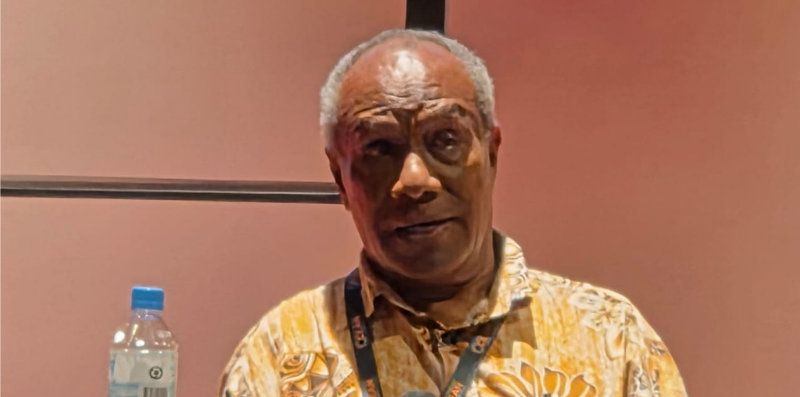
In an address at the 2026 Melanesian Ocean Summit, Professor Chalapan Kaluwin, Director of the Momis Ocean and Climate Research Institute, issued a bold challenge to policymakers: stop borrowing foreign ideas and start trusting Papua New Guinean science.
Professor Kaluwin revealed that years of independent research and experiments conducted “in our own backyard” have confirmed that Papua New Guinea, alongside Palau and neighbouring island seas, sits atop the warmest ocean waters on the planet.
“We decided to find time to do this work in our own university, in our own country,” Kaluwin told the summit.
He explained that by utilising advanced technology including pressure sensors and Argo floats deployed from Manus to Fiji, local scientists have tracked a steady rise in ocean temperatures since 1991.
“When you talk about global warming, that’s for politicians. Climate change is what scientists talk about,” Kaluwin said, noting that sea surface temperatures in the region remain the highest in the world.
This heat, he warned, is the engine driving more frequent and intense El Niño and La Niña cycles, which are now impacting the region every one to two years rather than the traditional five-year cycle.
Professor Kaluwin question why a nation of 1,200 islands does not yet have a dedicated Ministry of Oceans.
He argued that the country’s GDP, wealth funds, and future sustainability are inextricably linked to the sea, yet policies are often imported from the West rather than built on local data.
” You have smart people already in this country,” he said. “You will be able to develop your own policies based on your science. Don’t go and borrow policies from elsewhere.”
The Professor highlighted several urgent risks to PNG’s maritime interests.
Kaluwin raised alarms over mining licenses granted to foreign firms without scientific credibility, specifically mentioning the risks of terrestrial pollution from the Highlands flowing down to the Great Barrier Reef.
As ocean temperatures rise, Kaluwin warned that PNG is at risk of losing its tuna stocks as species migrate to cooler waters.
Prof Kaluwin said economic strategy must start with the people living on the 1,200 islands of PNG.
” It’s your home, it’s your land, it’s your ocean. It doesn’t belong to anybody else in the world,” Kaluwin stated.
“Our research is meant for the people, to protect their interests and their future,” he said.