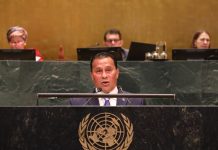
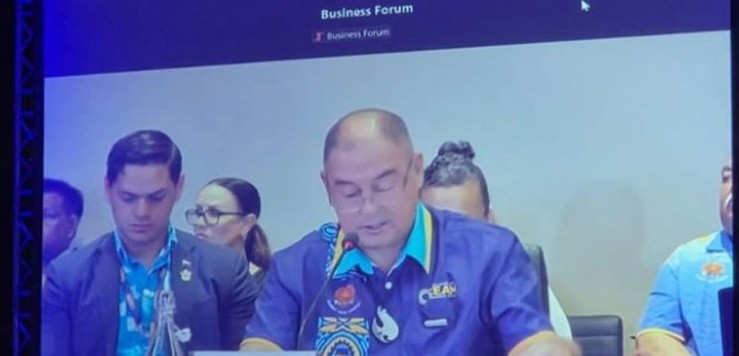
Cook Islands Prime Minister Mark Brown told leaders at the inaugural Melanesian Ocean Summit that his country is committed to safeguarding the Pacific Ocean through one of the world’s largest marine parks and science‑based governance of seabed minerals.
Brown said the Marae moana Act of 2017 created a multi‑use marine park spanning nearly two (2) million square kilometres, with 324,000 square kilometres designated as protected areas where large‑scale fishing and seabed mining are banned.
“Marae moana means sacred ocean,” he explained, adding that its principles of protection, sustainable use, cultural significance and transparency are obligations, “we carry for our children and our children’s children.”
He highlighted that the Cook Islands has completed maritime boundary agreements with neighbours, secured recognition of its extended continental shelf, and is considering whale migration corridors as new transboundary protected areas with Tonga and Niue.
Turning to seabed minerals, Brown said the nation’s Exclusive Economic Zone (EEZ) contains an estimated seven million tonnes of polymetallic nodules but stressed that “any future decision on whether to allow minerals harvesting must be science‑based.”
Three exploration licences issued in 2022 have produced extensive mapping data, but he noted, “the science is not yet complete” and more research is required before decisions are made.
Brown linked ocean stewardship directly to climate resilience, warning of warming seas, bleaching reefs, and shifting fish stocks.
He argued that protection and prosperity can work together: “By leading with knowledge and foresight we can show that a thriving environment is the very foundation of a thriving economy.”
He invited Pacific nations to share environmental standards, marine spatial planning experience, and join Cook Islands’ Women in Science expeditions. “Together let us protect it as our ancestors would expect of us. Let us develop it only as our children can be proud of it,” Brown concluded.