



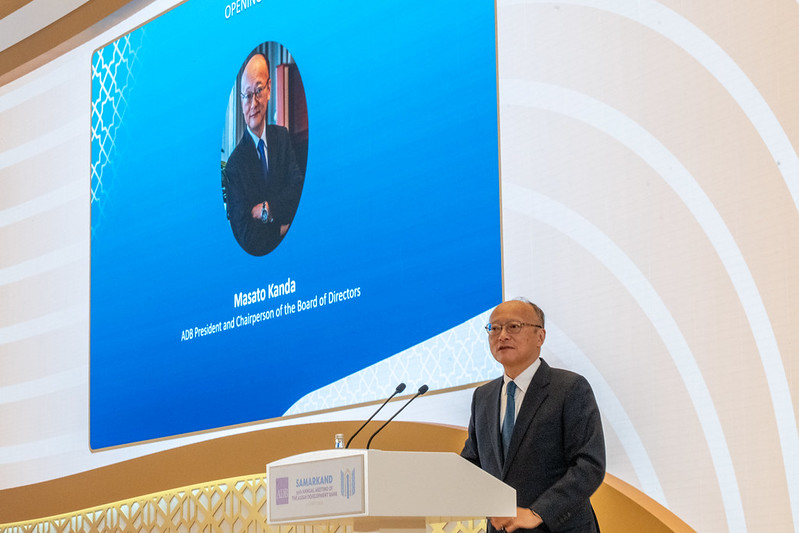
By Makereta Komai, PACNEWS Editor in Samarkand, Uzbekistan
The Asian Development Bank (ADB) must remain a “reliable partner” for countries navigating an increasingly uncertain global environment, President Masato Kanda said, as the institution marked 60 years of development across Asia and the Pacific.
Closing his address to Governors at the 59th Annual Meeting in Samarkand, Kanda anchored the bank’s future in the lived experiences of people across the region — from coastal communities rebuilding livelihoods to students gaining access to modern education and small businesses slowly expanding.
“The fisher families I met in Cambodia, working to restore marine ecosystems while building more secure livelihoods. The students I saw at a university in the Pacific that ADB helped equip, with modern lecture halls, science labs, and a real path forward. And the small business owners in Southeast Asia who spoke of gradual but genuine progress.
ADB’s responsibility is to be a reliable partner — one that listens carefully, acts decisively, and remains committed through difficulty.
Reflecting on ADB’s six decades since its establishment in 1966, he said the bank’s impact is best measured not only in financing figures, but in the resilience and determination of the people it serves.
“The people of this region do not wait for perfect conditions. They adapt, they build, and they press forward.”
The challenges before us are real. But so is the progress we have made together. And so is my confidence in what this institution and this region can achieve.
Region under pressure
Kanda’s remarks come against a backdrop of growing global instability, with conflict in the Middle East driving up fuel, freight and food prices across Asia and the Pacific.
He warned that the region — the world’s largest energy-importing bloc — is already feeling the strain, with rising costs threatening food security and placing pressure on government budgets.
“The economic consequences could be severe — on growth, on prices, and on livelihoods,” he said.

ADB stepping in
In response, ADB has expanded its crisis support, provided fast-disbursing budget financing and ensuring the continued flow of essential imports such as food, energy and medicines.
The bank is also reactivating exceptional support for fuel imports to cushion the impact of rising oil prices on vulnerable economies.
Kanda said protecting countries with the least capacity to absorb shocks remains a central priority.
Delivering impact at scale
ADB’s latest figures show a significant scale-up in operations, with US$29.3 billion in commitments in 2025 and an additional US$14.7 billion mobilised from partners.
These efforts are expected to generate more than 3.3 million jobs and benefit over 180 million people.
Examples of impact highlighted in the address include:
•Disaster response efforts following earthquakes and floods across Asia
•Investments in education and infrastructure in Pacific countries
•Support for small businesses and community livelihoods
•Environmental initiatives such as marine ecosystem restoration
Preparing for the future
Looking ahead, Kanda outlined major regional initiatives, including support for the ASEAN Power Grid and a broader Pan-Asia energy network, alongside a US$20 billion push to expand digital connectivity.
He also pointed to reforms within ADB — including increased financing capacity, stronger procurement standards, and deeper collaboration with the World Bank — aimed at improving delivery and impact.

A milestone moment
As ADB marks its 60th anniversary, Kanda said the institution must match ambition with execution, particularly as challenges grow more complex.
“The challenges before us are real. But so is the progress we have made together,” he said.
For the region’s developing economies — especially small island states and fragile countries — that partnership, he stressed, will remain critical in the years ahead.