
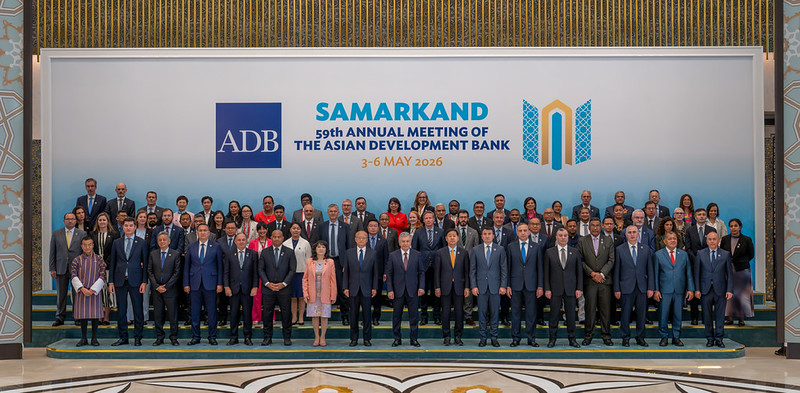
By Makereta Komai, PACNEWS Editor in Samarkand, Uzbekistan
Amid escalating global challenges in 2025, particularly stemming from the Middle East crisis, the Asian Development Bank (ADB) delivered an unprecedented US$44 billion in support to its member countries.
ADB President Masato Kanda told the Bank’s Governors in Samarkand that ADB will move “aggressively” to respond to evolving global shocks with greater speed and scale.
“These shocks do not respect borders. They travel through the arteries of the global economy — fuel, freight, finance, and factories — and land squarely on household budgets and the communities that can least afford them.
“The paradigm has shifted. Our response must shift with it,” Kanda said.
Of the total support, ADB committed US$29 billion from its own resources — a 20 percent increase from the previous year — and mobilised nearly US$15 billion from partners.
“But capital alone is not enough. The institution itself must be wired for speed and agility,” he said.
Kanda emphasised that ADB acted swiftly to support member countries during the crisis.
“This shows ADB can act with urgency when the moment demands it.
“We were the first development partner to reach out to many of you on budget support in response to the Middle East conflict, and the first multilateral development bank to announce a financial support package for affected countries,” he said.
ADB also secured the first amendment to its Charter in nearly 60 years, enabling the bank to increase financing capacity by 50 percent without requiring additional capital from shareholders.
The Bank has also introduced key reforms to improve efficiency and delivery.
“We launched the first-ever Full Mutual Reliance Framework with the World Bank to streamline joint support. This reduces the time, cost, and complexity of delivering assistance to our developing member countries.
“And we have implemented sweeping reforms to make ADB faster and more agile,” Kanda said.
Among the new tools is the Rapid Resource Reprogramming and Deployment Option, which allows countries to repurpose existing sovereign portfolio funds immediately at the onset of a crisis.
“At the start of this year, we rolled out a new Environmental and Social Framework to elevate standards and better protect communities.
“We are also accelerating decentralisation by pushing resources and decision-making out of headquarters and into the field, bringing us closer to our clients and the challenges they face.”
To support these changes, ADB has introduced a new strategic human resource framework aimed at attracting and retaining top talent.
“ADB is not waiting for the future. We are proactively reshaping our institution to meet it,” Kanda said.
However, he stressed that public resources alone will not be sufficient to meet the region’s growing financing needs.
“Fiscal space is tightening, aid priorities are shifting, and debt burdens are rising across the region.
“We must harness the private sector, which creates over 90 percent of jobs. Governments alone cannot fund the infrastructure needed for growing populations,” he said.
Despite large pools of private capital, Kanda noted that investment is not reaching where it is most needed due to policy constraints and market failures.
“The binding constraint is not a lack of capital, but the lack of an enabling environment.”
ADB has set a target to quadruple its private sector financing to US$13 billion annually by 2030.
Drawing on Samarkand’s historic role as a crossroads of trade and ideas, Kanda concluded with a call for unity and decisive action.
“Centuries ago, travellers stood at this crossroads, and the paths they chose shaped the future. Today, the decisions we make will define the future for the next generation.
“We cannot afford to retreat into isolation. This is not in ADB’s DNA.
“We have the strategy, the reforms, and the resolve to lead this transformation,” he said.
Kanda reaffirmed his commitment to ensuring ADB evolves to meet the region’s needs.
“The work ahead is immense, but our purpose is clear. We will strengthen power grids, build digital foundations, unlock private capital at scale, and protect the ecosystems that sustain us all.
“We will not face the future as a fragmented region. We will move forward together, with ADB as your steadfast anchor.
“Let that be our message from Samarkand,” he said.