
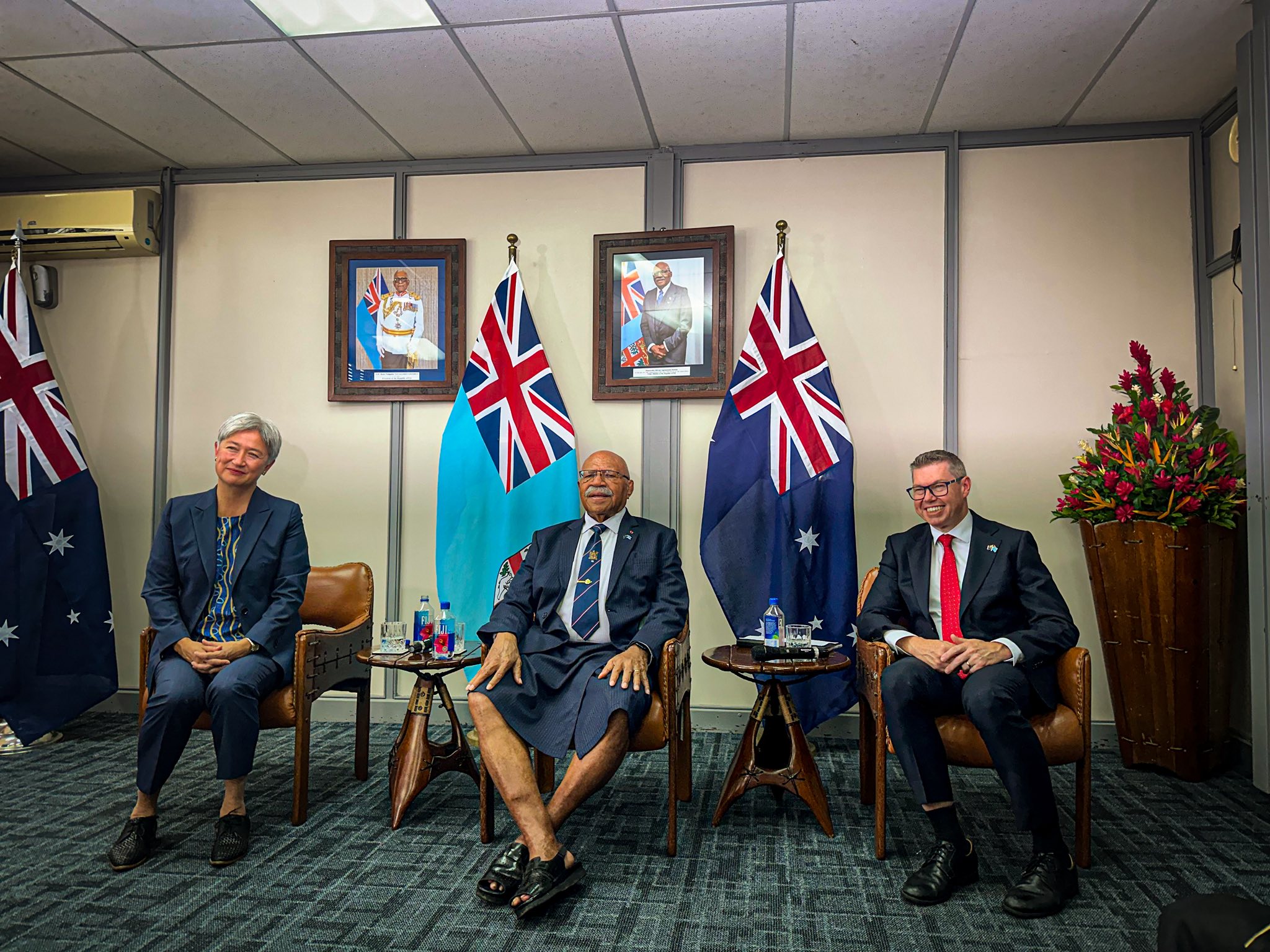
Fiji and Australia have reaffirmed their deepening partnership, announcing progress toward a landmark “Vuvale Union” while pledging closer cooperation on security, climate action and the ongoing global fuel crisis during a joint press conference in Suva.
Prime Minister Sitiveni Rabuka said the visit by Australia’s Foreign Minister Penny Wong and Minister for Pacific Affairs Pat Conroy reflected “the strength, maturity and depth of the Fiji-Australia partnership.”
“This visit… reflects the strength, the maturity and the depth of the Fiji-Australia partnership and our shared commitment to advancing a stable, secure and prosperous Blue Pacific,” he said.
Rabuka reaffirmed Fiji’s alignment with regional processes under the Pacific Islands Forum and highlighted progress toward the bilateral agreement.
“This represents a huge step up in our relationship,” he said, describing the Vuvale Union as being “anchored in shared values… designed to deliver enduring outcomes across security, economic cooperation and people-to-people connections.”
He added that the agreement would give practical effect to Fiji’s “Ocean of Peace” vision, embedding “sovereignty, respect and Pacific-led solutions into a practical, cooperative framework.”
Security cooperation remains central, particularly in tackling transnational crime. Rabuka noted that collaboration with Australia is strengthening intelligence sharing and law enforcement.
“This collaboration reflects our shared commitment to protecting our communities and upholding peace and stability,” he said.
On the global fuel crisis, Rabuka acknowledged mounting pressure on Pacific economies and welcomed Australia’s support.
“We appreciate very much Australia for taking a regional approach… to ensure fuel supplies into our region is sustained,” he said.
Looking ahead, he confirmed Fiji will host a pre-event ahead of COP31, describing it as “a critical platform to shape the global climate agenda.”
Wong echoed the strong ties between the two nations, describing Australia as “a committed partner” that has “stood with the Pacific family through challenging times.”
“We stand with you today,” she said, referencing the global energy shock driven by conflict in the Middle East.
She announced AU$30 million (US$21.7 million) in targeted budget support to assist Fiji’s fuel response, acknowledging the strain of rising costs.
“We understand the extent to which this is being felt as a price shock in Fiji and we want to provide our assistance,” Wong said.
She confirmed both countries had agreed to establish the Vuvale Union, describing it as “family under one roof.”
“It is a union that will rest on our shared trust, respect and responsibility,” she said, adding that it would focus on “security, economic and people” pillars and be guided by “durability, sovereignty and regionalism.”
“In a world that is more contested, we are stronger together,” Wong said.
Conroy reinforced Australia’s commitment to security cooperation, particularly in combating drug trafficking.
“The Australian Government stands shoulder to shoulder with the people of Fiji… in combating transnational crime and eliminating drug smuggling in our region,” he said.
He highlighted existing collaboration, including joint operations that have seized significant quantities of illicit drugs, and investments in maritime and border security.
“We are already working together to disrupt the drug trade,” Conroy said, noting a joint operation that seized “over four tonnes of methamphetamine.”
He also announced new support for Fiji to acquire an integrated border management system to track persons of interest.
“The Vuvale Union will further strengthen Fiji’s capabilities across interdiction, policing, legislation, prosecution and importantly health,” he said.
Both sides stressed that the partnership is grounded in mutual respect and sovereignty, with Wong underscoring that cooperation aims to strengthen Fiji’s institutions and resilience.
As discussions continue, leaders from both countries expressed confidence that the agreement will serve as a long-term foundation for regional stability.
“Together we are stronger,” Rabuka said. “We remain committed to advancing a peaceful, resilient and united Pacific region.”