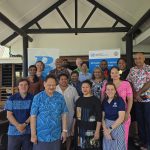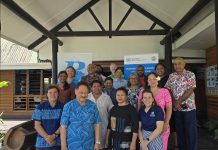


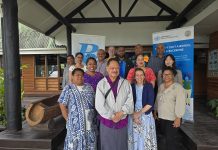
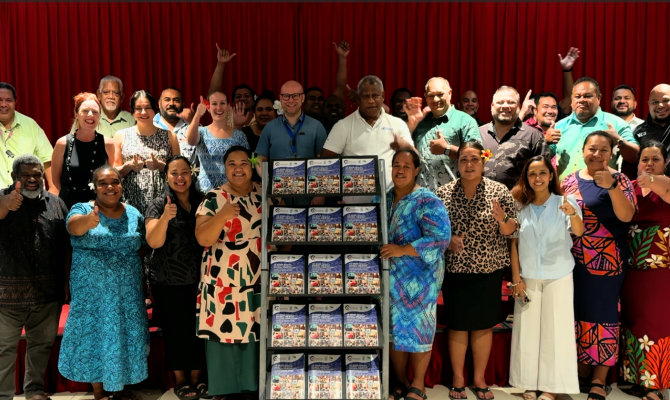
In a landmark moment for Pacific climate resilience, the Pacific Leaders Weather Ready Pacific (WRP) Programme being implemented by SPREP has launched its Gender Equality, Disability and Social Inclusion (GEDSI) Strategy 2025–2033.
The new strategy, launched on Friday 13 March 2026, is a comprehensive framework designed to ensure that early warning systems, weather forecasts, and disaster preparedness services reach every person across the Pacific, especially the most vulnerable.
At the heart of the WRP GEDSI Strategy is a simple but powerful truth: the people most at risk from extreme weather events are women, girls, persons with disabilities, youth, and other marginalised groups. They are also often those least reached by the services designed to protect them. The strategy is WRP’s formal commitment to changing that.
“Our commitment is to the vision of building a resilient and inclusive Pacific where everyone, and in particular Pacific women and girls in all their diversity, are empowered to anticipate, prepare for, respond to, and recover from all disasters and hazards,” said Salesa Nihmei, Director of the Climate Science and Information Programme at the Secretariat of the Pacific Regional Environment Programme (SPREP).
The strategy recognises that Pacific Island communities face escalating threats from tropical cyclones, tsunamis, droughts, storm surges, and flash floods, and that these events do not affect all people equally. Persons with disabilities, for example, are up to four times more likely to die in a disaster than those without disabilities. Women with disabilities face compounded disadvantages across education, employment, and health, and are more vulnerable to violence, particularly in the chaos immediately before or following a disaster.
The GEDSI Strategy directly shapes how WRP supports National Meteorological and Hydrological Services (NMHSs) across the Pacific region. While these services play a critical role in delivering life-saving forecasts and warnings, assessments already conducted across some of the Pacific Islands of Cook Islands, Niue, Palau, the Republic of the Marshall Islands, and Tuvalu have revealed a consistent pattern: gender and inclusion considerations remain poorly integrated into institutional operations, hindered by insufficient resources, male-dominated workforces, and a troubling tendency to offload responsibility for inclusive outreach onto community-level women’s groups rather than embedding it in institutional policy.
Under its Institutional Strengthening and Capacity Building priority area, WRP commits to providing mandatory, ongoing GEDSI training across all NMHS staff and partners; integrating GEDSI into core operational policies and strategic planning; and actively promoting gender balance, including in leadership and technical roles where women currently represent fewer than 20 percent of positions globally.
A dedicated programme to support Pacific Women in Weather and Water will foster professional development for Pacific women in meteorology, hydrology, and related sciences, both within formal NMHSs and through recognition of the vital informal roles played by community networks such as Fiji’s Women’s Weather Watch (WWW) and Vanuatu’s Women Weta Weta.
Crucially, the strategy outlines how WRP will also invests in the “last mile”, the hardest-to-reach communities where the gap between warning issued and warning received can mean the difference between life and death. WRP-funded satellite internet services in underserved areas will support information dissemination, while community leaders and traditional communication networks will be leveraged to ensure warnings are understood and acted upon by all.
During the launch, Pacific Met Services heard about the strategy’s “transformative twin-track approach”: simultaneously mainstreaming GEDSI across all WRP programming while delivering targeted interventions to address the specific barriers faced by marginalised groups.
The approach is built on the understanding that neither track alone is sufficient for lasting change.
Additionally, there are five Key Priority Areas that structure the approach: Inclusive Risk Understanding and Early Warning Systems for All; Gender Transformative Approaches; Holistic Disability Inclusion; Deepening Social Inclusion and Community Engagement; and Institutional Strengthening and Capacity Building. These are underpinned by dedicated monitoring and evaluation frameworks that collect disaggregated data, by gender, age, disability, location, and socioeconomic status, to track progress and continuously improve.
The WRP GEDSI Strategy 2025–2033 is more than a policy document, it is a transformation agenda for how Pacific meteorological and disaster preparedness institutions operate, who they serve, and who they employ. Its vision is clear: a resilient and inclusive Pacific where Pacific women and girls in all their diversity, persons with disabilities, and marginalised groups are empowered not merely to survive disasters, but to anticipate them, prepare for them, and recover from them with dignity.