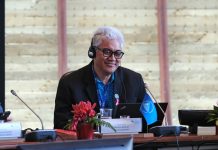
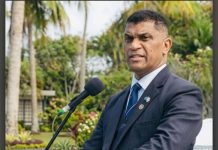

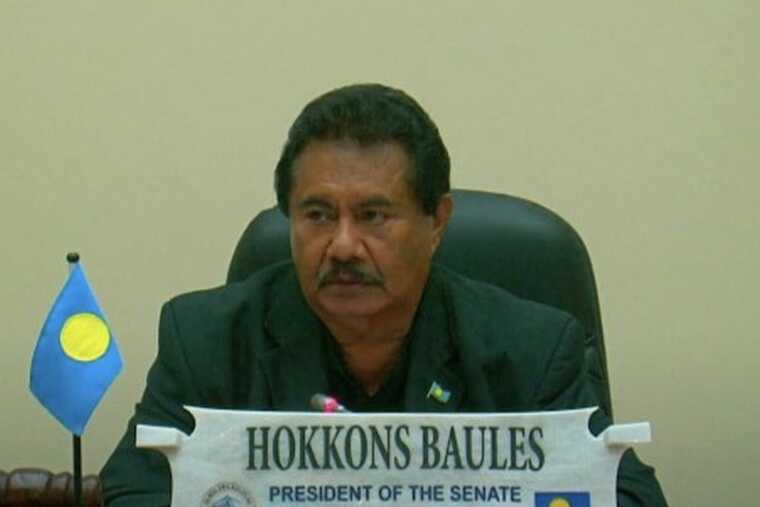
Palau Senate President Hokkons Baules has publicly rejected allegations referenced in a recent statement by the United States Department of State, saying he has never engaged in corruption, taken bribes or supported criminal activity involving Chinese nationals.
In remarks addressed to fellow senators of the 12th Olbiil Era Kelulau and to the people of Palau, Baules said he was “confused” by claims that he was involved in corruption, associated with Chinese criminals or had accepted money from Chinese businessmen.
“I don’t know what corruption I am involved in Palau or outside of Palau,” Baules said. “I don’t have Chinese friends who are criminals, in Palau or outside of Palau. And I have never taken money from businessman in Palau or outside of Palau, or support Chinese or Chinese businesses.”
Baules said he stands by the oath taken when the 12th OEK was sworn in — to “protect and defend Palau, Palau’s Constitution, Palau laws and laws of its 16 states.”
The statement from the State Department also indicated that Baules and his immediate family are banned from entering the United States. Baules questioned the basis for the decision but said he respects U.S sovereignty.
“My question is: have I broken any U.S laws while living in Palau? I don’t know what U.S laws I have broken,” he said. “But it is okay. It is their country, so it’s their discretion whether I can go there or not. Anyways, I am not crying to go to the United States.”
He noted that he has traveled to Guam in the past to attend Palau Independence Day celebrations but said if U.S authorities no longer wish to admit him, “that is their right.”
Baules called for transparency and due process, pointing to letters sent by Senate Vice President Senator Stevenson Kuartei and Palau Ambassador to the United States Hersey Kyota requesting information from the State Department regarding the allegations.
He urged President Surangel Whipps Jr. and the Ministry of State to make similar requests.
“If such information is available at the U.S Department of State, have them send it to Palau,” Baules said.
“And if that information says I am involved in corruption, let the Special Prosecutor and the Attorney General sue me. If it is proven in court that I did have criminal involvement, let it be. Let me be put in jail for it, and I’ll resign from the Senate because I’ve broken the law.”
Baules also addressed concerns about Chinese nationals in Palau, saying the country maintains diplomatic relations with many nations and is a member of the United Nations, where the People’s Republic of China voted in favour of Palau’s membership.
“We all know that Palau has no enemy in the world. But we do have many friends,” he said.
He acknowledged that some Chinese nationals in Palau have been involved in criminal activity and have been charged and jailed.
He also noted that some have been placed on the president’s Undesirable Aliens list. However, he raised questions about instances in which individuals with valid Foreign Investment Board licenses were listed without charges or investigations.
“But despite that, we respect the President of Palau’s decision on that,” Baules said.
The Senate president stressed that differences between the legislative and executive branches should not be interpreted as hostility.
“We do have differences of opinions on some issues but having differences of opinions does not mean we are against the President,” he said.
He cited a recent lawsuit filed by the Senate against the president, saying it was intended to seek clarification on constitutional or legal questions, not to oppose the executive branch.
“We represent the people of Palau, so we have right to question the President when we have differences in opinions,” Baules said. “When that is not clarified within OEK, we go to court to get clarification.”
Baules also revisited the ongoing debate over deportees entering Palau under a memorandum of understanding.
He said senators questioned whether there is legal authority for the president to allow individuals to enter and temporarily stay at Palau Community College while seeking employment.
“The United States cannot send people away without a reason. There is a reason,” he said. “They are deportees. Why? What caused that? Just like our citizens who go to the U.S and break laws and get deported.”
He emphasised that foreign workers from countries such as the Philippines and Bangladesh enter Palau under existing labour and immigration laws, unlike the deportees under the MOU arrangement.
Baules concluded by urging patience while awaiting responses from U.S authorities.
“I want to let you all know, I have nothing to hide,” he said. “Our country has an open government, a government of laws and there is a process to follow to determine if a person is guilty or not, said Baules.