
By Sanjeshni Kumar
The Pacific Resilience Facility (PRF) is poised to become the region’s first Pacific-owned and led international financial institution, with Forum Leaders set to sign its establishing treaty at their meeting in Honiara, Solomon Islands next month.
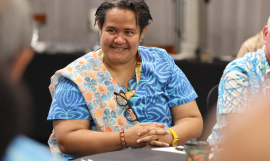
General Manager, Finau Soqo said the facility will deliver on leaders’ vision to “scale access to finance in a meaningful way” and ensure funds reach communities most affected by climate change.
“The PRF is actually going to be our first international financial institution to be owned by Pacific government. One of the key things is how do we establish a mechanism that can scale access in a meaningful way and that can give access to finance for communities.”
The PRF will operate under two grant pillars. The first, for climate and disaster resilience, will fund projects in adaptation, disaster preparedness, nature-based solutions, loss and damage, and disaster response. The second, for social and community resilience, will focus on “soft” investments such as capacity building, institutional strengthening, and resilience aspects of the Sustainable Development Goals (SDGs).
“For example, if someone is doing a school project and in the original scope, they didn’t plan that they would need to extend the seawall, the PRF can also support that, especially if it’s related to climate and disaster resilience,” Soqo explained.
On loss and damage, the PRF aims to provide targeted support within larger efforts, particularly for relocation projects.
“Different countries have different approaches to permanent loss and permanent damage — whether physical, non-physical, particularly culture and tradition, or relocations… Probably not the entire project, but where can the PRF support that loss and damage? In that case, a relocation project.”
The PRF has been nearly 10 years in the making, with extensive consultations before and after COVID-19.
“We’ve wanted to really show action, not just consult and consult,” Soqo said.
“In less than 30 days’ time we’ll be signing the treaty to legally establish the PRF. That’s the most important step.”
So far, the facility has secured US$162 million in pledges from ten sovereign investors, including Australia, Saudi Arabia, Germany, France, China, Nauru, Japan, Ireland, the United States and the United Kingdom, toward its US$500 million capitalisation goal.
The U.S has already released part of its committed funds, with the remainder expected after the treaty signing.
“We had a high-level advocacy mission to the U.S earlier this year with the Forum Chair and the Secretary General, and the dialogue was very positive,” Soqo said.
Once the treaty is signed in Honiara, at least eight Forum members must ratify it for it to enter into force. The goal is to complete ratification by the first quarter of 2026, hold the first call for proposals at the 55th Forum Leaders’ Meeting in Palau later that year, and begin disbursing grants in early 2027.
Between now and the Honiara meeting, Soqo said the PRF team will be “kick-starting the programming co-design” and finalising legal procedures. Visits to Tuvalu, Vanuatu and Nauru are planned before the signing, followed by further country visits to combine programming consultations with treaty ratification follow-up.
The PRF will have three channels for applications, via national governments, through partners, and directly to communities.
“If people can fill forms from their phones, why not?… We’re Pacific Islanders, we learn by seeing, we learn by doing — not necessarily by reading,” Soqo said.
To ensure small community groups can access funds, she said the facility will draw lessons from banking to simplify processes without compromising governance. This includes translating forms into local languages, using videos to guide applicants, and testing digital solutions to track project progress.
“Simple and simplified access to climate finance means having forms and proposals that don’t require too much work. We need to make it accessible but also monitor so that the money is being used for what it’s intended to do.”
Soqo said success will be measured not just by completed projects, but by long-term impact.
“The water tank is just there to store water. The real resilience is when there is a drought and there’s water there… and when the tap breaks, someone fixes it.”
She warned that participation alone, such as attending meetings, is not an indicator of resilience.
“Resilience is a mindset… We have to be more thoughtful about how we measure success at community level.”
Inclusion will be “front and centre” of PRF programming, with specific attention to women, youth, and people with disabilities.
“We can’t be designing projects just for infrastructure without thinking about how people will access it… The key will be how communities work with partners, and how partners work with communities, to support the PRF in that area.”
She said youth engagement will also be a priority, from using their digital skills to monitor projects to offering micro-credentials that build local capacity.
When the PRF becomes operational, Soqo said the focus will be on service and listening.
“If we don’t listen properly, we won’t succeed… If we improve how we serve communities, it’ll improve how we deliver and manage risks,” she said.