


The Western and Central Pacific Fisheries Commission (WCPFC) has narrowed options for managing bigeye tuna, setting the stage for further negotiations at its annual meeting in Port Vila, Vanuatu.
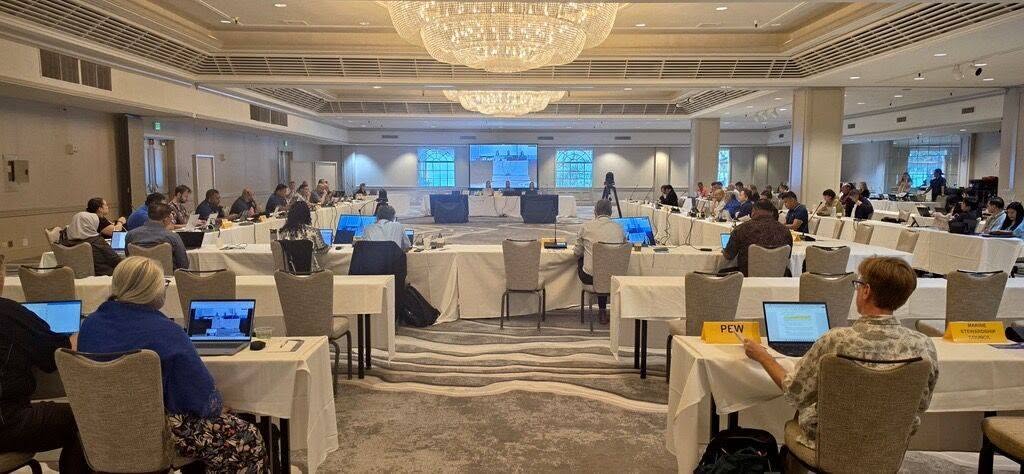
The Second Bigeye Tuna Management Workshop (BMW02), held in Honolulu on 01–02 October, agreed to carry forward three options for the areas and fishing fleets covered by the proposed management procedure, alongside two target reference point options.
The progress brings the Commission closer to adopting a management procedure for bigeye tuna in 2026, although key differences remain over how fishing responsibilities and conservation measures should be shared.
The workshop, chaired by Emily Crigler of the United States, reviewed scientific assessments and management options aimed at maintaining the sustainability of the bigeye stock while balancing fishing opportunities for different fleets.
The discussions took place against concerns raised by the Scientific Committee that the 2026 stock assessment indicated a more depleted bigeye stock and a greater probability of low stock levels than previously represented in the modelling framework.
Participants supported a revised operating model grid to better account for the possibility of lower stock levels, including scenarios below the limit reference point.
The Pacific Community (SPC), which provides scientific advice to the Commission, will undertake further testing of the revised models and candidate management procedures ahead of a special session of the Scientific Committee in late November.
A major issue during the workshop was the geographical coverage of the proposed management procedure and whether small island developing States (SIDS) fisheries and the Hawaii longline fleet should be included.
Several Pacific countries argued that SIDS exemptions under the existing Tropical Tuna Measure (TTM) must be retained, saying their domestic fisheries development rights and special circumstances must be recognised.
They warned that removing the exemptions without addressing wider allocation issues could place an unfair conservation burden on Pacific Island countries.
Other participants supported broader coverage of the bigeye fishery, arguing that management responsibility should be shared across major longline fisheries.
Discussions also highlighted concerns about the distribution of fishing effort, monitoring and enforcement of high seas longline operations, and the economic impact of fish aggregation device (FAD) closures on Pacific Island economies.
On target reference points, participants agreed to retain two options — a lower and an upper target, each assessed at a 50 percent probability.
The target reference points will guide the level of spawning biomass the management procedure aims to maintain.
The workshop also considered how the management procedure would adjust fishing controls over time, including longline catch limits and the duration of purse seine FAD closures.
Under the proposed approach, management settings would be reviewed over three-year periods, with the aim of balancing the impacts on longline and purse seine fisheries.
The workshop requested further scientific evaluation of an option that would produce adjustment factors, or scalars, for existing longline bigeye catch limits and FAD closure periods under the TTM.
The remaining options will be considered by the Commission at its 23rd Regular Session (WCPFC23) in Port Vila in December.
The Commission is expected to consider the areas and fisheries covered by the management procedure, the target reference points and the harvest control rule before moving towards adoption.
The estimation method and implementation arrangements will undergo further scientific and technical work in 2027.
The management procedure is intended to provide a predictable, science-based framework for adjusting fishing controls in response to changes in bigeye tuna stock conditions.