


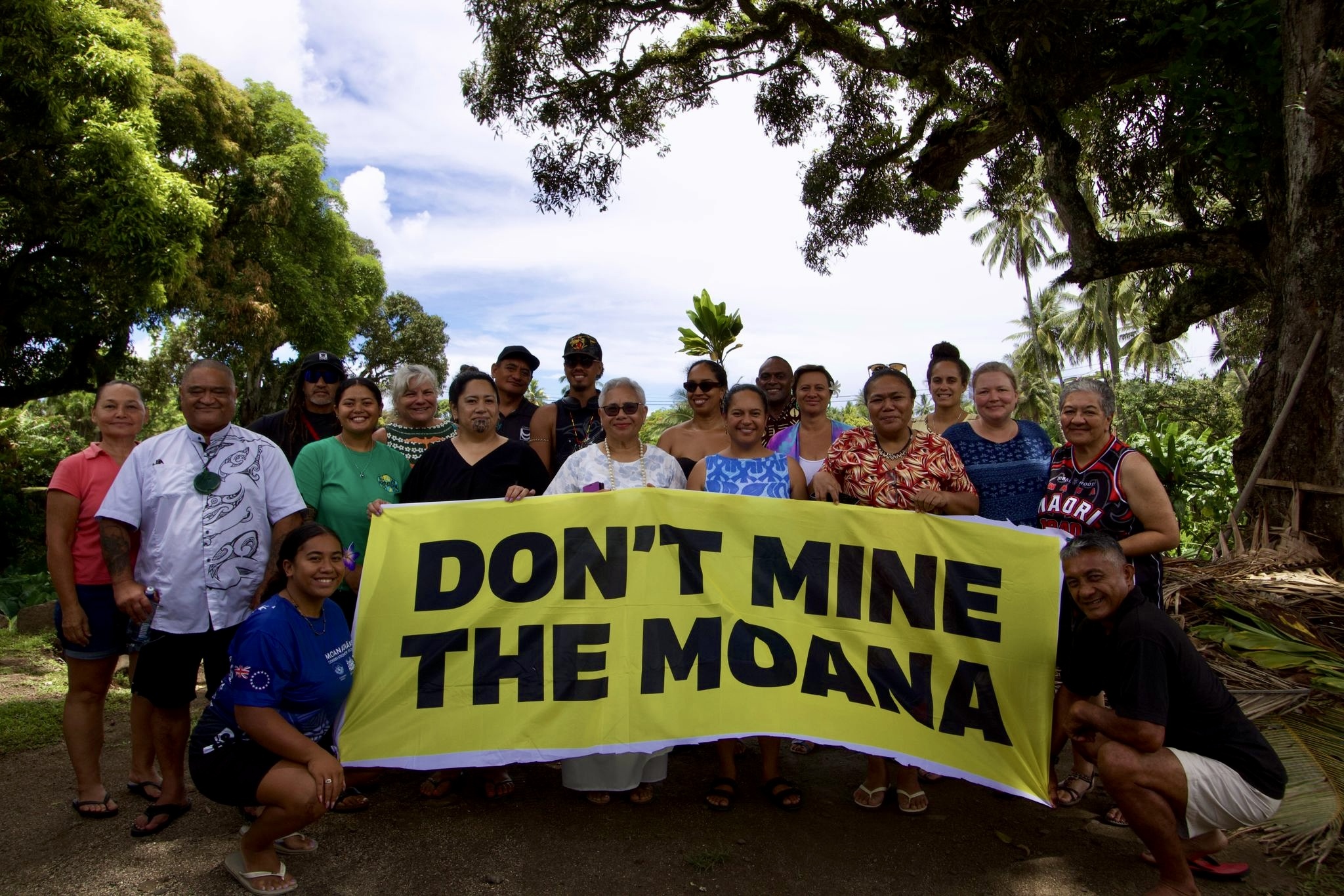
A new attempt to authorise deep-seabed mining through United States domestic law could have far-reaching consequences for international ocean governance, Pacific states and the Cook Islands.
The Metals Company USA, known as TMC USA, has submitted an application to the United States National Oceanic and Atmospheric Administration (NOAA), for an exploration licence and commercial mining permit in the Clarion-Clipperton Zone, an area of the Pacific Ocean between Hawai’i and Mexico.
The application covers a proposed commercial recovery area of approximately 65,000 square kilometres; that’s an area of ocean roughly 1000 times the size of Rarotonga. NOAA has determined that its application meets the information requirements to proceed through the assessment process, but it has not approved an exploration licence or commercial mining permit. A 60-day public consultation is open until 19 October 2026.
The process is taking place under the Deep Seabed Hard Mineral Resources Act (DSHMRA), a largely dormant 1980 law creating a domestic system for U.S entities seeking to explore for and recover hard minerals beyond national jurisdiction.
NOAA revised its regulations in January 2026 to allow eligible applicants to seek an exploration licence and commercial mining permit through a consolidated process.
This is significant because TMC USA is seeking authorisation through a unilateral United States process rather than through the International Seabed Authority (ISA), the institution established under the United Nations Convention on the Law of the Sea to control mineral activities in the international seabed.
Under UNCLOS, the seabed and its mineral resources beyond national exclusive economic zones (EEZ) waters are recognised as the common heritage of humankind. Decisions concerning these shared resources are intended to be made collectively by the member countries of the ISA, rather than determined by one country or private company.
Te Ipukarea Society Director Alanna Smith said approving the application would undermine collective rights and set a dangerous precedent for small island states.
“Although a United States permit would not directly remove the Cook Islands’ sovereign rights within our own EEZ, it could weaken the international rules-based system that helps protect those rights,” Smith said.
“Collective processes under the ISA give smaller states a voice in decisions affecting the global ocean commons. If powerful states and private companies can bypass these processes, Pacific peoples risk being excluded from decisions that may affect our ocean, livelihoods and future generations.”
The environmental implications also cannot be confined to lines drawn on a map. The ocean is interconnected, and sediment plumes, underwater noise, habitat destruction and disruption to marine ecosystems may extend beyond a proposed mining area or affect migratory species and wider food webs.
During NOAA’s virtual public hearing on 13 October, Te Ipukarea Society President June Hosking and Kelvin Passfield delivered oral statements opposing TMC USA’s application on behalf of Ocean Ancestors, a collective comprising Te Ipukarea Society, Kōrero o te ‘Ōrau and Ocean Toa.
Hosking told NOAA that Pacific peoples understand the ocean as the foundation of life and have a responsibility to safeguard it.
“As Pacific people, we recognise that ocean life is our life and, as guardians, we advocate for the health and wellbeing of our environment and all-kind, not just humankind,” Hosking said.
Their statements highlighted the risks of authorising commercial extraction before scientists adequately understand deep-sea species, microbial communities, ecological connections and recovery times. Polymetallic nodules form over millions of years, meaning their removal cannot credibly be described as sustainable on human timescales.
These developments are directly relevant to the Cook Islands, which remains at the exploration stage within its own EEZ. Exploration is not commercial mining, but it assesses the potential for future extraction. Approval could normalise the industry before its environmental, legal, cultural and economic risks are understood, while increasing pressure on Pacific countries to move towards exploitation.
“Decisions about our shared ocean must not be driven by an international race to mine or the interests of private companies,” Smith said. “They must be based on independent science, transparent economic information, meaningful public participation and a genuine ability to say no.”
Given the unresolved risks, Te Ipukarea Society maintains that deep-seabed mining should not proceed and supports calls for a global moratorium or precautionary pause.