
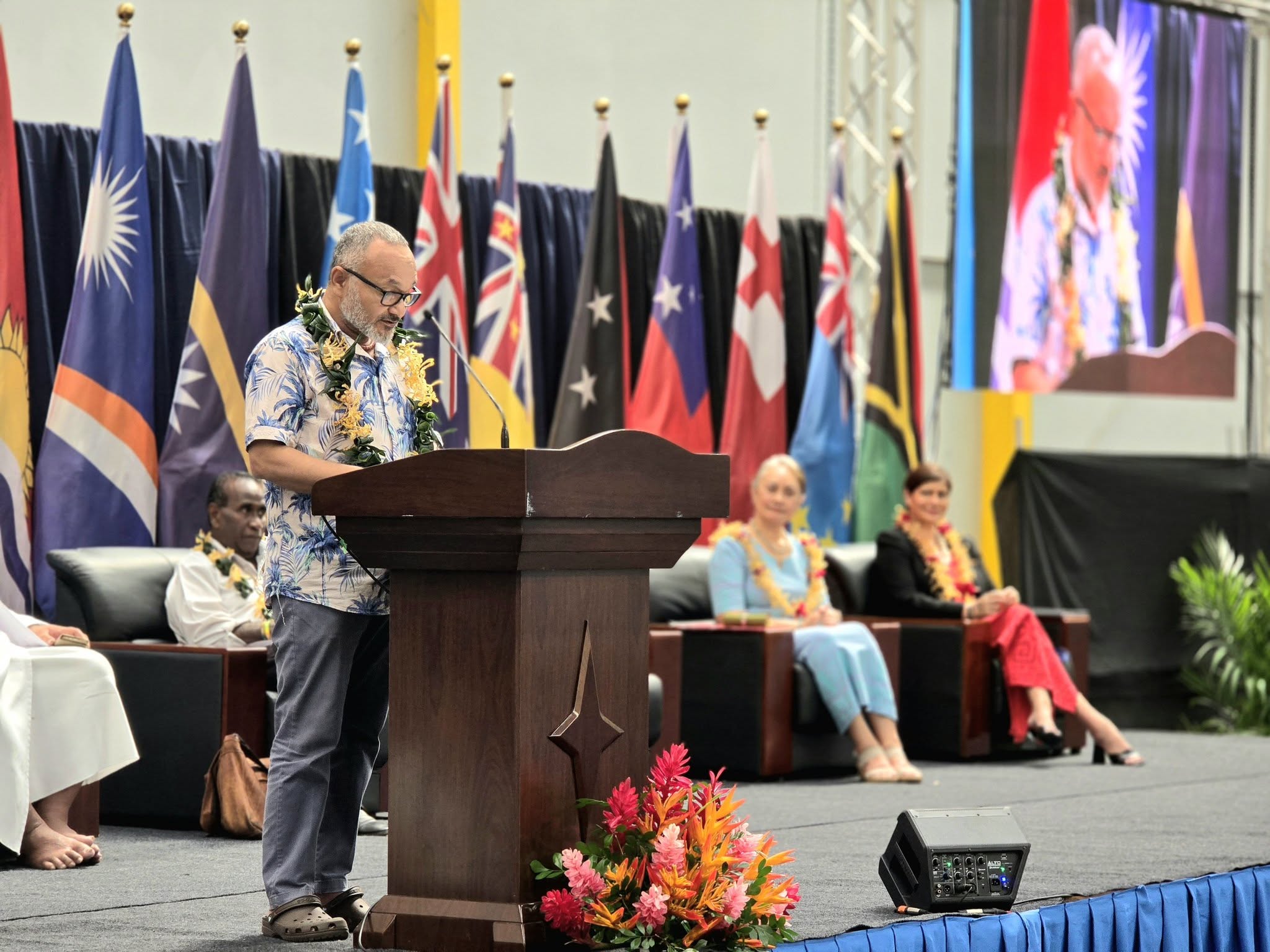
Solomon Islands Prime Minister Matthew Wale has declared climate change a national security and economic priority, unveiling a legislative and investment agenda aimed at building a climate-resilient country by 2050.
Opening the Pacific Climate Conference in Honiara, Wale said the GREAT Coalition Government had embedded climate responsibility across its policies, with a focus on people, responsible resource governance, environmental standards and long-term national resilience.
“Our task is to translate these commitments into visible improvements in villages, provinces, public services and livelihoods,” Wale said.
“We will legislate. We will budget. We will enforce. And we will report to our people on delivery, not on intentions.”
Wale said climate commitments must be measurable and backed by concrete action.
Under GREAT’s Environment, Climate Change, Disaster Management and Meteorology policy, the Government will pursue legislative and institutional reforms, including establishing a dedicated enforcement unit.
It will also integrate climate adaptation and disaster risk into national and local planning, including proactive relocation planning for vulnerable communities.
Other priorities include mobilising climate finance and green growth, protecting ecosystems, sustainable natural resource management, advancing a circular economy, strengthening weather and climate services, and investing in environmental education and knowledge systems.
Renewable energy transition has also been elevated as one of the Government’s six flagship development programmes.
Wale said Solomon Islands would expand solar, hydro, geothermal and biomass energy to reduce fuel imports, improve rural services and create green jobs.
The Government’s legislative agenda includes a Climate Change Bill, National Disaster Council Bill, Meteorological Services Bill and Independent Energy Regulator Bill.
It will also introduce Carbon Trading Regulations and Deforestation Compliance Regulations, while reviewing the Environment Act and Electricity Act.
Wale said climate finance must be treated as climate justice rather than charity, calling for finance that is adequate, predictable, accessible and grant-based.
“A fund that exists internationally but cannot be reached by a Pacific community is not delivering justice,” he said.
Solomon Islands will strengthen its domestic climate-finance architecture, develop a pipeline of investable projects, pursue national accreditation to access international funds directly and establish a Solomon Islands Renewable Energy Fund.
The Government is also developing the country’s first National Loss and Damage Policy and Investment Roadmap, covering both economic and non-economic loss.
Wale said ecosystems must be recognised as part of the country’s climate infrastructure.
“A healthy reef and mangrove are coastal protection. A healthy forest supports water security. These ecosystems are climate infrastructure,” he said.
He outlined reforms covering sustainable forestry, community forestry, high-integrity carbon markets with fair benefits for landowners, sustainable fisheries, marine spatial planning and circular economy waste management.
Wale also called for greater use of traditional knowledge in climate action.
“We are descendants of voyagers who crossed the world’s largest ocean without satellites,” he said.
“They did not deny risk. They understood it, prepared for it and navigated through it together.”
Wale said traditional knowledge remained a source of observation and innovation and should be reflected in research, education and climate investment.
The Pacific Climate Conference continues in Honiara this week.