


By Pita Ligaiula in Koror, Palau
Pacific civil society organisations are maintaining their call for a ban on deep sea mining, warning Pacific leaders that seabed extraction could expose countries to major legal, financial and environmental liabilities.
The warning was made during a civil society interview at the Pacific Media Workshop in Palau, where representatives from the Pacific Network on Globalisation (PANG), Pacific Islands Association of Non-Governmental Organisations (PIANGO), Pacific Islands Climate Action Network(PICAN) and Pacific Island Students Fighting Climate Change raised concerns over the push for deep sea mining.
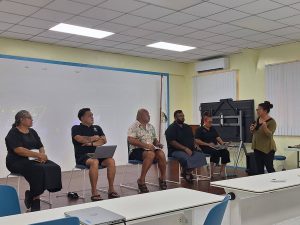
Joey Tau, Coordinator of the Pacific Network on Globalisation (PANG), said civil society had consistently opposed deep sea mining and called for stronger science, national consultation and legal safeguards before Pacific governments make commitments.
Tau said Pacific countries remained divided on deep sea mining, but civil society had maintained its position for more than a decade.
“Civil society continues to call for a ban. We’ve maintained that ban since the Leaders’ Forum in 2012,” Tau said.
He said Pacific advocacy had
helped build international support for a moratorium or precautionary approach to deep sea mining.
“The Pacific has really shifted the global move for a moratorium,” Tau said.
Tau said Pacific countries had also taken international leadership on climate justice and ocean protection, and questioned whether deep sea mining was consistent with that position.
He said decisions on exploration or exploitation should not proceed without adequate scientific evidence.
“We cannot be making decisions without science,” Tau said.
“And not just modern-day science, but traditional Indigenous science.”
“We cannot proceed on exploration or exploitation without science,” he said.
Tau said governments also needed to ensure proper consultation with communities and national stakeholders before making regional and international commitments.
“The concerns by civil society for due process to take place nationally before our leaders go globally and make global statements and commitments depicts the lack of consultation that governments or agencies have with their national constituents
“And I think that really needs to happen,” he said.
PIANGO Executive Director Emeline Siale Ilolahia said Pacific countries sponsoring deep sea mining activities could face significant long-term liabilities if something went wrong.
Speaking from the perspective of Tonga, one of the countries involved in the deep sea mining sponsorship debate, Ilolahia said the issue raised serious questions about the capacity of Pacific countries’ legal systems and domestic laws.
She warned that the transboundary nature of the ocean meant environmental damage could affect neighbouring countries and potentially lead to legal action.
“The way that it’s being formed in terms of the sponsorship within the ISA, it is actually the country that ends up being liable,” Ilolahia said.
She said Pacific governments needed to ensure they had adequate legal protections before entering into long-term arrangements with mining companies.
“If we are not speaking out to make sure that we have legal measures in place to protect our people from being liable should something go wrong, then we are putting everyone in our communities, even unborn children, at risk,” she said.
Ilolahia said the contractual arrangements being entered into by governments and companies could have consequences extending well beyond the current generation.
“It is really a long-term commitment.
“It raises the question: is it worth it? Is it worth getting into?,” she asked.
Ilolahia said the push towards deep sea mining was also linked to the economic pressures facing many Pacific Island countries.
She said governments facing high debt levels and deficit budgets could be attracted by promises that seabed minerals would generate major new wealth.
But she warned that the economic argument needed to be closely examined.
“Oftentimes we are thinking that all of a sudden we’ll be getting rich because we are highly in debt,” Ilolahia said.
She said civil society work on public finance management showed that many Pacific countries were already operating with deficit budgets, making them vulnerable to promises of new revenue streams.
“For civil society, we think that is already a red flag,” she said.
Ilolahia said deep sea mining could not be treated simply as an environmental issue.
“Deep sea mining is not just about the environment or the ocean. It is far deeper.
“It gets into our everyday lives because our ocean is where a lot of our communities depend for their livelihoods ,” she said.
Tau also questioned the geopolitical interests behind the growing global demand for critical minerals.
“When we talk about critical minerals, critical for whom?” he asked.
Tau said the global rush to secure minerals needed for strategic and military purposes was increasingly shaping the debate over resource extraction.
He warned Pacific countries to examine whether they would receive meaningful benefits or simply carry the environmental and legal risks.
“So what does it mean for us in the Pacific?.
“We don’t stand to benefit. And we are at risk,” Tau said.
He urged journalists and governments to scrutinise who stood to gain from the push to mine the deep ocean.
Pacific Island Students Fighting Climate Change Engagement and Outreach Lead Abdul Mufeez Shaheed questioned the argument that deep sea minerals were necessary for the global transition to renewable energy.
Shaheed said Pacific countries were being told that minerals from the ocean were needed to manufacture solar panels and other technologies required for the transition away from fossil fuels.
But he said the countries promoting that argument were not necessarily moving fast enough to reduce their own dependence on fossil fuels.
“They want our minerals and they are telling us it is for climate change mitigation and the transition, but they are not moving away from fossil fuels themselves,” Shaheed said.
He said Pacific governments and communities needed better information about how deep sea mining was being presented as an economic opportunity.
“Who has the advantage and for how long?.
“Where is the intergenerational wealth we are going to make out of this?,” Shaheed asked.
He also raised concerns about the possible impact of deep sea mining on tuna and other marine resources that are central to Pacific economies and livelihoods.
“What is going to happen to our tuna population ?” he asked
“When you dig into the ocean and drag those nodules, our seas do not have boundaries that are easy.”
Shaheed said the transboundary nature of ocean ecosystems meant the consequences of deep sea mining could extend beyond the country where an activity was taking place.
He linked the issue to the Pacific’s leadership in strengthening international law on state responsibility and transboundary harm.
“You have a sovereign right to act, but if your actions within your sovereignty affect another country, then you are liable for the harm you cause.
“And that applies here also,” Shaheed said.
He said there was a contradiction in Pacific countries championing international legal action on climate change and environmental protection while considering activities that could create environmental harm across national boundaries.
“We champion international law for climate change, but then we engage in activities that go contrary to what our leadership in climate and environmental protection looks like on the global stage,” Shaheed said.
Shaheed said this was where civil society could provide an important accountability role by reminding governments of their previous commitments.
“What did you say five years ago, and what are you considering now?” he asked.
“The alignment shifts, sometimes dramatically, between what we are saying regionally and what we are seeing as individual issues of priority,” Shaheed said.
PICAN Principal Advisor for Strategy and Regional Affairs James Viernes said deep sea mining remained one of several divisive issues in the Pacific.
He said difficult issues should not be pushed aside simply because regional consensus was difficult to achieve.
“Deep sea mining and several other issues are quite divisive in our region.
“Oftentimes, when there are issues where consensus cannot be reached, they tend to be shied away into the shadows until another time,” Viernes said.
Viernes said civil society was calling on Pacific leaders to confront those disagreements directly.
“We really call on our leaders to confront those difficult discussions that need to be had,” he said.
He said the debate should not be reduced to economics or geopolitics.
“This is not just a geopolitical issue. It’s not an economic issue,” Viernes said.
“Extraction impacts people in different ways. We know that women and youth and others will be impacted by this differently.”
“And so we need to have these conversations.” he said.
The civil society representatives said Pacific leaders must consider the full consequences of deep sea mining before allowing the industry to move forward.
Their concerns range from the lack of scientific knowledge and national consultation to legal liability, public debt, marine livelihoods and potential harm across national boundaries.
For civil society, the question facing Pacific leaders is not simply whether deep sea mining could generate revenue.
It is whether Pacific countries are prepared to carry the long-term environmental, legal and financial consequences if the promised benefits fail to materialise.