



Paramount chiefs representing five of Vanuatu’s six provinces have called on Prime Minister Jotham Napat to resign before 30 July 2026, over the use of cultural names in foreign agreements.
The chiefs have also called on the Governments of Vanuatu and Australia to remove the name Nakamal from the agreement and replace it with another name.
The call follows criticism from traditional leaders over the Government’s use of cultural names and identities in bilateral agreements with Australia and the People’s Republic of China.
Speaking on behalf of kastom chiefs from Shefa, Malampa, Penama, Sanma and Torba provinces, paramount Chief Bong Meleun Tempes of Ambrym and Chairman of the Lolehor Council of Chiefs accused the Government of using sacred cultural symbols without proper consultation.
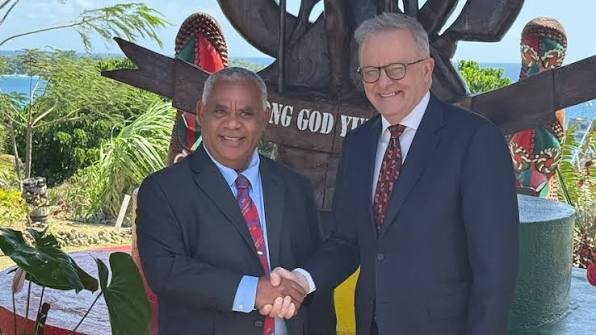
The Nakamal Agreement refers to the bilateral agreement signed between PM Napat and Australian PM Anthony Albanese in Canberra on 29 June 2026.
The Namele Agreement refers to a development cooperation agreement being negotiated with the People’s Republic of China.
Chief Tempes, serving as spokesperson for the kastom leaders, questioned the use of these names in foreign agreements, saying neither the Malvatumauri National Council of Chiefs nor the respective Island Councils of Chiefs were consulted.
“The Government has no right to decide how our custom identities are used. Our custom identity is not a commodity.
It is the soul of our people, the heritage of our ancestors and the promise we hold for future generations. To sell it cheaply in agreements with foreign powers is to betray the very essence of Vanuatu,” Chief Tempes said.
The chiefs said customary culture and Christian principles form part of the foundations of Vanuatu’s identity under the National Constitution.
They argue that cultural identities should be protected and not used as political tools.
Chief Tempes criticised PM Napat, a Member of Parliament (MP) for the Tanna Constituency, saying politicians do not own kastom.
“This is not a minor oversight. It is a direct affront to the guardians of our culture. Yet the Government now treats these sacred identities as bargaining chips in foreign diplomacy. Any Prime Minister or government of the day must respect chiefs and the Constitution. Stop trading culture for diplomacy,” Chief Tempes said.
In Vanuatu, the Nakamal is a traditional meeting place where community leaders consult, mediate and make decisions based on mutual respect and understanding.
The Namele leaf is a traditional symbol associated with peace, taboo and customary law.
While the Napat-led Government has used the names to represent respectful partnerships with foreign countries, traditional leaders argue that their use was not authorised and undermines the role of customary leadership.
The chiefs have set a deadline, calling on PM Napat to step down before the country celebrates its 46th Independence Day on 30 July.
Chief Tempes said if PM Napat does not resign, traditional leaders across the country will take further customary and administrative steps to ensure the voices of the Malvatumauri and Island Councils of Chiefs are heard.
The Prime Minister’s Office (PMO) previously responded to the issue through VBTC News, saying the agreements protect Vanuatu’s sovereignty while supporting economic development. However, the issue has created tension between Government diplomacy and customary leadership.
Asked about the next step if Napat does not resign, Chief Tempes said, “it will be known later”.
Meanwhile, the Embassy of the People’s Republic of China said the name Namele was proposed by the Government of Vanuatu, not China.
Daily Post understands that China is opting to use only “Vanuatu-China Cooperation” rather than Namele for the proposed agreement.
The agreement between Vanuatu and China has yet to be signed.
It is understood that China had been prepared to sign the agreement before the Nakamal Agreement with Australia, but the signing was delayed by Vanuatu.
The PMO has been informed of the chiefs’ demand and has indicated it will not comment on the matter.