

The Republic of the Fiji Military Forces (RFMF) has backed ending constitutional immunity provisions, saying accountability is essential for lasting peace and constitutional reform.
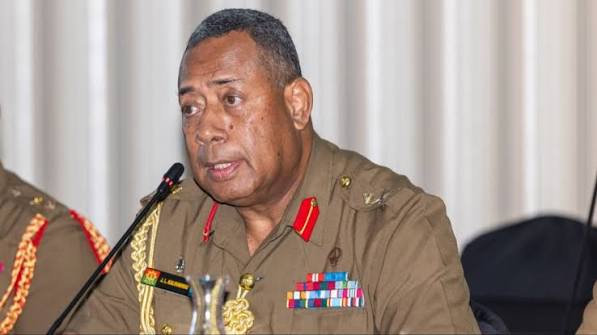
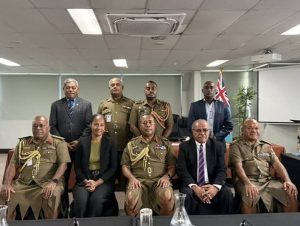
In a landmark submission to the Constitution Review Commission Thursday, RFMF Commander Major-General Ro Jone Kalouniwai acknowledged the military’s role in shaping Fiji’s turbulent political history and said the institution was prepared to accept the consequences of reform.
“We come before this commission carrying the weight of our own history,” he said.
“The systemic institutionalised pattern of political instability that has fractured this nation since 1987 was not merely witnessed by the Republic of Fiji Military Forces. At points, it was built and maintained by our own hands.”
Major-General Kalouniwai said the RFMF was voluntarily stepping away from legal protections that had shielded the institution for decades.
He acknowledged such a move could expose soldiers and officers to legal consequences, but said Fiji’s future depended on confronting its past.
“The survival of any single institution can no longer be purchased at the expense of this nation’s soul,” he said.
The military also supports reforms to strengthen civilian supremacy and establish a truth and reconciliation process.
He said Fiji cannot achieve lasting national healing without confronting the military’s role in decades of political instability.
The RFMF accepted responsibility for contributing to Fiji’s cycle of coups and constitutional disruption, describing the country’s political history as one that had fractured its “moral soul”.
“We do not say this lightly, nor without genuine remorse for the part our institution has played,” Major-General Ro Jone said.
The Commander acknowledged the military’s involvement in Fiji’s major political upheavals, including the 1987 coups, the military intervention during the 2000 crisis, and the 2006 takeover.
He said Fiji had lived with a fragile peace built on silence rather than justice.
“We have watched national stability become a phrase used to bypass the law.”
Major-General Ro Jone said infrastructure development and economic progress alone could not heal the country’s deeper wounds.
“Beneath the surface of new roads and new technology, there is a restless spirit in Fiji.”
He argued that many Fijians remained uneasy because truth and accountability had been sacrificed in favour of political stability.
The RFMF proposed establishing a national truth and reconciliation process guided by United Nations principles to allow victims and institutions to confront the past openly.
 Major-General Ro Jone said Fiji had reached a point where future generations deserved a country governed by integrity rather than fear.
The military also proposed a constitutional right to truth and reforms to dismantle what it described as a “machinery of silence”.
The submission said the Constitution should ensure no institution or individual stood above the law, regardless of rank.
Major-General Ro Jone acknowledged the reforms could expose members of the military to greater accountability.
“We accept the risk this submission carries to our own institution because the alternative, a nation of perpetual drifting, is a cost future generations should never have to bear.”
Meanwhile, the Republic of Fiji Military Forces (RFMF) has proposed the establishment of an independent Military Court of Fiji as part of its submission to the Constitution Review Commission.
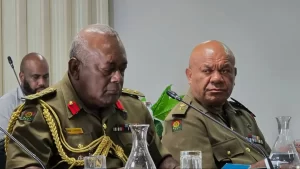
Director of Army Legal Services Colonel Kitione Tuinaosara made the submission during the commission’s consultation, saying the proposed Military Court would replace the current General Court Martial system while operating alongside Fiji’s civilian courts.
He said the reform would strengthen transparency, fairness and accountability within the military justice system.
Colonel Tuinaosara said discussions on the proposal began in 2019 when drafting of the court’s rules commenced.
Implementation would require approval from the High Court following further consultations within the RFMF.
“We intend to have it for independence, transparency and fairness. We intend to have a Military Court of Fiji here at the camp,” he said.
Under the proposed model, a military judge would preside over proceedings with a panel of military personnel, similar to the current court martial system. However, the panel would comprise senior officers, warrant officers and other ranks instead of being made up exclusively of senior officers.
Colonel Tuinaosara said the reforms are intended to address longstanding concerns about the perceived independence of military justice and improve public confidence in the system.
He said the Military Court could operate separately from the civilian courts, with discussions also exploring the possibility of holding military court sessions after civil court sittings conclude.
The proposal forms part of the RFMF’s broader recommendations to the Constitution Review Commission as Fiji considers reforms to its constitutional and legal framework.