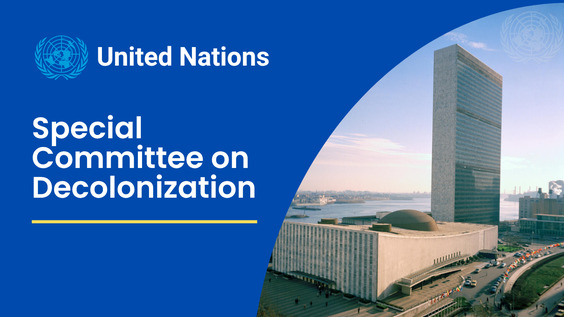
The United Nations Special Committee on Decolonisation heard renewed calls for action on New Caledonia, French Polynesia, Guam and Tokelau as it opened the main part of its 2026 session, with Pacific representatives, petitioners and administering Powers debating the pace of self-determination and decolonisation in the territories.
The discussions came as the committee approved three draft resolutions aimed at strengthening UN support for the world’s remaining Non-Self-Governing Territories, including measures promoting information-sharing, reporting obligations and visiting missions.
New Caledonia dominated much of the debate, with petitioners urging the United Nations to take a more active role in addressing the territory’s political crisis and advancing its self-determination process.
Petitioner Reverend James Bhagwan questioned whether the Special Committee’s annual consideration of New Caledonia was producing meaningful progress.
He asked whether the Special Committee’s annual consideration of New Caledonia without a visiting mission, measurable benchmarks or a decolonisation timetable is advancing freedom, “or merely managing delay”.
Bhagwan also urged the United Nations to assess the electoral environment ahead of provincial elections scheduled for 28 June and “ensure that the poll is not used to normalize an unresolved colonial situation”.
Petitioner Billy Wetewea said the unrest that erupted in 2024 reflected deeper problems within the territory.
“The 2024 uprising was not an isolated event, but rather the consequence of a failed colonisation process,” said Wetewea.
He also cited a widespread “collapse of confidence” in France as the administering power.
Other petitioners called on the United Nations to help resolve the territory’s political crisis, defend Indigenous Kanak rights and revive what they described as a stalled self-determination process.
Speaking on behalf of France, the administering Power, its representative said New Caledonia remains a sui generis collectivity established under the 1998 Nouméa Accord and retains the right to self-determination under the French Constitution.
The representative said France would continue supporting New Caledonia through the upcoming elections and assist efforts to rebuild following the violence of 2024.
Fiji and Papua New Guinea both called for all parties to engage in good faith in the self-determination process and urged the United Nations to deploy a visiting mission to New Caledonia as soon as possible.
The committee also heard renewed criticism of France’s role in French Polynesia.
Petitioner Mareva Kitalong told delegates that “Decolonisation is not an issue of the past.”
She called on France to “finally open dialogue on decolonisation” as requested by the United Nations, arguing that despite its autonomous status, French Polynesia remains without political autonomy and legislative sovereignty.
Kitalong also highlighted to what she described as France’s “nuclear debt” to French Polynesia, citing the environmental and health impacts of decades of nuclear testing in the territory.
France rejected suggestions that French Polynesia lacked autonomy, saying the territory exercises broad powers over its economy, education, health and tourism sectors.
The French representative said the relationship between France and French Polynesia is based on longstanding dialogue and noted that France contributes approximately €2 billion (US$2.32 billion) annually to the territory, equivalent to about 30 percent of its gross domestic product.
In Guam, petitioner Pim Limtiaco said the Pacific territory continues to face challenges linked to its strategic location in the Asia-Pacific region.
She argued that Guam remains affected by the legacy of the Second World War and warned that current geopolitical competition is creating new pressures.
“The United States continues to ignore our input,” she said.
Limtiaco claimed the United States is now “eyeing our oceans” for deep-sea mining as it seeks to compete with Beijing and invited the Special Committee to visit Guam to observe what she described as active colonialism.
The discussion on Tokelau highlighted a more gradual approach to self-determination.
Andre Van Der Walt, Interim Administrator of Tokelau, said New Zealand remains committed to supporting the territory and noted that Tokelau has effectively exercised self-government for decades.
“It remains essential that the people of Tokelau are able to consider questions [of decolonization] at their own pace and in their own way,” he stressed.
Fiji’s representative welcomed New Zealand’s long-term investment in Tokelau despite the territory’s unique challenges and encouraged continued support until a mutually agreed governance arrangement is reached.
The debates highlighted the differing paths being taken by Pacific territories still listed as Non-Self-Governing Territories, with New Caledonia facing renewed scrutiny over its political future, French Polynesia continuing to push for a formal decolonisation dialogue, Guam raising concerns over strategic and resource interests, and Tokelau maintaining a gradual, locally driven approach to determining its future status.
The Special Committee’s discussions will continue as delegates examine the remaining Non-Self-Governing Territories and consider further recommendations for submission to the UN General Assembly.