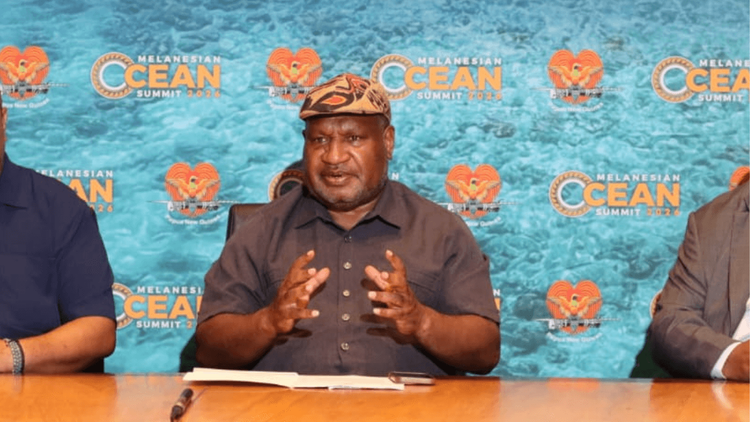
Papua New Guinea Prime Minister James Marape has welcomed leaders arriving in Port Moresby for the inaugural Melanesian Ocean Conference, which will be held at APEC Haus in Port Moresby from 11–14 May 2026.
Prime Minister Marape described the conference as a historic gathering that would unite Pacific Island Nations and International Partners in a common effort to protect the world’s oceans, strengthen climate resilience, and promote sustainable ocean management.
He said the conference comes at a critical time when rising sea levels, warming oceans, marine pollution, and environmental degradation continue to threaten vulnerable island nations and global ecosystems.
“The Melanesian Ocean Summit is a critical opportunity to turn Pacific leadership into practical action. Our Ocean sustains our food security, cultures, economies and climate resilience,” Prime Minister Marape said.
“By working together, we can protect our marine biodiversity, strengthen sustainable livelihoods, and build an ocean future grounded in partnership, stewardship and shared prosperity.”
Prime Minister Marape said the Oceans are central to sustaining life on Earth and must be protected for future generations.
“Ocean sustains life. The ocean starts the process of the water cycle. The ocean contains marine ecosystems and plays a mammoth role as a carbon sink while producing oxygen that sustains life on Earth,” he said.
The Prime Minister also reflected on the uniqueness of Earth itself, saying the Planet’s water systems distinguish it from all other known planets in the universe.
“When you look at the vastness of the cosmos, there are no other planets like Earth. The difference between our planet and all the others is that we have water — seas, rivers, and oceans, and these are life-sustaining properties,” Prime Minister Marape stated.
“If we destroy this water and the ecosystems within it, then we are destroying the Planet itself.”
Marape said Pacific Island nations are not merely small island states, but custodians of one of the world’s largest and most important Ocean regions.
“We may be seen as small island nations by population and land size, but by the size of our sovereign Ocean space, we are big Ocean states,” he said. He noted that the Pacific Ocean serves as one of the world’s largest carbon sinks and remains essential to global environmental balance.
The Prime Minister said one of the major expected outcomes from the Conference would be stronger regional commitments towards preserving at least 30 percent of sovereign Ocean spaces from harmful exploitation and environmental damage.
“Our generation must save our Oceans so that our children can continue to enjoy the life-giving properties of the Ocean and preserve our planet for future generations,” Prime Minister Marape said.
Marape also called on industrialised nations and major carbon emitters to work alongside Pacific countries in supporting Ocean and Forest conservation efforts. “We ask those Nations who hold large carbon footprints to help us save our Oceans and help us save our Forests,” he said.
“Together, these global assets can be managed sustainably for the benefit of all humanity.”
He highlighted Papua New Guinea’s globally significant location within the Coral Triangle, one of the richest Marine Biodiversity Regions on Earth.
“Papua New Guinea is in the heart of one of the most important Reef Systems in the world. We are in the heartbeat of the Coral Triangle,” he stated.
Prime Minister Marape welcomed all visiting Leaders and Delegates to PNG, including Pacific Island Leaders, development partners, and international representatives.
The inaugural Melanesian Ocean Summit 2026 started on Monday with registration and exhibitions.
Regional leaders, scientists, development partners and community organisations are in the country ahead of four days of high-level discussions on ocean protection and climate resilience this week.
Delegates gathered at the summit venue as exhibitions showcased marine conservation initiatives, research programmes, and NGO-led projects focused on safeguarding ocean ecosystems across Papua New Guinea and the wider Melanesian region.
PNG National Oceans Office Acting Director, Bonaventure Hasola, who also chairs the Summit’s working committee, said the opening day was dedicated to preparatory activities, allowing participants to familiarise themselves with the summit’s scope and objectives.
Hasola explained that the Summit aims to advance the Melanesian Ocean Corridor of Research, a regional initiative designed to strengthen the protection of marine protected areas across Papua New Guinea and neighbouring Melanesian states.
According to organisers, the exhibitions will remain open throughout the week, providing a platform for information sharing and collaboration between governments, researchers, civil society organisations and regional partners.
He also noted that public understanding of the Summit’s purpose remains limited and highlighted the importance of continued outreach and awareness raising around ocean issues affecting the Pacific.
The Melanesian Ocean Summit will provide a platform for developing declarations and policy frameworks aimed at strengthening ocean governance, while reinforcing the critical role oceans play in regulating climate and supporting livelihoods across the region.
Papua New Guinea is hosting this year’s Summit, positioning itself as a regional hub for dialogue on ocean conservation and climate resilience. Leaders and participants are expected to examine pathways for coordinated regional action as Pacific nations continue to face the impacts of climate change and environmental degradation.