



By Makereta Komai in Samarkand, Uzbekistan
Pacific Island countries have called on the Asian Development Bank (ADB) to significantly scale up climate financing, warning that climate change remains the single greatest threat to the region’s survival despite compounding global crises.
In a statement delivered at the ADB Annual Meeting, Pacific Developing Member countries leaders stressed that rising sea levels, coastal erosion and saltwater intrusion are already undermining food security, water supplies, public health and the very habitability of island nations.
“We cannot afford to divert our focus from this ongoing devastation,” the statement said.
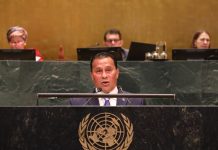
While acknowledging ADB’s leadership in mobilising climate finance, Tuvalu;s finance minister, Panapsi Nelesone urged the bank to expand funding tailored to the Pacific’s unique structural vulnerabilities.
Pacific countries also called for stronger support to access global climate funds, including the Green Climate Fund, particularly through the establishment of National Implementing Entities (NIEs) that would allow countries to directly manage and deliver adaptation programmes.
A key concern raised was the continued reliance on Gross National Income (GNI) as a primary measure of vulnerability, which leaders say restricts access to critical climate and development financing.
“The current reliance on GNI is outdated,” the statement noted, urging ADB to adopt the Multidimensional Vulnerability Index (MVI) to better reflect the Pacific’s environmental and geographic realities.
Looking ahead, Pacific leaders highlighted the significance of COP31, which will be led by Australia with pre-COP meetings hosted in the Pacific, describing it as a critical opportunity to elevate global attention on the challenges facing Small Island Developing States.
They invited ADB to engage directly in these events to better understand both the scale of vulnerability and the urgency of national adaptation efforts.
The statement also stressed that regional initiatives such as the Regional Programmatic Approach to Climate Action (RPACA) must remain aligned with national priorities and deliver tangible benefits to frontline communities, while complementing existing mechanisms including the Pacific Resilience Facility and the Pacific Catastrophe Risk Insurance Company.
Reaffirming ADB as a “trusted partner” and “the climate bank for the Pacific,” leaders called for stronger efforts to mobilise financing from global partners such as the Green Climate Fund and the Global Environment Facility, including through co-financing arrangements and climate-tagged budget support.
Pacific countries further advocated for more predictable and transparent climate finance, including trigger-based financing mechanisms to enable rapid disaster response and address loss and damage.
“To maintain this momentum, we request regular and transparent updates on key regional initiatives,” the statement said, highlighting the need for accountability in tracking how international support aligns with national climate commitments and long-term survival strategies.