
Ocean leaders at the World Ocean Summit warned that illegal fishing costing $23.5bn annually and weak enforcement threaten global ocean protection targets, urging stronger monitoring, financing, and implementation of international agreements.
It was the sentiment that addressed the elephant in what must feel like every room right now, when Jelta Wong, the Minister for Fisheries and Marine Resources of Papua New Guinea declared at the World Ocean Summit last week that it is “easier to pinpoint someone in Tehran and bomb them” than it is to monitor our own ocean.
It was part of a sweep of statements made in solidarity by global ocean leaders at the Montreal conference, which warned that ambitious marine protection targets will only fail should they not receive stronger enforcement and large-scale financing.
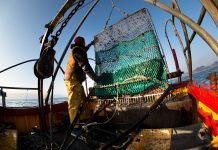
At the tip of the spear is the issue that governments are struggling to monitor vast ocean territories and tackle illegal fishing, a crisis with an estimated cost of US$23.5bn a year.
Policymakers, scientists, industry leaders, and investors had all gathered at the World Ocean Summit last week to host discussions on turning a wave of ‘recent international ocean agreements into practical action.’
It couldn’t have landed at a more critical time for ocean governance. Landmark deals – such as the High Seas Treaty (BBNJ) and the WTO Fisheries Subsidies Agreement – are beginning to reshape how oceans are managed. They land amid a flurry of concerns raised by scientists who have warned that planetary boundaries are reaching tipping points and in some cases – particularly the issue of ocean acidification – have been breached.
Across the summit, speakers emphasised that commitments to protect 30 percent of the ocean by 2030 will only succeed if governments invest in monitoring, enforcement and new financial mechanisms to support ocean protection.
“We know that today, still, roughly a third of the seafood on people’s plates comes from illegal, unreported or unregulated fishing,” said Niall O’Dea, Senior Assistant Deputy Minister at Canada’s Department of Fisheries and Oceans.
“That drains about US$23.5bn from the legal economy every year.”
For many countries, particularly Small Island Developing States, the challenge is the sheer scale of the ocean areas they are responsible for managing.
“Yes we are small island nations, but we have big ocean space, and it’s very hard to survey the whole area,” said Jelta Wong, Minister for Fisheries and Marine Resources for Papua New Guinea.
Leaders at the summit highlighted new technologies – including satellite monitoring, AI, and digital ocean models – as key tools to improve ocean governance and enforcement.
Canada’s Ocean Supercluster also used the summit to launch its new Market Solutions Platform, a strategic initiative designed to accelerate the commercialisation of ocean-based climate solutions and close the gap between innovation and market deployment.
UK organisations including the National Oceanography Centre and Plymouth Marine Laboratory also participated in the summit discussions. Throughout the event, speakers emphasised that the next phase of ocean governance must move beyond commitments and pledges toward concrete investment and implementation.
Topics discussed during the two-day summit included that of blue security and disaster resilience for Small Island Developing States, marine plastics and strategies to reduce plastic pollution, and sustainable fisheries and tackling illegal fishing.
The subjects of a ‘blue industrial revolution’ in the ocean industries and scaling investment and financing for the blue economy were also broached.
More than 800 participants from nearly 60 countries took part in the summit, including government officials, scientists, investors, NGOs and industry leaders. Speakers stressed that while global ocean agreements are a major step forward, implementation will determine whether they succeed.
“The science is already there,” said Surangel Whipps Jr, President of Palau.
“Now it’s time for practical solutions and implementation. We can’t keep talking about it – we need to start working on it,” he said.